



This, more than participating in great tournaments against his peers, was Blackburne's bread and butter. He was the chess professional par excellence in an era when most of the other players were amateurs with wealthy sponsors or a private income. Yet Blackburne saw chess as nothing less than a business, travelling not just the length and breadth of Britain taking fees for astounding simultaneous displays, but even touring Australia and New Zealand. It is estimated that in the course of a career spanning over half a century, Blackburne played more than 100,000 games of competitive chess, far more than any other player.
This must have put an enormous strain on even a man as physically robust as Blackburne: today's grandmasters would blanch at the journeys that Blackburne endured in the days before the convenience and speed of air travel — and none of them, not even the redoubtable Korchnoi, would put themselves through the hundreds of simultaneous blindfold displays that he performed across the globe. Blackburne's way of coping with this immense stress was drink.
There was some irony in this, as his father had been best known as one of Manchester's leading temperance campaigners. Joseph certainly manifested one of the effects of the demon liquor that his father warned of.
At times, after post-game "relaxation", he became physically violent, as even the world champion, Steinitz, had cause to recount in 1889: "During [the] Paris [tournament], we occupied adjoining rooms at the same hotel when he came home drunk and began to quarrel, and after a few words he pounced upon me and hammered at my face and eyes with full force about a dozen blows, until the bedcloth and my nightshirt were covered with blood. But at least I had the good fortune to release myself from his drunken grip, and I broke the window pane with his head, which sobered him down a little." Ah, the good old days.
Here is Blackburne's most memorable game, from the London tournament of 1883, one of several beatings that he gave the great Steinitz using only the power of his brain, rather than of his fists. 1.e4 e5 2.Nf3 Nc6 3.Nc3 g6 (A Steinitz patent. Blackburne's subsequent attack ingeniously exploits the "hole" it makes on the Kingside) 4.d4 exd4 5.Nxd4 Bg7 6.Be3 Nf6 7.Be2 0-0 8. 0-0 Ne7 9.Bf3 d6 10.Qd2 Nd7 11.Bh6 Ne5 12.Bxg7 Kxg7 13.Be2 f6 14.f4 Nf7 15.Rad1 c6 16.Bc4 Bd7 17.Bxf7 Rxf7 18.f5 Nc8 19.e5!? (19.Nce2 with the idea of Nf4 would now be the normal continuation and doubtless what Steinitz had expected. Blackburne's remarkable sacrificial idea, as he wrote at the time, "took both him and the spectators by surprise") fxe5 20.Ne6+ Bxe6 21.fxe6 Re7 22.Qg5 Qe8? ( "A fearful blunder," Steinitz admitted. 22...Nb6! was the best defence, after which he should be able to defend) 23. Rd3! Qe7 24.Rh3 Qe7 25.Qh6+ Kg8 and now comes the brilliant point of Blackburne's attack: 26.Rf8+! Qxf8 27.Qxh7 checkmate. Perhaps the most crushing defeat ever to be inflicted by an Englishman against a reigning world champion, and something to inspire the four leading English grandmasters as they take on world champion Vishy Anand in the 2010 London Chess Classic.
Puzzle: Blackburne was famed for his sudden mating attacks. Here, in Man-chester in 1863, he pulls off an especially dazzling finish against Alexander Stein-kuehler. Can you see how (as Black) he delivered mate in three?
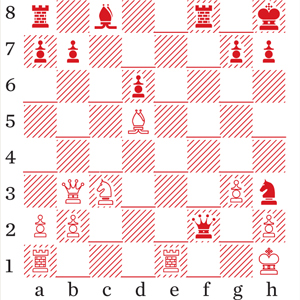
Solution: Blackburne played 20...Qg1+!! and after 21.Rxg1 Nf2+ 22.Kg2 Bh3 is checkmate with the Bishop’s first move of the game!


