



Yet he left his own biggest imprint on history as a referee of chess matches between the great players of his own day, a task for which he was uniquely suited. It was not just that, as a strong grandmaster himself, he would have the players' respect. Nor that he had trained as a lawyer, and was therefore comfortable in situations demanding arbitration. As the English grandmaster Ray Keene recalls, "Lothar would never react crossly or even irritably, no matter how dreadful or rude the behaviour of the people he was dealing with. He would just smile at everyone and keep the situation on an even keel."
Yet dealing with the mercurial and indeed impossible Bobby Fischer tested even Schmid's composure and tact to the limits. The American had first of all failed to turn up in Reykjavik in time for the scheduled first game of his 1972 match against the world champion Boris Spassky. Then, the Soviets having been persuaded not to claim the match by default, Fischer refused to turn up for the second game in a protest against the television cameras in the playing hall (the noise of which he said disturbed him). Fischer was now two games down. If he didn't emerge for the third game, the match would be abandoned, with Spassky declared the winner. Somehow Schmid managed to persuade the Russian to agree to play the third game of the match in a private room backstage, while the legal issue with the owner of the film rights was being settled. In agreeing to this, Spassky was flouting the wishes of his Communist Party minders, but Schmid could play on the fact that the proud reigning champion wanted to win the match over the board (and in fact had never lost a game against Fischer up to that point).
Yet almost as soon as Spassky made his first move of the third game, Fischer noticed that there was a CCTV camera in the room (which was just relaying footage to the spectators in the main hall) and began shouting. At this, Spassky finally lost his patience and declared to Fischer and Schmid that he was leaving for the playing hall, and if the American wanted to continue the game, he would have to follow. Schmid of course understood there was no way Fischer would do that, and that the "match of the century" would immediately be over before it had properly begun.
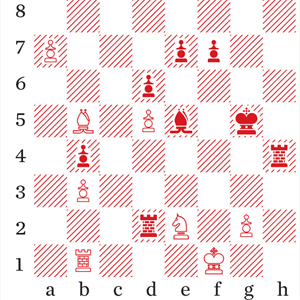
Puzzle: Schmid (Black, to move) was at his best playing for West Germany in the biennial chess Olympiads. Here, in a 1958 match against the US, he finishes off Arthur Bisguier with great elegance. Can you spot the move that Schmid unleashed? (Clue: he is not too bothered about his opponent’s a pawn becoming a Queen.)
Solution: Schmid played 42…Bd4! The Bishop can’t be taken because of 43.Nxd4 Rh1 mate. But the main point is that after 43.a8=Q Rh1+ 44.Ng1 Rxg1 checkmates. Bisguier tried 43.g3 but resigned after 43…Rh8 44.Ke1 Be3 45.Nd4 Rf2!


