



The fascinating thing is that although the greatest modern players have rejected the classical approach set out by such champions of the 19th and early 20th century as Steinitz and Capablanca, who asserted that Black should try to equalise rather than fight for an advantage, in master chess overall the modern counter-attacking defences give no better results for Black than the dour forward-defensive block favoured by the old school.
This most basic dispute about the whole nature of chess is, at least in theory, solvable. By this I mean that if a computer could "solve" chess, then it would tell us whether the initial position was a draw or a win for White. If it told us that "chess is a draw", then we would know that whatever advantage White seems to have is, in the last resort, of no theoretical significance.
Fortunately for us chess players, such a "solution" is very far away. Back in the 1950s, the pioneering chess computer programmer Claude Shannon pointed out: "There will be 10120 variations to be calculated from the initial position. A machine operating at the rate of one variation per microsecond would require over 1090 years to calculate its first move." Computer calculating speeds have grown in a way which even Claude Shannon might not have been able to envisage — but his point remains valid: a conclusive answer as to whether the game is a draw, or a win for White, remains thoroughly elusive.
Meanwhile, the reason why some of us prefer to play with the Black pieces is because we prefer counter-attack to attack. We don't want to charge at our opponents like a jousting knight, but instead feel more comfortable digging a hole, covering it, and then lying in wait for the enemy to fall in. By way of demonstration, this is a game I played earlier this year — with the Black pieces, of course — against Peter Lee (a man with the unique achievement of having been British champion at both chess and bridge). 1.e4 d6 2.d4 g6 3.Nc3 Bg7 4.Be3 a6 5.Qd2 Nd7 6.0-0-0 b5 7.h4 h5 8.Nh3 Bb7 9.Ng5 Rc8 10.f3 c5 11.dxc5 Nxc5 12.Bd4 Nf6 13.Qe3 (Black has allowed White to come charging forward; with his last move Peter is clearly intending to drive his king pawn into Black's guts with e5, so...) Qc7 14.e5 dxe5 15.Bxe5 Ng4! (The ambush — White has fallen into the pit: If 16.fxg4 Bxe5 threatens Bf4 winning the Queen, but after 17.Kb1 Na4 wins) 16.Bxc7 Nxe3 17.Re1 Nxf1 18.Bd6 0-0 19.Rxe7 Bf6 20.Rxb7 (20.Bxc5 would have been best, but after 20...Bxe7 21.Bxe7 Rfe8 22.Rxf1 Rxe7 Black has a considerable advantage) Nxb7 21.Bxf8 Ng3 22.Rh3 Bxc3 23.bxc3 Ne2+ 24.Kd2 Nf4 25.Be7 Nxh3 26.Nxh3 Nd6 (with the point that after 27.Bxd6 Rd8 White's Bishop cannot be saved) 27.Bf6 Rc4 28.Nf2 Ra4 29.Kd3 Nf5 30.g4 hxg4 31.fxg4 Nh6 32.Bd4 Rxa2 33.Ke4 Rxc2 34.Kf4 a5 35.Ne4 Nxg4 (The other knight sacrifices itself on g4, again for the greater good) 36.Kxg4 f5+ 37.Kg5 fxe4 38.Kxg6 a4 39.h5 Rh2 and White resigned.
Puzzle: András Adorján, who devoted himself to defending the honour of the Black pieces, here shows just how dangerous he could be with the supposed disadvantage of moving second. In this position from a game in 1983 against the former world championship semi-finalist Zoltán Ribli, Adorján came up with a truly startling move, forcing his immensely tough opponent to resign on the spot. Can you see what Black played?
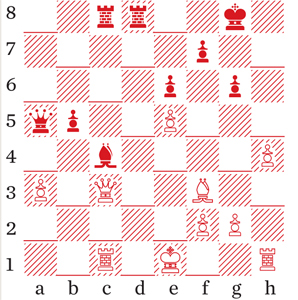
Solution: Adorján played the staggeringly beautiful 27...Bf1!! After 28.Qxa5 Rxc1+ Ribli can delay mate by only one move with 29.Bd1. He could have tried 28.Bc6 but then 28...Rxc6! 29.Qxa5 Rxc1 is mate.


