



To say that relations between Karpov and Kasparov were sulphurous would be an understatement. Yet in 2007 something happened which not only transformed their relationship, but also the outside world's view of Karpov as some sort of political stooge of Moscow. Kasparov had by then launched himself as a politician, challenging the presidency of Vladimir Putin, which he bravely denounced as a form of neo-Soviet tyranny. He was then briefly jailed for attending an "unauthorised" opposition rally. To everyone's astonishment, the only notable figure who attempted to visit him in jail was... Anatoly Karpov. I suspect this was not intended as a statement of political support — Karpov has never disowned the communist past — but was based on the feeling that a fellow former world champion should not be treated so contemptuously.
As a result of that startling gesture, Karpov's subsequent campaign in 2010 to become FIDE president, against the weird and sinister ruler of the Russian republic of Kalmykia, Kirsan Ilyumzhinov, attracted the whole hearted backing not just of his erstwhile deadliest foe, Kasparov, but also of many Western chess federations including the US. Who would have imagined that in 1975, when Karpov was denounced as a "fake world champion" by the Americans?
I have dined with Karpov on a couple of occasions — in his lethal prime in the mid-1980s — and he was certainly not, even then, the crude homo Sovieticus that some imagined. He was full of curiosity about the West and open to discussion on anything that came up, cultural or political. The last occasion we met was during his 1987 world title match with Kasparov in Seville. Kasparov managed to retain his title only by grinding out a win in the final game, to tie the scores at 12-all: yet Karpov reacted to this devastating disappointment with his usual inscrutable good manners — not, I'm afraid, something Kasparov would have been able to manage in similar circumstances.
Here is the second game of that match, in which Karpov, playing Black, stunned the reigning champion with an extraordinary novelty as early as move 9 — and finished him off with a checkmating attack seemingly out of nowhere.
1.c4 Nf6 2.Nc3 e5 3.Nf3 Nc6 4.g3 Bb4 5.Bg2 0-0 6.0-0 e4 7.Ng5 Bxc3 8.bxc3 Re8 9.f3 e3!? (this pawn sacrifice — most uncharacteristic of the normally ultra-solid Karpov — had a devastating effect on Kasparov: he thought for an hour and 20 minutes over his next move, and as a result became dreadfully short of time) 10.d3 d5 11.Qb3 Na5 12.Qa3 c6 13.cxd5 cxd5 14.f4 Nc6 15.Rb1 Qc7 16.Bb2 Bg4 17.c4 dxc4 18.Bxf6 gxf6 19.Ne4 Kg7 20.dxc4 Rad8 21.Rb3 Nd4 22.Rxe3 Qxc4 23.Kh1 Nf5 24.Rd3 Bxe2 25.Rxd8 Rxd8 26.Re1 Re8 27.Qa5 b5 28.Nd2 Qd3 29.Nb3 Bf3! (Kasparov had only a minute left on his clock at this stage; Karpov himself was down to his last three, but that was enough to work out this killer — if Kasparov plays 30.Rxe8, he is immediately mated with 30...Qf1) 30.Bxf3 Qxf3+ 31.Kg1 Rxe1+ 32.Qxe1 Ne3! and a visibly shocked Kasparov resigned: amazingly, despite both sides having only two pieces left, he has no defence against mate.
Puzzle: This is from Karpov’s most devastating win in his poisonously bitter 1978 world title match against Korchnoi. How did Karpov, playing White, force home his attack?
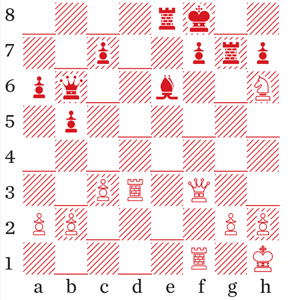
Solution: Karpov played 26.Rd7!! If 26...Bxd7 27.Qxf7+! Bxf7 28.Rxf7 is mate. Korchnoi played 26...Rb8, to give his king the escape square e8; but after 27.Nxf7!! Bxd7, Karpov played the beautiful discovered check 28.Nd8+!! blocking the rook’s defence along the back rank. Wherever Korchnoi now moves his king, Karpov will mate next move with 29.Qf8. Geometry as art.


