



This is caused, in large part, precisely because we are not playing alone, but in conflict with another person whose objectives run exactly counter to our own. He, or she, wants to destroy what we are trying to create: it is completely different to the chess problem, where a single mind attempts to devise something with a solution of such mathematical purity as to take the breath away. In fact, Duchamp did create a chess problem — an endgame — as his contribution to a 1943 exhibition in New York entitled The Big End of the Opera Glass. Ever the surrealist, Duchamp's problem has no solution (though grandmasters have tried hard enough to find one).
One might have thought that Duchamp's chess style would be as imaginative as his work while part of the Surrealist movement; but a study of his games reveals him to have been quite conventional. Though his period of greatest over-the-board activity between 1923 and 1933 exactly coincided with the chess revolution known as hypermodernism, his games are not part of this counter-culture: if anything, they might be described as conservative, more in the style taught by that somewhat dogmatic classicist, Siegbert Tarrasch (1862-1934).
Naturally, beauty in chess is not the exclusive property of those who break with convention; but I have struggled to find any game of Duchamp which could be described as truly beautiful. This may partly be because he was not as strong as most of the masters he was matched up against when he played for France in various Olympiads: they were just too good at destroying the patterns he was trying to create.
The following game, from the Folkestone Olympiad of 1933, the last event before Duchamp abandoned his full-time chess career, gives a good sense of his approach to the game. He is playing White against the Latvian champion Movsa Feigin: 1.d4 Nf6 2.c4 d6 3.Nc3 g6 4.e4 Bg7 5.f3 0-0 6.Nge2 Nbd7 7.Be3 c6 8.Qd2 a6 9.g4 b5 10.Ng3 bxc4 11.Bxc4 d5 12.Be2 e6? (Black should keep the centre fluid with 12...dxe4. Now he is quite efficiently strangled) 13.e5 Ne8 14.b4 Qe7 15.Rab1 Nb6 16.0-0 Nc7 17.a4 Rab8 18.Rfc1 Bd7 19.a5 Nc8 20.Na4 Nb5 21. Nc5 Ra8 22. Bxb5 cxb5 23.f4 Bh6 24.g5 (24.f5 was the most active way of exploiting Black's last move, but Duchamp was clearly unwilling to be diverted from his grand strategy of complete encirclement) Bg7 25.Kg2 Rd8 26.h4 Be8 27.h5 Qc7? 28.hxg6? (Duchamp refuses even to be distracted by a blunder: 28.Nxe6! Qxc1 29.Qxc1 fxe6 30.Qc7 is decisive) hxg6 29.Rh1 (again Duchamp dogmatically insists on sticking to Plan A, rather than executing the tactical short-cut 29.Nxe6!) Ne7 30.Rh3 Nf5 31.Nxf5 exf5 32.Rbh1 Bd7 33.Rh7 Bc8 34.Qe1! and Black, now completely asphyxiated, resigned. Also, there is no escape by fleeing with his King: if 34...Kf8 35.Rxg7! Kxg7 36. Qh4 Kf8 37.Qh8+ Ke7 38.Qf6+ Ke8 39.Rh8 is checkmate.
Puzzle: In this game against the nine-times Irish champion John O’Hanlon, played in the Nice tournament of 1930, Duchamp (Black) has a choice of two apparently crushing Knight moves: either 30...Nxf3+ or 30...Nd3+ Which is correct?
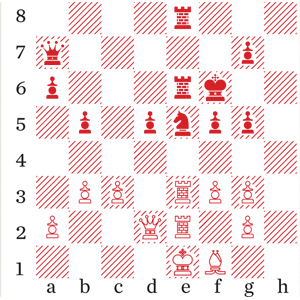
Solution: The one Duchamp played: Nd3+! After 31.Rxd3 Rxe2+ 32.Bxe2 Qg1++ is a startlingly abrupt checkmate, so Black had to give up his Queen with 32.Qxe2 but after Rxe2+ 33.Bxe2 Ke5 34.Rd4 Qc5 he resigned. If Duchamp had played the tempting 30...Nxf3+ then after 31.Rxf3 Rxe2+ 32.Bxe2, the would-be killer Qg1+ is confounded by 33.Rf1.


10:10 AM
9:10 PM
1:10 PM
12:10 PM