



"There are some writers who have entirely ceased to influence others, whose fame is for that reason both serene and cloudless, are enjoyed or neglected rather than criticised and read. Among them is Scott. Yet there are no books perhaps upon which at this moment more thousands of readers are brooding and feasting in a rapture of silent satisfaction. The Antiquary, The Bride of Lammermoor, Redgauntlet, Waverley, Guy Mannering, Rob Roy, The Heart of Midlothian — what can one do when one has finished the last but wait a decent interval and then begin again upon the first..."
This was the opening of an essay by Virginia Woolf on The Antiquary, in The New Republic in December 1924, a century after the publication of Redgauntlet, Walter Scott's last indisputably great novel. It is now almost two centuries since the first of his novels, Waverley, was published in 1814. Sadly, it's probable that the claim made in the third sentence no longer holds good. Woolf's "common reader" has, it seems, deserted the first master of the historical novel, ironically at a time when the genre is more fashionable than it has been for more than 100 years. All six of last year's Man Booker shortlist were set in the past, with the winner, Hilary Mantel's Wolf Hall as far back as the 16th century.
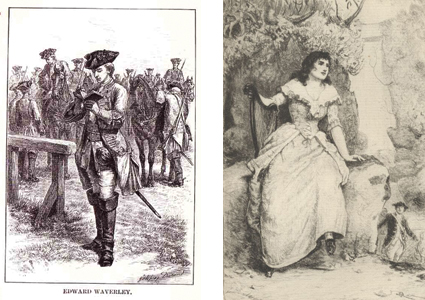
Edward Waverley; Flora MacIvor at the waterfall in Waverley" (etching by R.W. Macbeth in the 1893 edition)
I still meet people who read and appreciate Scott, and the splendid new Edinburgh edition of his works has led to a reawakening of academic interest. Yet Woolf was probably justified in saying that he had "entirely ceased to influence" other writers, even 80 or 90 years ago. Certainly, it is likely that none of the authors on the Man Booker list owed him anything, consciously or unconsciously. It was different in the 19th century. Dumas and Hugo in France, Manzoni in Italy, Fontane in Germany, Tolstoy in Russia, and Thackeray — in Henry Esmond certainly and Vanity Fair probably — were all in his debt, as were Stevenson and Buchan in their historical novels. Hugh Walpole, in his Herries chronicles, was one of the last novelists to regard himself as a disciple of Scott. But though he was Woolf's friend, he knew, to his dismay, that she didn't think much of his books.
Historical novels continued to be written, and some were very good: Ford Madox Ford's trilogy, The Fifth Queen, for instance, makes for an interesting comparison with Mantel's award-winner, as does Buchan's Tudor novel, The Blanket of the Dark. There were fine novels set in antiquity by Robert Graves, Naomi Mitchison, Rex Warner, Alfred Duggan and Mary Renault among others, while Evelyn Waugh thought Helena his masterpiece (or said he did). But by and large the genre fell into disrepute in Britain, historical novels being regarded as entertainment, not serious fiction. Many of the most popular writers who set their fiction in the past offered no more than that, good examples being the romantically fictionalised histories of Margaret Irwin, and that 1940s' bestseller Forever Amber. Colourful swashbuckling novels pleased a public but were ignored or derided by serious critics.
Scott himself bears some responsibility for the disfavour with which the historical novel came to be regarded. His medieval novels, written for money and made from his wide reading, were more influential, more easily imitated than the novels set in the Scotland of the 17th and 18th centuries that are praised by Woolf. (Unaccountably, she omits The Tale of Old Mortality, one of the finest and most intelligent political novels in the language.) These medieval novels have their own charm. Ivanhoe especially, several times filmed, remains captivating and is, in John Buchan's words, "a glittering pageant". Goethe, entranced, called it "a wholly new art". Quentin Durward, with its fascinating depiction of that extraordinary figure, Louis XI of France, can still delight.
Scott was never other than intelligent, and, even in these later novels his analysis of conflicting currents in history and of the clash of cultures is often acute and interesting.


- Shame On The Liberals Who Rationalise Terror
- The Cowardice Of John Le Carré
- The Establishment Is In Denial — Yet Again
- Is There A Right Way To Write?
- Did Burke Betray The Cause Of Liberty?
- A Fascist Coup In Poland? Give Us Poles A Break
- Double Games Of The UK Muslim Brotherhood
- Two Languages And The Chasm Between Them
8:04 PM
7:04 PM
6:04 PM
6:04 PM
5:04 PM
5:04 PM
4:04 PM
4:04 PM
3:04 PM
2:04 PM