


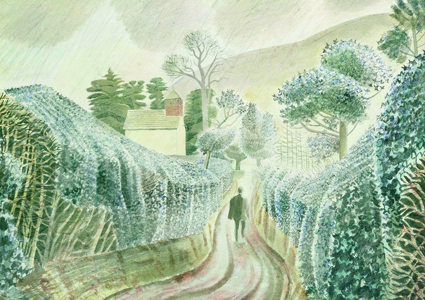
"Wet Afternoon" (1939)
In Essex he painted sleepy deckchair afternoons under shady trees and strawberry beds covered by netting to keep the birds off. Here he played cricket — though with rather more enthusiasm for the refreshments than the game: "It was a holiday playing cricket yesterday, only the game went on a bit too long for my liking and I began to get a little absent-minded in the deep field after tea . . . It all felt just like being back at school, especially the trestle tea with slabs of bread and butter, and that wicked-looking cheap cake."
He rarely went abroad if he could avoid it. Awarded a travel scholarship to Florence by the RCA in 1924, he went under sufferance. Instead of copying Giottos and Masaccios, he took long walks along the river Arno into the countryside. Later, he would go to France to sketch the port at Le Havre.
At the beginning of the war, he was recruited by Kenneth Clark to the War Artists' Scheme, and in this new official capacity he painted coastal defences at Newhaven in East Sussex, a loft of carrier-pigeons and an outpost in which sentries dried their boots and made their cups of char.
When he was sent on active service to Norway in 1942, the trip ended in tragedy. His small seaplane went missing off the coast of Iceland on a reconnaissance mission and was never recovered. It was all too common for the planes' propellers to ice up and judder to a deathly halt.
In the years immediately after his death, the London galleries mounted retrospective exhibitions. Wedgwood continued to produce his Persephone dinner service and reissued his coronation mug in new colours for Elizabeth II in 1953. The tragedy of his death — a bright star lost over the icy wastes — appealed to journalists and art critics. But by the Sixties, the muted, modest subtlety of Ravilious's work had begun to look dated to modern eyes.
His was an England of Joan Hunter Dunns, Lyons tea shops, hospital corners, unspoilt countryside, damp Bank Holidays and high streets where the ironmonger knew your name. Ravilious's England was disappearing and his art had come to be seen as parochial, dated, even twee.
This was the age of Bridget Riley's hallucinogenic Op-Art paintings, David Hockney's Los Angeles pools and Peter Blake's Dayglo Sergeant Pepper collage. Ravilious entered a period in the wilderness. His work remained popular with insiders — an exhibition of his submarine lithographs produced during the war sold out at the Royal Arts Society in 1979 — but he dropped from popular notice.
The author A.N. Wilson, whose father Norman Wilson was managing director of Wedgwood and commissioned Ravilious's first designs for the firm, suggests that the soft, rainy-day greys, blues and greens of the artist weren't in tune with the Sixties love of bright colours. Nor did his subject matter chime with the new age: "Elegy for lost Britain wasn't very fashionable in the Sixties and Seventies."
Nor indeed in the Eighties and Nineties. Though galleries including the Tate have fine collections of his watercolours, there was a wariness about exhibiting them as they are so vulnerable to light. And because he died young, Ravilious's body of work remained small. Galleries have to work hard to assemble exhibitions of any size. The murals he painted in the early 1930s were destroyed by bombing during the war or by damp.
Like this article? Share, save or print using the icons below:


More Features
- Migrant Crisis? Europe Hasn't Seen Anything Yet
- Why Palmyra Should Matter To The West
- Corbyn's Rise Makes Cameron Redundant
- No, Jeremy: Politics Is All About Borders Now
- Why 'Lady Chatterley' Still Provokes Us
- For Climate Alarmism, The Poor Pay The Price
- Will Putin's Empire Outlast The Soviets?
- British Witnesses To Lenin's Revolution
- Bibliophiles Beware: Online Prices Are A Lottery
- How Jeremy Corbyn's Coup Hijacked Labour
- Corbyn's Signpost Back To The Ghetto
- Unionists, Don't Despair: Scotland Is Not Lost — Yet
- Britain's Apologists For Child Abuse
- Lift The Fee Cap And Set Universities Free
- The Story Behind One Dead Man's Penny
- Hitler's 'Ecological Panic' Didn't Cause The Holocaust
- Meet The Montalvos: The First Global Family
- Mr Gove, Here Is Our Statute of Liberty
- A British Bill Of Rights
- Something For Nothing Just Won't Do Any More
Popular Standpoint topics

7:04 PM