



Professor Klausen attained fame a year later as the result of the Danish cartoon affair, having written a book about the subject. Yale University Press, the publishers, decided to delete the controversial cartoons rather than use them to illustrate the text. This, in turn, generated some protests, but Yale did not budge, and the impression was created that Professor Klausen in her book was breaking a lance for freedom of expression. Her intention, however, was to criticise the Danish government and even its society, which she thought intolerant. This was based on the belief that if integration did not work, this must have been the fault of the state, the authorities and the ethnic majority, not the religious or national minority, for it was the former that had to make the concessions.
Vaisse's and Dr Cesari's points of view were shaped largely by the French riots of 2005. The view can be summarised briefly but not unfairly as: "It's Marx, not Muhammad, stupid." In other words, the deeper causes of the unrest in the banlieues (housing estates) were social and economic, not religious fanaticism. This point of view is not entirely wrong, for if the people in the banlieues were as prosperous as Professor Klausen's happy few, it would indeed be less likely that they would engage in burning cars or in suicide missions. This generalisation should not, however, be pressed too far. Osama bin Laden and many of his intimates never went to bed hungry and did not come from poor backgrounds. For the deeper reasons, we do not find an answer in Das Kapital. How do we explain the fact that Muslim immigrants in Europe have not been doing remotely as well as newcomers from other countries? How to account for the fact that pupils in European schools from other cultures, for example China and India, have often been doing better than their classmates born in Europe — and that Muslim students have been doing much less well and that the dropout rate among them has been so high?
Optimism with regard to the prospects of multiculturalism (or more recently of integration) usually went hand in hand with optimism concerning the future of Europe and its standing in the world, and it is easy to see why. In the Last Days of Europe, I tried to point to the important social and cultural changes taking place in Europe and to the other grave dangers facing it. These arguments were neither sensational nor very original. Leo Tindemans, the former Belgian Prime Minister, had written in a position paper in the 1970s on the future of Europe that a house half finished would not last and that economic unity without a greater measure of political union would not work. Chancellor Helmut Kohl, the father of the euro, had expressed similar concerns. But the views I had expressed were not popular. They were criticised in the Economist and the Financial Times. It was not the message one wanted to hear. Only a few years have passed and one does not now see many new books or articles predicting that Europe will be the world's leading superpower and that the whole world will try to emulate the European model. The prophets of the European superpower have turned to other subjects whereas the critics of the Eurabian model have not given up so easily.
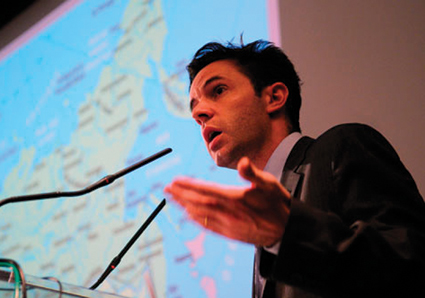
Justin Vaisse: Against the prophets of Eurabia
Before taking our discussion of Eurabia any further, there's need for a brief historical reminder. Those indignant about the use of the concept seem to be unaware that its origins are by no means Western and were not concocted in the cabals of the neoconservatives. It is a Muslim, or rather specifically Arab, concept. Among Middle Eastern public figures and writers, the idea that Muslims would be a majority in Europe goes back a long time. One early well-known example is the speech made in the United Nations General Assembly in 1974 by Houari Boumedienne, the then President of Algeria, in which he argued that in view of the high birth rate of Muslim women (and the low and declining birth rate in Europe) such a development was more or less inescapable. He was referring specifically to the "wombs of our women". Boumedienne was not among the leading demographers of his generation (nor was Libya's Colonel Gaddafi, who made a similar statement in 2006) but no special training was or is needed to observe the changes taking place in Europe's cities.


- Let Justice Be Done Though The Liberal Heavens Fall
- A Fascist Coup In Poland? Give Us Poles A Break
- It's Sharia, Not Alcohol, That Threatens Women
- Double Games Of The UK Muslim Brotherhood
- The Land Where History Repeats Itself As Tragedy
- Holocaust Survivors Are Still Waiting For Justice
- Rhodes, Race, And The Abuse Of History
- Shame On The Liberals Who Rationalise Terror
- France, Islam, And The Second Class Sex
- Isis Is Not Invincible — If The West Has The Will
- After Paris, Who Will Speak For France?
- The Establishment Is In Denial — Yet Again
- Don't Patronise Muslims: Integrate Them Properly
- The Israel Boycotters Who Threaten Us All
- Britain Is A Free Country — Thanks To The Queen
- Is British Democracy Still For The People?
- The Great Climate Change Boondoggle
- Obama's Iran Deal Makes The World More Dangerous
- 'Anti-Extremists' Who Equate Israel With IS
- Russia's Moment: How Putin Has Seized The Day

- Shame On The Liberals Who Rationalise Terror
- The Establishment Is In Denial — Yet Again
- Is There A Right Way To Write?
- A Fascist Coup In Poland? Give Us Poles A Break
- Censoring The Censors Won't Do
- France, Islam, And The Second Class Sex
- The Stalinist Past Of Corbyn’s Strategist
- The Long Shadow Of Malthus
- Shame On The Liberals Who Rationalise Terror
- The Establishment Is In Denial — Yet Again
- Is There A Right Way To Write?
- A Fascist Coup In Poland? Give Us Poles A Break
- Censoring The Censors Won't Do
- France, Islam, And The Second Class Sex
- The Stalinist Past Of Corbyn’s Strategist
- The Long Shadow Of Malthus
10:07 PM
5:07 PM
10:07 AM