



"Any kind of excitement?"
"It would be life-threatening."
"And this here?" [Kerner shows the doctor a newspaper reading: "Good Luck, Germany. Yes to Reunification"] "Wouldn't you call this exciting?"
So Kerner takes his mother home, and out of fear that reality could kill her, he tells her nothing. To maintain the illusion that history has not moved on, he tours the supermarkets looking for cans bearing the labels of communist brands which no one wants any more, and bribes children to come to her sick room and sing her old party songs. Communism disappears everywhere except in his mother's flat.
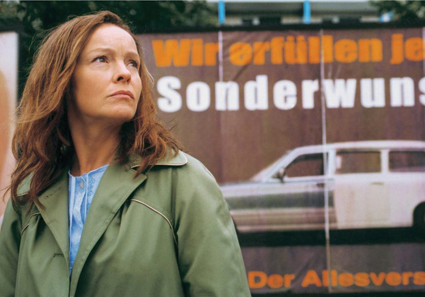
What's gone is gone: Katrin Sass as the die-hard communist mother in "Goodbye Lenin"
The political class in this election has behaved like Alexander Kerner and treated the voters as if they were sick relatives who needed to be tucked up in bed and kept in quarantine for fear that the shock of Britain's predicament might kill them. It fed them the old policies, sang the old party songs "Tory Cuts" and "Labour Tax Bombshells" — and behaved as if the world could carry on as it always had done.
The politicians are not entirely to blame. There are millions who don't want to face reality for reasons I will get to, but no one should be surprised that the established political order struggled in the first election since Lehman Brothers collapsed because the crash took with it the common sense of rival ideologues who thought they had little in common but who all depended on the assumption that finding the money was not a problem when you examined their ideas closely.
The good times that followed the pound's fall out of the European Exchange Rate Mechanism in 1992 broke every record. In budget after budget, Gordon Brown announced that we had had 40... 50... 60... quarters of continuous economic growth. Globalisation was delivering the goods, and very cheap they were too as China flooded the market and kept down the retail price inflation and the interest rates that tracked it. With Chinese savers pouring their capital into the international markets, money was cheap as well. Britain had no need to worry because although its manufactured goods withered before the competition from the East, it had the City with its apparently assured position in the global financial system. As long ago as the late 1990s, I had heard futurologists predicting that even if in the 21st-century Asia became the world's manufacturer and Africa its new food basket, Britain would survive and prosper because of its competitive advantage in financial services. I scoffed at the time — Africa's emergence as an agricultural powerhouse seemed as unlikely then as now — but like so many others over the years, my scepticism was worn down and I had to concede that the City did seem to be driving Britain's prosperity.
It is commonplace to marvel at how human beings adapt to suffering or how they learn to accept war or deprivation and carry on with their lives. Less widely discussed is how prolonged periods of prosperity change mentalities. The psychology of bubble markets is well understood. From Charles Mackay's 1841 Extraordinary Popular Delusions and the Madness of Crowds, economic literature has documented herd behaviour in speculative manias. But bubbles are over in a year or so. People rush to buy shares in the South Sea Company or dot.com start-ups. If they're lucky, they sell them on to "the greater fool" before the bubble bursts and the mania passes. The boom from the mid-1990s through to 2008 wasn't a spasm in the market or a passing mania but 15 years in which prosperity became so normal that we took it for granted.
To take the statistic closest to the hearts of the British, between 1996 and 2006 the average house price rose by 10.6 per cent per annum (from £62,453 to £179,425). Investing in homes was more profitable than the stock market, which grew at 4.6 per cent per annum and the returns outstripped the 2.6 per cent rise in retail price inflation fourfold. (Ominously for everyone except the young, house prices haven't fallen back to anything like reasonable levels, and a real property crash remains possible when the Bank of England is forced to stop its emergency help to the economy and raise interest rates.)


- Migrant Crisis? Europe Hasn't Seen Anything Yet
- Why Palmyra Should Matter To The West
- Corbyn's Rise Makes Cameron Redundant
- No, Jeremy: Politics Is All About Borders Now
- Why 'Lady Chatterley' Still Provokes Us
- For Climate Alarmism, The Poor Pay The Price
- Will Putin's Empire Outlast The Soviets?
- British Witnesses To Lenin's Revolution
- Bibliophiles Beware: Online Prices Are A Lottery
- How Jeremy Corbyn's Coup Hijacked Labour
- Corbyn's Signpost Back To The Ghetto
- Unionists, Don't Despair: Scotland Is Not Lost — Yet
- Britain's Apologists For Child Abuse
- Lift The Fee Cap And Set Universities Free
- The Story Behind One Dead Man's Penny
- Hitler's 'Ecological Panic' Didn't Cause The Holocaust
- Meet The Montalvos: The First Global Family
- Mr Gove, Here Is Our Statute of Liberty
- A British Bill Of Rights
- Something For Nothing Just Won't Do Any More

12:04 AM