



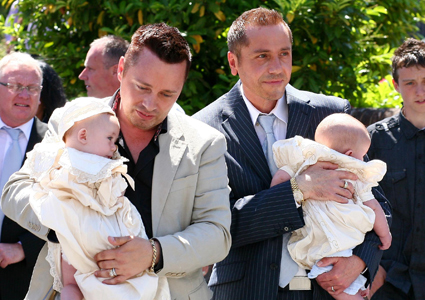
 Designer babies: Barrie and Tony Drewitt-Barlow with Aspen and Saffron, the first of their five children (PA Photos)
Barrie Drewitt-Barlow is passionate about fatherhood and speaks lovingly of his five children. But he is no ordinary dad. Barrie and his partner of 11 years, Tony, were determined to start a family despite the obvious difficulties.
The couple, both wealthy businessmen, realised their dream ten years ago with the birth of twins Aspen and Saffron. The babies were a product of the sperm of both men, an egg donor and a surrogate mother. Since then, the Drewitt-Barlows (the men merged both of their second names) have added another three children to their brood and have spent at least £700,000 doing so. The couple has pioneered a growing and ethically questionable trend among gay men and lesbians — using surrogates and other fertility procedures to produce designer babies.
Today, the "Gaybe" revolution is booming. Although surrogacy and related fertility services are still accessed mainly by heterosexual couples, gay men are increasingly demanding equity.
Known by some critics as "reproductive trafficking", surrogacy is an ethical minefield. Heterosexuals will use their own eggs and sperm but will rent a womb for the gestation, whereas gay men will need to use in vitro fertilisation (IVF) and the eggs from a donor in order to impregnate the surrogate.
Prior to the Drewitt-Barlows' pioneering act, gay men accepted that having their own children as couples was impossible. In the past, lesbian couples would decide which one would carry the child and then ask a male friend to donate sperm and then self-inseminate. Today, they are more likely to use one of Britain's commercial sperm banks.
While children's homes are full to bursting with abused, neglected and unwanted children, increasing numbers of lesbians and gay men are making their own, often spending huge amounts of money in order to conceive.
IVF was developed in the 1970s as a response to infertility, with the first so-called test-tube baby being born in 1978. None of the major religions had, in 1978, an official policy on artificial insemination but the Roman Catholic Church raised the strongest objections at the time.


- When the call of the wild can go too far
- Odds against life after the final whistle
- A beginner’s manual to grievance gibberish
- Cull the thinkers whose ideas have tanked
- Holier than thou: the hypocrisy of the zealot
- The way forward for Europe’s great outsider
- The woke gent’s guide to blurred lines
- The tricky business of gender identity
- “You’re really a man, aren’t you?”
- The ticking timebomb of internet porn
- A distinctive melody in the melodrama of our time
- A mysterious alchemy
- Corbyn's road map to a communist Britain
- The Troubles cast a shadow over Brexit
- South of the border, China holds sway
- You can love Europe and oppose the EU
- Academic pawns in the game of Orban v. Soros
- A brief glimpse of Corbyn’s Utopia
- Memories of a long lost Jewish world
- Wholesome homes are better for all of us

- The inevitability of Fortress Europe
- The devout sceptic: hope for those of little faith
- The way forward for Europe’s great outsider
- In Corbyn’s mind, there is no place for the Jews
- Corbyn waves the flag of anti-Semitism
- Is the mental illness epidemic just a myth?
- Viennese rooms with a point of view
- Corbyn's road map to a communist Britain
3:11 PM
5:10 AM
5:10 PM
8:10 AM
10:09 AM