



This psychological ascendancy paid dividends in their final game, in the penultimate round of the event. As early as the 22nd move, Fischer had achieved what appeared to be a winning position. Then, as Tal relates in an autobiographical sketch, Fischer did not immediately play the killing move, (which would have been 22.Rae1) but wrote it down on his scoresheet, and not in his usual English descriptive notation. Instead, he wrote it in international algebraic, which was the method used by Tal.
Tal realised that Fischer was trying a slightly childish psychological trick on him, by seeking to discover his reaction to the indicated move, without actually playing it. Tal just got up and wandered across to another player, and, as he records, "made some joke to him". Tal went on: "Fischer, who was essentially still a large child, sat with a confused expression on his face, looking first at the front row of the spectators, where his second was sitting, and then at me."
Then Fischer played a different move, which threw away all his initiative. He eventually lost, giving tournament victory and the right to a world championship match to Tal. In his memoir of the event, Tal says of this episode: "When I later asked Fischer why he hadn't played 22.Rae1, he replied ‘Well, you laughed when I wrote it down!'"
Yet the most dramatic moment of the great 1959 tournament came at the beginning of the second leg, in Zagreb, when Tal played Smyslov. The ex-world champion had given an interview to the Zagreb Evening News a few days earlier, in which he indicated how lucky he thought Tal had been in the first two legs of the tournament, and that he regarded it as his duty as a grandmaster to punish the young Latvian's tricks when they next met. This is what happened, with Smyslov playing White: 1.e4 c5 2.Nf3 e6 3.d4 cxd4 4.Nxd4 a6 5.Bd3 Nc6 6.Nxc6 bxc6 7.0-0 d5 8.Nd2 Nf6 9.Qe2 Be7 10.Re1 0-0 11.b3 a5 12.Bb2 a4 13.a3 axb3 14.cxb3 Qb6 15.exd5 cxd5 16.b4 Nd7 17.Nb3 e5 18.Bf5 e4 19.Rec1 Qd6 20.Nd4 Bf6 21.Rc6 Qe7 22.Rac1 h6 23.Rc7 Be5 24.Nc6 Qg5 25.h4 Qxh4 26.Nxe5 Nxe5 27.Rxc8 Nf3+ 28.gxf3 Qg5+ 29.Kf1 Qxf5 30.Rxf8+ Rxf8 31.fxe4 dxe4 32.Qe3 Rd8 33.Qg3 g5 34.Rc5 Rd1+ 35.Kg2 Qe6 36.b5 Kh7 37.Rc6 Qd5 38. Qe5?? Rg1+! 39. Kh2 Rh1+! 40. Kg2 Rg1+. Draw!
Smyslov, of course, had been completely winning, until his 38th move. Tal had also been very short of time, which must have contributed to Smyslov's hubris: he missed Tal's diabolical perpetual check swindle (for example, if Smyslov had captured with 39.Kxg1 then Qd1+ 40.Kh2 Qh5+ 41.Kg2 Qf3+).
Tal later recorded the dramatic conclusion of this game with thinly-disguised glee: "Smyslov ran into almost the only swindle I had been able to think up. Smyslov is normally imperturbable at the board, but after my 39th move Rh1+, his face changed, and after thinking for some three minutes, he made his reply and slammed his clock with furious force. Some of my pieces fell over, but I gave check with my Rook on g1, pressed my clock, and only then began to restore order on the board."
What a man, what a game, and what a tournament!
Puzzle: There are almost too many Tal brilliancies to choose from, but here is one played in a simultaneous display in Stuttgart in 1969. Tal has the white pieces, against Sviridov. What did Tal do next?
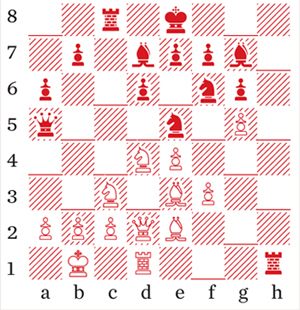
Solution: Black would have expected the automatic recapture 16.Rxh1 and then replied 16…Nh5. Tal, however, played 16.gxf6!! After 16…Rxd1+ 17.Nxd1!! Qxd2 18.fxg7!! Black has nothing better than 18…e6, but after 19.g8=Q+ Ke7 20.Qxc8 Qxd1+ 21.Bxd1 Bxc8 the pyrotechnics are over with Tal a piece up, winning.


