



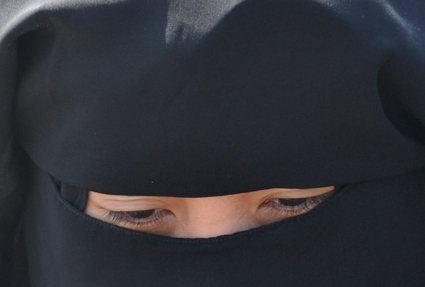
Sister act: A Muslim woman at prayer (AFP/Getty Images)
Following 9/11, the number of people converting to Islam began to rise. In the US it is estimated that approximately 30,000 convert annually. There are about 2.4 million Muslims in Britain and studies suggest there are between 10,000 and 14,000 white converts among them. It is estimated that 75 per cent are female.
As a feminist who rejects religion on the grounds that it promotes inequality between men and women, I wanted to try to understand why so many women are attracted to Islam. Its messages are clear about a woman's role. She will be subservient to her husband and devote her life to pleasing him and raising his children. "If a man calls his wife to his bed, and she refuses, and he goes to sleep angry with her, the angels will curse her until morning," is a popular phrase recited to Muslim women during religious study.
"The true Muslim woman is always keen to win her husband's love and to please him. Nothing should spoil his happiness or enjoyment of life," says the Sisters' section of Muslimconverts.com. The website also has a section on how the Taliban upheld certain rights of women that are "non-existent in the West".
Saskia converted to Islam 15 years ago during her first year at university. "I did so because I married a Muslim. I can't imagine why women would do it for other reasons." But prior to meeting her future husband, Saskia had begun to engage with Islam. "The Bible can be vague about the roles of men and women and I wanted certainty. Islam gave me that." She was brought up by an atheist father and a "pushy feminist" mother who occasionally attended church. "Although they had quite a traditional marriage, my mother made it clear that the only options for her daughter's future, as far as she was concerned, were an education and a career. I rebelled."
Soon after starting at university, Saskia began attending its Islamic Society through which she met Muayid, a Moroccan Muslim. "I was attracted to the conservative family values and the high esteem in which mothers are held." Dropping out of university, Saskia married Muayid and had two children within the first three years. But she was unhappy. "Marriage to Muayid was very hard. I wanted to be a good Muslim but he hardly prayed and almost never went to mosque." Saskia became increasingly devout and as a result tension built up in the relationship. The children would be taken to mosque every day to learn Arabic but Muayid was uninterested in their education. "He didn't even work, even though the Koran makes it clear that a man has to provide for his wife."
The fact that Muayid's family lived in Morocco meant that there was no pressure on him to change his ways. "The mother reigns supreme in Islam and even grown men have to respect and obey them," says Saskia. "If I needed Muayid to listen to me I would ask my mother to talk to him, which sometimes worked."
The couple divorced five years ago after ten years of marriage. "He really changed after 9/11. All of a sudden, he stopped drinking alcohol and began to pray and attend mosque. He would endlessly talk about the Zionist conspiracy and how Zionists rule the world. I found tapes and books that just fed his paranoia about Jews. I disliked the radical Muayid more than I did the non-devout one."
What is the attraction of Islam for Saskia today? "Women are respected and not seen as sex objects. Western women are defined by their appearance but we are viewed as whole human beings. I find the veil liberating." Saskia tells me she gets "particularly mad" when white men tell Muslim women they should not cover up. "In whose interests are they arguing?"
On gender segregation, she says: "I think it is good for Islamic women. Western women are often rivals but Muslim women have a much stronger sense of sisterhood."
Rahila Gupta is a writer and member of Women against Fundamentalism, set up in the 1980s in response to the Salman Rushdie affair. She believes that dissatisfaction with consumerism and the perceived moral decadence of the West has sometimes pushed people into a search for religious or spiritual transcendence. However, she does not think that white women converting to Islam is the start of a new trend. "Islam is superficially attractive in that it offers an analysis [and condemnation] of the abuse of women's bodies to sell products but once you look deeper, as with most religions, it is women who are blamed for men's predatory behaviour and who must cover themselves for protection. "
Inequality between men and women exists in Christian, Jewish and Muslim communities but perceptions of female sexuality differ considerably within those religions. The Islamic view of women as active sexual beings who are encouraged to enjoy sex with their husbands is uncomfortable for the traditional Muslim man, and therefore stricter control of women is seen as necessary.
Islam's obsession with virginity and childbirth has led to gender segregation and early marriage. In Muslim countries, Western feminism is seen as irrelevant and part of the wider process of colonisation. I attended a Saturday afternoon meeting of the New Muslim Sisters at the notorious East London Mosque. Last year, the venue was criticised for hosting a pre-recorded talk by Anwar al-Awlaki, the radical cleric based in Yemen whom US officials claim acted as a spiritual leader for three of the 9/ 11 hijackers. The room is packed with women and their children. We sit in a circle and introduce ourselves. I am the only one with an uncovered head. I explain that I am researching a piece for a magazine on women who convert. No one is uncomfortable with me being there and the room is vibrating with warmth and friendliness. There are women from Tanzania, Australia, France and the UK, a number of black and mixed-race Londoners and two Anglo-Asians born into Sikh families. There are also Muslim-born women who say they are "reclaiming" their religion, having been brought up by fairly secular parents. The group leader tells me I should use the term "revert not convert. All people were Muslim once so we are just reverting to our natural state."
One woman is married to a Caribbean-born man who is also a convert. A 19-year-old who converted six months ago constantly asks questions about modesty. She raises the issue of menstruation, asking: "Are we allowed to come to mosque if we are having a period?" She is told yes, but she must not go anywhere near the men's areas, speak to any of the "brothers" in the communal areas, or pray. "You are not allowed to touch the Arabic letters in the Koran if you are menstruating. Read it with gloves," says the group leader. "Or touch the lettering with your pencil." It sounds to me as if they have accepted blatant misogyny as religious protocol.
Every sentence is peppered with several "In sha'allahs (God willing). "How many children do you have?" "Four, In sha'allah." "Is the Imam coming to talk to us today?" "In sha'allah, yes. He said he would come after the brother's group, In sha'allah."
Aisha asks if she is ever allowed to show her feet (she was hoping to be able to wear sandals in summer) and was told: "No. The only part of a woman's body which can be shown in public is the hands." The conversation turns to the five pillars of Islam. I leave.
I meet Fatima in a Soho café. Her name used to be Isabelle. She was born in France and converted to Islam when she was 30, five years ago. Having escaped an extremely violent relationship, she decided to undergo an entire identity transformation. "I had moved to a new city and would walk past a group of Islamists outside my local library, handing out leaflets and encouraging people to read the Koran." One man told Fatima about a "sisters group" for converts being held at the mosque and the following day she found herself in a hall with 20 other women and their children. "It gave me such a warm feeling to be a part of something that I knew there and then Islam was for me. I have never looked back."
Moving to London last year to be closer to her sister, her only surviving relative, Fatima found that she could instantly make friends with other Muslim women by attending one of the many groups in the local mosque. "I feel I could go anywhere in the world now and be safe and surrounded by friendly faces."
Not everything in Fatima's life is easy, however. Her unmarried and childless status can arouse suspicion, and she tells me that, at her age, she is doomed to be "permanently on the shelf".
Fatima has also experienced hostility from others who react to her white face beneath the hijab. "They seem to take personal offence at the fact that I have chosen a religion and way of life deemed only suitable for backward women from Muslim countries. The idea that an educated Western woman would choose it puzzles them."
It also puzzles some Muslim-born women. Selay Ghaffar is the director of Humanitarian Assistance for the Women and Children of Afghanistan (HAWCA), an Afghan national NGO dedicated to working for the social wellbeing of women and children who live in Afghanistan or in refugee communities in Pakistan. Much of its work focuses on male violence towards women and children. Ghaffar is clear that women living under Islam find it "extremely difficult, if not impossible" to achieve anything close to equality with men. "Violence and abuse are allowed, even expected, because under Islam the man's word is law."
Dr Haifaa Jawad is Senior Lecturer in Islamic and Middle Eastern Studies at Birmingham University and is currently writing a book on the contribution of European converts to Islam. She believes that converting to Islam "provides a sense of belonging and a clear identity. Islam has clarity to it that some other religions or lifestyles do not. Some women in the West may feel let down by feminism. But it is probably for spiritual reasons that many women convert. We have to ask, why go through with it despite the negative view of Islam at present?"
All the women I spoke to insisted that Islam affords them rights as women that no other religion does. As one woman told me: "In Islam, women have a much higher status than in other religions. In Christianity, for example, the women were regarded as someone who did not even have a soul." (This is, of course, untrue.)
Yasmin is a British-born woman who converted 30 years ago. In her late teens, Yasmin travelled to Yemen with a friend who was looking for her estranged father. She was looking forward to starting university later that year and to a career as a journalist. While there she was gang-raped. "My friend left me. I don't think she could cope. I was desperately lonely and going a bit off my head. A nurse told me Yemeni girls don't get raped because they dress modestly and don't go out alone. It sounds mad but I decided there and then I would convert, and I did."
On her return to the UK, Yasmin met Mohammed, a British man of Caribbean descent, who had also converted. They married and had a child within a year. Mohammed started to beat her during her pregnancy and when their son was born threatened to kidnap him and take him to live in Jamaica. "I went to the imam for help but he just told me to look at my own behaviour. He said a good wife does not make her husband angry."
Yasmin fled from Mohammed and took her son to live in a refuge. She has changed her name and moved to another town, so scared is she of him tracking her down and killing her. "I know why he converted," she says, telling me she plans on giving up her faith and raising her son outside it. "Islam gave him the perfect excuse to treat his wife like dirt. It helped him feel like a real man. I thought being a good Muslim meant putting up with what he did to me, but no woman deserves that."
There are many women, I am told, who have converted to Islam, married a Muslim man and then live happily ever after. But, despite the fact that the women I spoke to were open and generous with their time and effort to help me understand why they had converted, I found I was unable to comprehend their choices. Perhaps it is my disdain for all religion, perhaps my radical feminism. And so I continue to ask, why do women in the West, having grown up with the benefits that four decades of feminism have brought, choose a lifestyle and religion which brings them such a subjugated existence?


- Our EU Deal Gives Us The Best Of Both Worlds
- Brexit Would Save Us And Set Europe An Example
- Are Both Sides Playing By The Referendum Rules?
- Should We Stay Or Should We Go?
- Ignore Project Fear: Brexit Won't Ruin Us
- Uncontrolled Immigration Means Finis Britanniae
- The Next US President Must Carry A Big Stick
- Can Clinton Or Trump Crack The US Tax Code?
- How to Survive the Fourth Industrial Revolution
- The Spectre Of Mayor Khan's Islamist London
- Students Are Leading The Free Speech Fightback
- Fortress Europe Faces An African Migrant Tsunami
- Trump May Be Bad, But What Comes Next Will Be Worse
- Myth Of Stressed-Out Soldiers On The Street
- The Russian Love Affair With Palmyra Resumes
- How Russia Is Ruled By The Putin Doctrine
- The Doors Of Holocaust Memory Are Closing
- Rediscovering The Point Of Language
- The Novelist For Whom Small Was Beautiful
- A Recipe For Disaster

1:04 PM
10:11 PM
4:07 AM
4:06 PM
2:06 AM
8:05 AM
1:05 PM
6:05 PM
11:05 PM
11:05 PM