



The "undergraduate atheists" have had their day. The spiritually deaf onslaught of Richard Dawkins, Christopher Hitchens and their ilk has presented such an unfair and one-sided picture of religion that not only has it won few converts, but it may even have aided the cause of faith. If such crude tactics are the best the militant atheists can come up with (many open-minded readers must have thought) then perhaps religion is worth a second look after all.
Of much greater interest, and vastly more intellectual sophistication, are two books, one by the Princeton philosopher Mark Johnston, the other by the French best-selling author André Comte-Sponville, formerly of the Sorbonne. Both are inspired by the achievements of modern science, both firmly reject the traditional idea of a transcendent creator and yet both are sympathetic to our long heritage of spirituality, whose riches they would like to preserve if humanly possible.
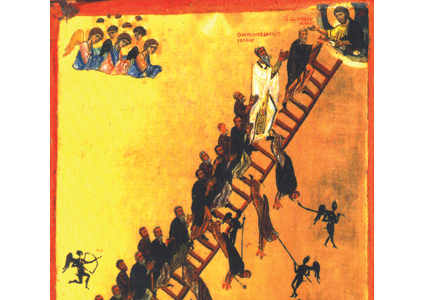
Upwardly mobile: The 12th-century "Heavenly Ladder of Saint John Climacus" at the Monastery of Saint Catherine, Mount Sinai, Egypt
But can it be done? Johnston, in his intriguingly titled Saving God (Princeton University Press, 2009) insists: "The causal mechanisms that lead to life, conscious awareness, and choice can be perfectly natural, that is, in accord with the laws of nature, and they may indeed take the form of random mutation and natural selection." This is something that most theologians would now accept: why should not a divinely created cosmos develop and evolve in accordance with natural laws? But Johnston proceeds to rule out any transcendent creator by nailing his colours to the mast of ontological naturalism — the idea that there are no supernatural entities or forces and that basic science explains all there is: it provides a "causally complete model of reality".
And now comes the distinctive twist. There is, Johnston argues, "a religious argument...that we should hope that ontological naturalism is true. For ontological naturalism would be a complete defence against...our tendency to servile idolatry and spiritual materialism." Spiritual materialism involves retaining our ordinary selfish desires (for security, comfort, success, etc) and trying to get them satisfied by manipulating supposed supernatural forces. Idolatry is similar, placating the gods to get what we want. Authentic spirituality, by contrast, must address the "large-scale structural defects in human life" — arbitrary suffering, ageing, our and our loved ones' vulnerability to time and chance and, ultimately, death. The religious or redeemed life, Johnston argues, is one where we are reconciled to these large-scale defects.
Johnston's achievement here is to grasp the crucial difference that authentic religion makes to ethics — to the whole question of how we should live. The ordinary secular virtues (self-confidence, fairness, good judgment, etc) "take life on its own unredeemed terms and make the most of it". By contrast, the theological virtues (faith, hope, love) are "not merely intensifications of ordinary virtue, but conditions of a transformed or redeemed life". Johnston, unlike the "undergraduate atheists" (the aptly pejorative label is his own coinage), is deeply sympathetic to the resonant insights of Scripture — for example, the story of the Fall, which shows how we are by our nature caught in an oscillation between self-will and the "false righteousness" which conforms to the good out of fear or self-interest.
What Johnston does is to take the authentic moral message of religion to what he sees as its logical extreme. To truly abandon our selfish nature, he argues, would be to give up the specious promise of an afterlife in which our faithfulness is rewarded. For a truly redeemed human being would no longer need an "illusory" arena, in which "we can imagine our acquisitive desires being comprehensively slaked, even after death". Such supernatural rewards, in Johnston's eyes, make a mockery of the true sacrifice of Christ. For the salvation Christ proclaimed (and something similar might be said about the message of the best of the Old Testament prophets) was not about placating a supernatural God or about "making it all better", but rather was about "the grace of finding a way to live that keeps faith with the importance of goodness and love even in the face of everything that can happen to you".
Johnston is surely right that much of the resonance of the Judaeo-Christian worldview lies in its luminous moral insights and its power to change our lives here and now. But it is surely wishful thinking to suppose that this power can be retained while bracketing off, or deleting, the traditional faith in a loving creator God. Johnston constantly helps himself to terms like "holy", "grace" and "gift", to which, as a naturalist, he is not properly entitled. In the end, his naturalism must mean that, despite his sympathy for true religion, and despite his frequent use of the word "God", and phrases like "The Highest One", he cannot really believe in anything like the personal God of the traditional Abrahamic faiths. Instead, drawing on Alfred North Whitehead's "process theology", he identifies God with "a universal process understood as outpouring and self-disclosure". Here, God is "no longer in the category of substance, as in traditional theology, but in the category of activity".
Traditional theology (for example in Thomas Aquinas) described the Creator in terms of "pure activity". But Johnston means something very different; for when his own religious-sounding language is deciphered, all he can really mean by "God" is the natural process itself — the whole flux of activity that is the universe. He asks, perhaps a little wistfully, whether the holiness of the world, instead of deriving from its being the work of a transcendent divine Creator, might not consist instead "just in the sheer givenness of the world — that is, in its existence and disclosure".
Unfortunately, the short answer, so it seems to me, must be no. For the natural process, understood as nothing more than a natural process, is manifestly not holy. As understood in modern physicalist cosmology, it is the debris of a vast explosion, full of violence and chaos, out of whose dust we and our planet happen to be formed. And, what is more, it is a process that (so the inexorable second law of thermodynamic tells us) is decaying, gradually cooling, inevitably running down. Johnston's spiritual and moral aspirations are admirable. But he cannot, in my view, have them realised while remaining wedded to the dogma of naturalism — the insistence that the natural, purely physically-based process is all there is.
A similar adherence to naturalism pervades André Comte-Sponville's L'esprit de l'athéisme (translated as The Book of Atheist Spirituality, Bantam Books, 2008). Like Johnston, Comte-Sponville firmly subscribes to the view, as he puts it, that nature is the "totality of reality" and that the supernatural "does not exist". Again like Johnston, in rejecting the divine creator, he is drawn instead to an immanentist view: "Everything is immanent to the All." (The capital letter, he swiftly adds, is due to "convention rather than deference".) So there is no God here, only the whole of Nature. Nevertheless, throughout the book a strong wish emerges to preserve "the sacred" — the existence of "a value that seems absolute, that imposes itself unconditionally and can be violated only on pain of sacrilege or dishonour".
The long tradition of spirituality, Comte-Sponville realises, is a primary vehicle for preserving this vital sense of the sacred, and the moral imperatives that go with it. And so he describes himself as "faithful" to that tradition. Fidelity, in his sense, is "what remains when faith has been lost". And "renouncing a God who has met his...demise...does not compel us to renounce the moral, cultural and spiritual values that have been formulated in his name."
But there is a crucial ambiguity here. It is absurd to suggest that becoming an atheist entails abandoning morality. But if the natural process is all there is, and social and moral norms are simply conventions devised by humans as part of that process, then what provides morality with its authority — that sense of an imperative that exerts a call on us whether we like it or not? Again like Johnston, Comte-Sponville frequently helps himself to a vocabulary to which as a naturalist he is no longer entitled — in this case, notions like "absolute", "sacred", "unconditionally imposes itself", etc. Once we probe deeper, we see that, for Comte-Sponville, the "absolutisation of ethics", as he puts it, is in the end "illusory". It is a "projection on to Nature" of "what only exists within ourselves". So for all the fine language about the sacred, we end up slipping down the primrose path to relativism: the call of morality reduces to what I decide to do or to refrain from doing. "Should I rob or rape or murder?" Comte-Sponville asks. And he quotes admiringly from Alain's answer: "No, because it would be unworthy of what I am, and what I wish to be." This is clearly supposed to be a rather splendid answer, but actually its implications seem to me as chilling as Nietzsche's terrifying suggestion that I might justifiably decide to suppress impulses of compassion if they got in the way of some grand project I might choose to adopt. Despite all the good intentions, we end up with a worldview in which people's own self-inflated sense of what is "worthy" of them is all the barrier that stands between us and barbarism.
For all their obvious sincerity and their impressive philosophical gifts, these neo-naturalists end up, so it seems to me, betraying the legacy of spirituality to which they are, on their own commendably honest admission, so deeply indebted. Both writers mention, en passant, that they were brought up as Catholics. But, like many academics and intellectuals, I suspect they have given insufficient credit to the pervasive subliminal effects of the culture to which they were exposed, day by day and week by week, as they grew up. To be sure, there was much about that culture, especially in its more rigid and fossilised forms, that was no doubt oppressive, if not worse. But the sense, powerfully articulated in both writers, of the sacred, of the mystery and wonder of existence, of the power and resonance of the moral ideals that call us to transcend ourselves, of the supreme value of love and self-sacrifice — how much of this is really independent of the liturgical and scriptural and sacramental culture which nurtured them? And how much of it can be retained once that culture has been dismantled?
What we are witnessing among these religiously sympathetic naturalists, if I am right, is an attempt to have one's spiritual cake and eat it — or rather to continue to be able to eat it once the main ingredients have been discarded as rubbish. Rather like the British socialist politicians of the second half of the 20th century, intent for doctrinal reasons on destroying the very grammar schools to which they themselves owed so much, many naturalists would no doubt argue that the price of the demolition job is worth paying: in the educational case, elitism was the supposed bogey that had to be eradicated, while in the present case it is supernaturalism. Yet if the scientific outlook is supposed to be the reason for scrapping the supernatural, the irony is that there is nothing in science that in fact leads, or could possibly lead, to that result. Science, the study of the natural world, cannot conceivably pronounce on what may or may not transcend that world.
The spiritual praxis that has enriched so much of our collective history, the practices of prayer, meditation, lectio divina and the whole structure of private and public worship, has been, in the Western tradition, inextricably linked to the Judaeo-Christian idea of our creatureliness — the notion that our very existence is shaped by a creative power, source of all goodness, truth and beauty. This theistic framework is not the only possible framework for spirituality: both the writers under discussion flirt intermittently with the Buddhist notion of anatta — the idea that the self is an illusion and that there is nothing beyond a constant flow of impermanent conditions that arise and pass away. But it is no easy task to graft such ideas on to the ethical rootstock of Western spirituality. For one thing, it is far from clear how a worldview based on detachment and oceanic merging into the impersonal void could support anything like a morality of unconditional requirements that calls us to orient our lives towards the Good.
We need, as Comte-Sponville rightly concedes, fidelity to the tradition that shaped us. But part of that tradition condemns intellectual pride and calls us to humility. A little humility may be enough to allow us to make the short step from fidelity to faith. We need the humility to accept that we cannot create our own values, or pick and choose the rootstock from which our fragile moral sensibilities have sprung. Instead of embarking on the project of "saving God" by replacing him with the naturally and humanly shaped world, it is perhaps time, even at this late stage, to acknowledge that it is we ourselves who need saving, and that the salvation cannot be entirely of our own making.


5:09 AM
4:09 AM
3:09 AM
2:09 AM
1:09 AM
11:09 PM
9:09 PM
8:09 PM
6:09 PM
6:09 PM