



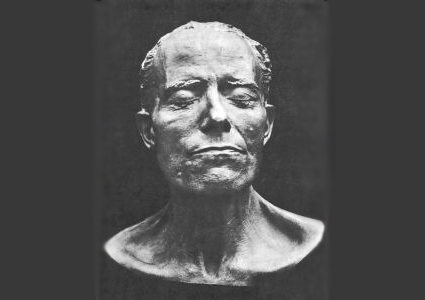
Turning point in the fame game: Gustav Mahler's death mask
The cast of characters could have walked out of the pilot for a television period serial. The great musician is dying, his trophy wife at the bedside with a letter from her lover. One of the doctors romances her. Another makes the cover of Time magazine.
They travel to Paris to consult a scientific genius. Reporters throng his doorstep, opposite the Bois de Boulogne. The great scientist graciously drops them a soundbite, twice a day. In Venice, a novelist reads the newspapers and models his anti-hero on the dying man. In Vienna, the cultural elite crowd his deathbed. The wife, now widow, is nowhere to be seen. Cue the Adagietto from Mahler's Fifth symphony.
The death of Gustav Mahler 100 years ago, at the dawn of the mass media age, marked the end of personal privacy for public figures and its replacement by a celebrity cult in which no medical confidence was sacrosanct and death itself was a springboard for survivor fame and media fortunes.
In February 1911 Mahler was the most talked-about musician in New York and Vienna, two cities whose culture he transformed. In ten years as director of the Vienna Opera he deposed the dominance of singers and aimed for an equal collaboration of all art forms. In America he demonstrated that orchestral concerts could be more than just a seasonal repetition of family favourites; he played for workers and students, introducing a gamut of unheard works. His utopian idealism did not make him popular with the paying classes but he was the talk of both towns, so much so that cab drivers would point him out to their passengers as an eccentric attraction.
He fell sick in New York after being waylaid in a legal ambush by wealthy ladies who tried to bludgeon him into signing a new Philharmonic contract. Against doctor's orders, he conducted a concert of new Italian works with a serious throat infection and barely made it back conscious to his hotel. The family physician, Joseph Fränkel, suspected the onset of endocarditis, a heart disease incurable at the time, and called in the world authority from the nearby Mount Sinai Hospital.
Emanuel Libman, 38, had already stamped his name on an intestinal germ and was working on a theory that endocarditis might not be triggered by bacterial infection; it could be verrucous or viral, a variant soon to be known as Libman-Sachs endocarditis. A bachelor workaholic famed for on-sight diagnoses, Libman practised at the hard-pressed Mount Sinai (formerly Jews Hospital) because well-endowed Columbia would not employ a Jew. His patients included Sarah Bernhardt, Thomas Mann and Albert Einstein. It is said of Libman that he once looked down a White House dinner table at President Warren Harding, and whispered to Vice-President Calvin Coolidge that he would succeed within two months. A man of monolithic certainties, he saw from the blood-test results that Mahler was doomed to die.
The patient demanded to be told the truth, then asked to be taken home, to Vienna. Libman suggested he stop off in Paris to see the Pasteurian bacteriologist, André Chantemesse, who might stall the infection and buy him some extra time. While the consultation took place, Doctor Fränkel in the next room was making moves on Alma Mahler. Alma, for her part, was trying to arrange a Paris rendezvous with her lover, the future Bauhaus architect Walter Gropius. Nobody in this melodrama was in the least bit obscure. Even the assistant who took Mahler's blood, George Baehr, was the pioneer who persuaded the future Mayor La Guardia to found New York's first group health insurance plan.


- Our EU Deal Gives Us The Best Of Both Worlds
- Brexit Would Save Us And Set Europe An Example
- Are Both Sides Playing By The Referendum Rules?
- Should We Stay Or Should We Go?
- Ignore Project Fear: Brexit Won't Ruin Us
- Uncontrolled Immigration Means Finis Britanniae
- The Next US President Must Carry A Big Stick
- Can Clinton Or Trump Crack The US Tax Code?
- How to Survive the Fourth Industrial Revolution
- The Spectre Of Mayor Khan's Islamist London
- Students Are Leading The Free Speech Fightback
- Fortress Europe Faces An African Migrant Tsunami
- Trump May Be Bad, But What Comes Next Will Be Worse
- Myth Of Stressed-Out Soldiers On The Street
- The Russian Love Affair With Palmyra Resumes
- How Russia Is Ruled By The Putin Doctrine
- The Doors Of Holocaust Memory Are Closing
- Rediscovering The Point Of Language
- The Novelist For Whom Small Was Beautiful
- A Recipe For Disaster

7:02 PM