


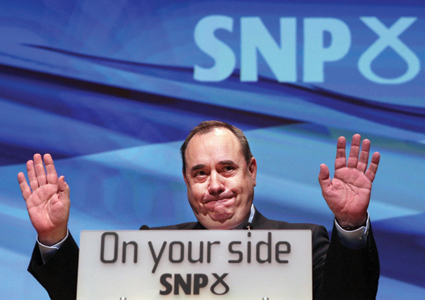
But are the Scots on his side? Alex Salmond needs to rethink his attitude towards Europe
Watching the disintegration of the European project begin, torn between feelings of jubilant eurosceptic vindication and horrified foreboding about the potential economic impact of the coming explosion, I see a bright spot. The European Union's crisis is a major opportunity for those of us who want to hold together the United Kingdom.
Since the Scottish National Party's leader Alex Salmond won an overall majority in the devolved parliamentary elections in May it has looked as though the Union is a hopeless cause. He has all but wiped out his opponents, and most of those that remain seem incapable of marshalling arguments against separation. But Salmond — generally regarded by the English media as an entertaining Caledonian equivalent of Boris Johnson, an unstoppable populist figure seemingly above normal politics — has a problem. The European project is doomed. It is little understood in England that since the late 1980s modern Scottish nationalism has been built on the intellectual bedrock of something called "Independence in Europe", a slogan designed to indicate to voters north of the border that Scotland could safely leave the UK and simply join the rising EU. Salmond used to deploy the term "Independence in Europe" incessantly, although he uses it a lot less since the eurozone started its death spiral.
The First Minister, an economist by training, has recently acknowledged that, post independence, he would not try to take Scotland into the single currency. After all, only a total maniac would now attempt to enter the "burning building with no exits", as William Hague famously described the euro a decade ago. Salmond's new position is that Scotland would leave the UK but keep the pound rather than launching a new currency. He doesn't rule out entry to the euro at some distant future date, though it is questionable whether the euro in its current form will even exist by then. Quite how he squares this position with the requirement of new entrants to the EU — and Scotland would have to apply for accession status — to sign up for monetary union is not explained.
Before the European project stalled it was clear what Salmond was asking Scots to vote for in the independence referendum he plans to hold in the next few years. Scots would leave one union, the UK, and sign up to a bigger union, the EU. But now what exactly are they being asked to join? An independent Edinburgh-based government would try to join the EU, but not the euro, which means leaving Britain but asking the English for shelter under the umbrella of sterling. The nationalist offer sounds a good deal less appealing than it was.


- Migrant Crisis? Europe Hasn't Seen Anything Yet
- Why Palmyra Should Matter To The West
- Corbyn's Rise Makes Cameron Redundant
- No, Jeremy: Politics Is All About Borders Now
- Why 'Lady Chatterley' Still Provokes Us
- For Climate Alarmism, The Poor Pay The Price
- Will Putin's Empire Outlast The Soviets?
- British Witnesses To Lenin's Revolution
- Bibliophiles Beware: Online Prices Are A Lottery
- How Jeremy Corbyn's Coup Hijacked Labour
- Corbyn's Signpost Back To The Ghetto
- Unionists, Don't Despair: Scotland Is Not Lost — Yet
- Britain's Apologists For Child Abuse
- Lift The Fee Cap And Set Universities Free
- The Story Behind One Dead Man's Penny
- Hitler's 'Ecological Panic' Didn't Cause The Holocaust
- Meet The Montalvos: The First Global Family
- Mr Gove, Here Is Our Statute of Liberty
- A British Bill Of Rights
- Something For Nothing Just Won't Do Any More

4:10 PM