


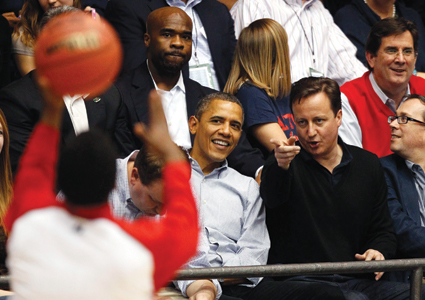
Slam dunk footage: David Cameron told Tory MPs that images of him watching basketball with Barack Obama were more important than press criticism of the government — but few British voters were impressed (Credit: Getty)
In 1992, Governor Bill Clinton agreed to allow a leading documentary-maker inside his campaign as the Democratic primary season got under way. A pioneer of direct cinema, or cinéma vérité, D. A. Pennebaker had been part of the team that made Primary, the classic 1960 account of John F. Kennedy and Hubert Humphrey's battle in the Wisconsin Democratic primary.
But his most important subsequent films were about rock stars such as David Bowie. In Ziggy Stardust and the Spiders from Mars Pennebaker captured the singer killing off his famed persona live on stage in order to facilitate another reinvention. An earlier film was Don't Look Back, the quintessential 1960s chronicle which recorded Bob Dylan on tour in Britain at the height of his powers.
How appropriate that more than 30 years later, when the 1960s generation made its first proper run at the US presidency, it should be Pennebaker who was there to record the Governor of Arkansas retaking the White House for the Democrats. There was a symmetry to it. Clinton was young enough to have shaken Kennedy's hand as a teenager, dodged the Vietnam draft, smoked pot (although not inhaled) and appreciated Dylan's Blonde on Blonde album.
The resulting Pennebaker documentary on Clinton's election, The War Room, filmed 20 years ago and released in 1993 after the inauguration, has proved to be an immensely influential piece of work with a questionable legacy. It may have been seen by only a small audience, but it set the tone for two decades of political combat on both sides of the Atlantic. On its release The War Room was devoured by communications specialists and junior spin-doctors looking for tips on how to manipulate a message and manage the media.
The Clinton campaign team was too smart to allow much access to the candidate himself. In the film Clinton was presented as a rock star, appearing in close-up only a few times to create the illusion of intimacy. Instead, the cameras focused mainly on charismatic strategist James Carville, the so-called "ragin' Cajun", and communications director George Stephanopoulos as they battled with journalists and fired up their young workers at campaign headquarters. The effect on screen was postmodern. The campaign was inverted, with Clinton in the background and the spinning of his hard-nosed operatives pushed to the fore.


- Licence To Chill? Not Yet, Prime Minister
- Money Can't Buy Us Love: Profiting From Loneliness
- More Immigration Means Less Integration
- Is France As Doomed As Houellebecq Thinks?
- Compassion To Refugees, Not Capitulation To Islamic State
- How Mervyn King Got Northern Rock Wrong
- Fix Rotten Boroughs Or Risk Voting Wars
- Migrant Crisis? Europe Hasn't Seen Anything Yet
- Why Palmyra Should Matter To The West
- Corbyn's Rise Makes Cameron Redundant
- No, Jeremy: Politics Is All About Borders Now
- Why 'Lady Chatterley' Still Provokes Us
- For Climate Alarmism, The Poor Pay The Price
- Will Putin's Empire Outlast The Soviets?
- British Witnesses To Lenin's Revolution
- Bibliophiles Beware: Online Prices Are A Lottery
- How Jeremy Corbyn's Coup Hijacked Labour
- Corbyn's Signpost Back To The Ghetto
- Unionists, Don't Despair: Scotland Is Not Lost — Yet
- Britain's Apologists For Child Abuse

9:04 PM
10:04 AM
10:04 AM