


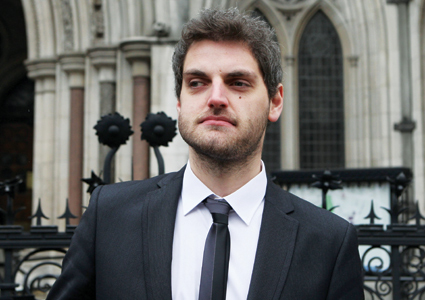
A new kind of free speech case: For tweeting a bad-taste joke Paul Chambers lot his job, was arrested and charged with a catch-all offence (Reuters)
In 1998 a science-fiction writer called David Brin tried his hand at science fact. Brin's predictions in The Transparent Society were not accurate in all respects – predictions never are. But he provided a way of thinking about the modern forms of invasion of privacy, which concern Lord Justice Leveson, and the criminalisation of speech, which unfortunately troubles him less.
At the end of the last century Utopian enthusiasts for the internet and all the computerised and miniaturised technologies that accompanied it, thought that scientific progress had allowed them to escape censorship. They foresaw an age of freedom when dictators, judges and secret policemen would no longer be able to contain them.
Techno-enthusiasts brushed aside the possibility that malicious public and private bodies (including malicious newspapers) could exploit computer technologies. Online activists, most notably Phil Zimmermann of Pretty Good Privacy, thought they could secure the emancipatory potential of the web with encryption systems that dark forces could never crack. A dissident in a dictatorship, for example, would use the web to circumvent state controls. But the technology was Janus-faced. Just as it gave him new powers, it gave the authorities new and minatory means to monitor him. Western geeks could solve his problem by giving him codes which ensured that only his intended recipients in the underground could read his emails. Western citizens could use encryption too if they wished. But as voters in democracies they could also demand that governments give them legally enforceable rights to protect their privacy.
Brin's Transparent Society stood out from the mass of now forgotten predictions about the internet because he understood that technology had made old levels of privacy impossible: "The djinn cannot be crammed back into the bottle. No matter how many laws are passed, it will prove quite impossible to legislate away the new tools and techniques." The best encryption systems in the world are of no use if the state or another public, private or criminal organisation can place a miniature camera behind you while you type, or insert a program into your system to monitor your key strokes. Instead of trying to protect the unprotectable, Brin called for political change to match changes in technology. He envisaged possible responses by imagining how two cities might look in 2018.


- The Spectre Of Mayor Khan's Islamist London
- Students Are Leading The Free Speech Fightback
- Fortress Europe Faces An African Migrant Tsunami
- Even If Trump Is Sunk, Republicans Can't Cruz
- Myth Of Stressed-Out Soldiers On The Street
- The Russian Love Affair With Palmyra Resumes
- How Russia Is Ruled By The Putin Doctrine
- The Doors Of Holocaust Memory Are Closing
- Rediscovering The Point Of Language
- The Novelist For Whom Small Was Beautiful
- A Recipe For Disaster
- Culture And Politics In The Age Of Trumpery
- Will Labour Listen To Its Eurosceptic Voters?
- Would Brexit Play Into Putin's Hands?
- Why Brexit Could Be A Blessing For Europe
- Will The Pollsters Get It Right On The Referendum?
- The Great Illusion: Why We Are Still Europe’s Fall Guys
- Make June 23 Britain’s Independence Day
- Don't Pit Generations Against Each Other
- Let Justice Be Done Though The Liberal Heavens Fall

- Shame On The Liberals Who Rationalise Terror
- The Cowardice Of John Le Carré
- The Establishment Is In Denial — Yet Again
- Is There A Right Way To Write?
- A Fascist Coup In Poland? Give Us Poles A Break
- The Long Shadow Of Malthus
- The Stalinist Past Of Corbyn’s Strategist
- France, Islam, And The Second Class Sex
- Shame On The Liberals Who Rationalise Terror
- The Cowardice Of John Le Carré
- The Establishment Is In Denial — Yet Again
- Is There A Right Way To Write?
- A Fascist Coup In Poland? Give Us Poles A Break
- The Long Shadow Of Malthus
- The Stalinist Past Of Corbyn’s Strategist
- France, Islam, And The Second Class Sex
- Shame On The Liberals Who Rationalise Terror
- The Cowardice Of John Le Carré
- The Establishment Is In Denial — Yet Again
- Is There A Right Way To Write?
- Did Burke Betray The Cause Of Liberty?
- A Fascist Coup In Poland? Give Us Poles A Break
- Double Games Of The UK Muslim Brotherhood
- Two Languages And The Chasm Between Them
2:07 AM
8:07 AM
1:07 PM
10:07 AM
7:07 AM
6:06 PM
6:06 PM