



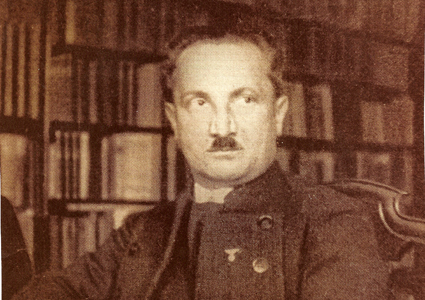
 Martin Heidegger: The philosopher embraced Nazism yet was rehabilitated after the war
Perhaps only if one is under mortal terror can one understand why highly civilised people endorse extreme dictatorships. One thinks of the fear in which Stalin forced Shostakovich to live; or the obedience that Furtwängler and Richard Strauss chose to show to the Nazi regime. Yet how does one explain why civilised people who not merely have the capacity for thought, but whose life is thinking, embrace evil? In her new book Hitler's Philosophers (Yale, £25) Yvonne Sherratt explores, among other things, this conundrum. She does not merely look at those who, literally, should have known better but who threw themselves and their learning behind the Nazis. She also looks at those, mainly but not exclusively Jewish, who maintained a sense of intellectual and moral integrity and took against Hitler, and shows what happened to them. It is, in the end, a peculiarly unedifying story, though exceptionally well told.
The industry that portrays and describes the Third Reich is now considerable, with many authors and publishers regarding the subject as inexhaustible. This aspect of Hitler's terror — how he sought to control the thought processes first of academia and then, presumably, of the rest of Germany who would defer to the eminent philosophers in the Reich's universities — has been insufficiently explored.
Dr Sherratt describes the influences on Hitler before he rose to power — notably Houston Stewart Chamberlain, from the Wagner family circle in Bayreuth, Feuerbach, Schopenhauer and (insofar as he could understand him) Nietzsche. Hitler does not really seem to have understood philosophy. Had he done so he would have recognised Chamberlain as a charlatan and seen that his reading of Nietzsche was superficial and selective. This leads inevitably to the main problem with Hitler: of all "his" philosophers, he was the philosopher-in-chief. Since his principal tract was the ragbag of prolix bigotries that is Mein Kampf, we know how warped and inadequate the quality of his "thought" was, and how little qualified he was to judge others.
Dr Sherratt provides compelling studies of the philosophers who fled or died rather than play along with Hitler. There was Walter Benjamin, a philosopher who was supposedly the finest writer in German, who went into exile shortly after Hitler came to power. It was his misfortune to have made France his home, and as the Gestapo closed in on him near the Spanish border in September 1940 he took enough morphine "to kill a horse". There was Theodore Adorno, a musicologist who went first to Oxford (where he was taken up by Maurice Bowra, but patronised and derided by Isaiah Berlin, in further proof that his judgment and humanity were not all his adorers claim them to have been) and then to America. He ended up in Los Angeles, immersed in Hollywood. There was also Hannah Arendt, brilliant student and sometime mistress of Martin Heidegger, who managed to escape round-ups in an almost miraculous fashion. And it is Arendt who brings us back to the most puzzling and disturbing feature of this story.
Heidegger embraced Nazism with apparently complete enthusiasm. He was a genius: Dr Sherratt calls him "Hitler's Superman" but asks the question whether Hitler could possibly, with his "pernicious" and ignorant views attract to his cause someone so gifted. The answer was yes, and it was Heidegger. She recounts how in 1929 Heidegger had complained about the "Jewification" of his university — the word he uses is Verjudung, one that peppers the pages of Mein Kampf.
On May 1, 1933, three months after Hitler came to power, Heidegger had joined the Nazi party in a blaze of publicity at the University of Freiburg, where he was professor and celebrated for his work in metaphysics. He had taken the precaution beforehand of disembarrassing himself of Arendt who, being Jewish, was not an ideal bedfellow. Heidegger made a speech protesting his devotion to National Socialism, and described the urgency of the need to Nazify Germany's universities. His reward was to be made rector of Freiburg, with an inauguration ceremony that he underwent in Nazi uniform and whose programme had the words of the Horst Wessel Lied printed on its back page. He then proceeded to remove all non-Aryans from the university. With the philosopher's approval, Brownshirts toured the campus and conducted military exercises there. Heidegger was such a disaster in his new post that even his loyalty to the party and the Führer could not preserve him in it for more than a year.
Heidegger endorsed the corruption of the German legal system under the Nazis. He also supported censorship. He maintained his devotion to Hitler until 1945, which ensured he would retain his chair and continue to have his books published.
With the fall of the Third Reich, so began Heidegger's attempts to exculpate himself. He was outraged that there was a suggestion that he should be subject to denazification hearings, "singled out for punishment and defamation before the eyes of the whole city — indeed the whole world". Despite the zeal with which he had supported the Nazi party and its doctrines, Heidegger was classed merely as a fellow traveller, given emeritus status, and allowed to continue to teach.
That, though, was only the beginning of his good luck. His rehabilitation continued, and was managed not least by his former lover, Hannah Arendt. She argued the case for Heidegger around the world. She celebrated and promoted his genius. Heidegger had fallen in 1934 from the rectorship at Freiburg not least because his nationalism was considered to be too "romantic", and not of the Darwinian/Nietzschean variety favoured by the Nazis. He claimed to have found Mein Kampf, in parts, repugnant. What seems to have motivated Arendt in taking up the cudgels in favour of her former lover and teacher was not so much that she believed any of his excuses, but that the flame of their former relationship was rekindled when she met him again after her exile.
Whatever her motivation, the results were sobering. Heidegger died in 1976 with his reputation as intact as it could possibly be. Dr Sherratt describes him as being now the "star" of continental philosophy. The Jewish thinkers such as Arendt, Benjamin and Adorno, whom Nazis like Heidegger drove out of the country, are more peripheral. We like to pride ourselves on having finally disgraced and marginalised Nazism. Perhaps we should not be so sure.


10:03 PM
10:03 PM
6:03 PM
5:03 PM
1:03 PM
11:03 AM
7:03 AM
4:03 AM
10:02 PM