


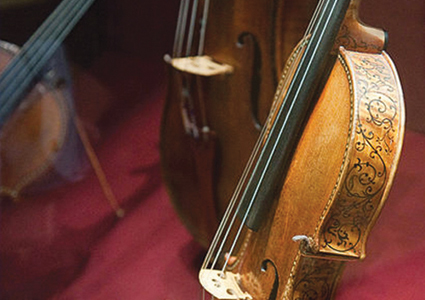
 Stringing them along: The price of rare violins (such as the Smithsonian Museum's 1687 Stradivarius shown here) has lost contact with functional reality
No other instrument makes so much noise on the airwaves. You can smash up a piano in front of the Pope, play the cello stark naked in the Oxford Circus rush hour or assault a policeman with a silver flute and all that would make the news is the act, not the instrument. But leave your violin in a taxi or play it in the subway, drop it on stage or get it stolen, and every media outlet from Fox News to Sports Illustrated will headline the fiddle with mounting degrees of manufactured amazement and horror.
What is it about the violin that commands such unparalleled attention? The price, apparently. When Philippe Quint left his 1723 Stradivarius in a Newark airport cab, the BBC told the world that it was worth, wait for it, four, breath, million, breath, dollars (the cabbie who returned it got a $100 reward and some concert tickets). Joshua Bell's busking stunt in the Washington metro, from which he made $32.17 in tips and the greatest fame of his life, was on a "$3.5 million violin". Last month, Min-Jin Kym's "$1.84 million Stradivarius" was recovered by British Transport Police, three years after it was stolen, from beside her feet, in a Euston Station café. And when David Garrett tripped and fell at the Barbican, interviewers were less concerned for possible damage to his spine than for cracks in his "priceless" violin. Each and every one of these incidents made the nightly TV news.
There is a paradox here that screams out for elucidation. The less classical music features in mass media, the greater the media interest in the price of violins. No one ever asks Lang Lang how much his Steinway cost (around two hundred grand, at a guess), but put a no-name violinist in front of a camera and journalists will want to know what he or she paid for the instrument.
The price, as it happens, has little to do with normal economic considerations, namely cost of materials and complexity of manufacture. Making a violin is one of the simpler crafts, practised by peasants for centuries with wood from nearby forests and gut from slow felines. It is, by comparison, much harder to make a good keyboard instrument. Visiting my harpsi-pal Mahan Esfahani, I was stunned at how much he needs to know, for constant tuning purposes, about the intricacy of its insides. The strings of a harpsichord are silken strands of metal, whittled down to wisps at an intense heat that claimed the lives of many artisans in less health-and-safety-conscious times. Its quality depends on the soundboard, just as it does on the violin. Yet you can buy a modern double-manual harpsichord for 30 grand; a violin of equivalent calibre will cost ten times as much.


- Empty Seats At The Met
- Labour's Antisemitism Problem
- The Cowardice Of John Le Carré
- Why Only Countries Willing To Take Risks Will Survive And Prosper
- A Fascist Coup In Poland? Give Us Poles A Break
- Double Games Of The UK Muslim Brotherhood
- Did Burke Betray The Cause Of Liberty?
- Two Languages And The Chasm Between Them
1:09 AM
3:09 AM
1:09 AM
12:09 AM
6:09 PM
11:09 AM