



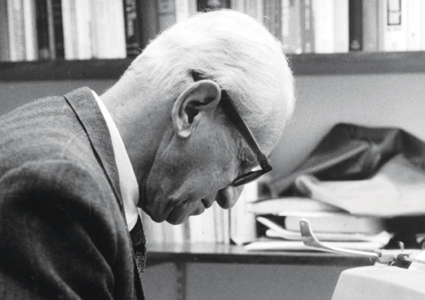
 Herbert Marcuse: The father of the New Left worked for US military intelligence during the war
The Frankfurt School, founded in Germany in 1923 — the Institute for Social Research being its official name — was a group of intellectuals who played an important role in Europe and the United States over several decades. The school's orientation was "critical", which in practice meant undogmatic Marxist (within limits). It stood for a synthesis of Marx and Freud, philosophy and sociology. It also tried to integrate some German thinkers who were closer to Nazism than to Marxism, such as Martin Heidegger and Carl Schmitt. It advocated a society that was more just, saw monopoly capitalism as the main threat and was more preoccupied with high culture and the evils of mass culture than political issues.
The dramatic upheavals of the 1930s and '40s directly affected the Frankfurt School and moved it in directions its leading figures had neither foreseen nor wanted. Since almost all its members were Jewish, or part Jewish, they had to leave their native country soon after Hitler's rise to power. Most made their way via London to the United States, where they had to look for new sponsors since their financial means were limited. One group, mainly based in California, undertook a study of anti-Semitism on behalf of a leading Jewish organisation, it eventually took the form of investigating prejudice and the authoritarian personality. Another group, having joined American military intelligence, the Office of Strategic Services (OSS), contributed to the war effort by trying to explain Nazi Germany to American political and military leaders. They included Franz Neumann, the head of this group, Herbert Marcuse and Otto Kirchheimer. Some 30 of their many wartime position papers have now been published under the general title Secret Reports on Nazi Germany.
Why did William "Wild Bill" Donovan, the most highly decorated American soldier of the First World War and later head of OSS, enlist this group of radical theorists? There is no obvious answer: they were born and educated in Germany but, the question of their unorthodox political orientation quite apart, they were not really political animals. This goes especially for the most prominent and influential thinkers among them, such as Walter Benjamin or Theodor Adorno. Jürgen Habermas, the leading German intellectual of our time and the universally recognised legitimate heir of the Frankfurt School, said about Adorno that he was an authentic genius. Perhaps, but his genius was in the field of cultural studies rather than politics.
They were intelligent, well-educated people with wide interests and it is only legitimate that the editor should have picked out of their many reports those which have best stood the test of time. But were they prescient, pioneering an understanding of the character of Nazism, its aims and ambitions? This has been claimed in the past and is sometimes argued even now. True, they made some useful points, such as stressing that Hitler's Germany contained essentially new elements, quite different from the Germany of 1914, and should not be seen through the lenses of a bygone period. (Churchill in 1937 still tended to believe that Hitler and Nazism were in the tradition of Kaiser Wilhelm II, the misbegotten grandson of Queen Victoria.) The Frankfurters warned against the Morgenthau Plan of 1944-45 to deindustrialise a defeated Germany. They realised early on that underneath the seemingly monolithic façade of Nazism there was a great deal of chaos. It was never made quite clear who was in charge of what, the role of Hitler, the state apparatus, the party, etc.


- Shame On The Liberals Who Rationalise Terror
- The Establishment Is In Denial — Yet Again
- Is There A Right Way To Write?
- A Fascist Coup In Poland? Give Us Poles A Break
- Censoring The Censors Won't Do
- France, Islam, And The Second Class Sex
- The Stalinist Past Of Corbyn’s Strategist
- The Long Shadow Of Malthus
- Shame On The Liberals Who Rationalise Terror
- The Establishment Is In Denial — Yet Again
- Is There A Right Way To Write?
- A Fascist Coup In Poland? Give Us Poles A Break
- Censoring The Censors Won't Do
- France, Islam, And The Second Class Sex
- The Stalinist Past Of Corbyn’s Strategist
- The Long Shadow Of Malthus
3:09 PM
2:09 PM
2:09 PM
4:09 AM
8:09 AM
2:09 AM
6:09 PM