


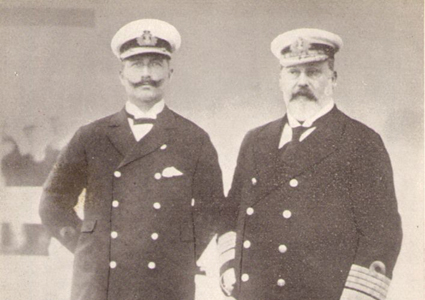
 No warmonger: Kaiser Wilhelm II (left) was goaded by his uncle, Edward VII (right), but although unstable he was not a barbarian
The problem with prejudice is that it ignores fact. We are in the throes of a new spasm of bigotry because of the impending centenary of the Great War. It is becoming very fashionable to be rude about the Germans. They may be Germans of history rather than our cousins in Europe today: but a great injustice is being done to them nonetheless, which many find quite acceptable.
Among serious historians, Christopher Clark has argued that the Germans were not to blame for the war, and Niall Ferguson has reiterated his long-held thesis that it was not in Britain's interests to have fought. (I happen to agree with both of them, but that is neither here nor there.) On the other side, Sir Michael Howard and Gary Sheffield both argue that Britain had to do it because of the threat posed by an increasingly ambitious Germany. Professor Sheffield holds a chair in war studies, and Sir Michael has made a worldwide reputation as a scholar of warfare. This may be the problem for those who choose to imitate such serious scholars in making their own arguments about who was to blame, and whether Britain should have fought. In shaping their own views they rely on expert military historians, when most of the necessary evidence lies within the realms of diplomacy and politics.
That is bad enough: but in feeding our anti-German prejudice — a prejudice some second-rate authors manifestly deem necessary to help shift their rather superficial books — they advance the view that the Germans had a uniformly vile and aggressive attitude to their neighbours and potential enemies from the time of Bismarck until the surrender of 1945. Therefore, the type of obloquy we quite naturally offer to Hitler and his gang, and the revulsion we feel for their works, should also be applied to those who "started" the earlier conflict.
The sheer unhistorical nature of this view is breathtaking but the black-and-white, heroes-and-villains view of the Great War is manifestly one that engages masses who prefer a good yarn to rigorous analysis. There is also the suggestion that if one does not endorse the ignorant view of the war, one is somehow besmirching the memory of those who fought for our country in it. Let us dispose of that first of all: the men who joined up or who, later, were conscripted, were engaged in what their country told them was a noble and patriotic cause. They deserve, a century later, to be regarded as heroes. They were victims, in their hecatombs, of instability between the main continental powers, and of poor leadership by Asquith, the Prime Minister, and Grey, the Foreign Secretary.
Those who would paint the Germans as villains assert that they would have won a European war without British involvement; that they would have dominated the continent of Europe and imposed a brutal autocracy on their new empire; and that when the time came the Germans would come for us, and for our empire, too. So if we did not fight them in 1914 we would fight them in 1917 or 1920. All that is missing from this set of contentions is any evidence. The British misunderstanding of Germany had been built up, not least by the popular press and by authors of penny dreadfuls (and even some more serious novels), for the decade before 1914. The public was schooled in the belief, again based on no evidence, that Germany would invade at any moment. The monarch, Edward VII, a man far less stupid than history makes him out to be, also fed the fires of anti-German feeling by goading his nephew the Kaiser whenever possible — something that had started with Wilhelm's accession to the throne in 1888 — and made the catastrophic mistake of inspiring the Entente Cordiale in 1904 and following it up with the Triple Entente, including Russia, four years later. The Kaiser said he was encircled, and he had a point. He started to expand his fleet, and the British public called for two Dreadnoughts to be built for every German ship. A meeting in Germany in 1912 discussed how war against Britain might be prosecuted: but not for aggressive, rather for defensive reasons. Germany really, really did not want a war.
Like this article? Share, save or print using the icons below:


5:04 AM
9:03 PM
8:03 PM
11:03 AM