



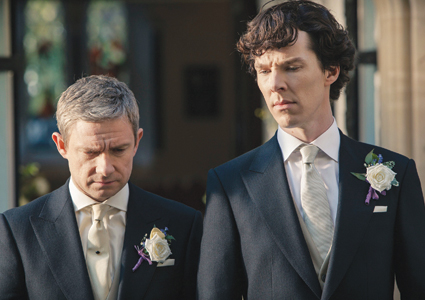
Plot-free zone: Benedict Cumberbatch (right) and Martin Freeman as Holmes and Watson in "Sherlock"
The most popular and critically acclaimed drama British television produces lacks drama's basic component: a coherent plot. Few care. Commissioning editors and the viewing public acclaim Sherlock's creators Steven Moffat and Mark Gatiss. The press loves them so much it covered their last series as if it were breaking news.
To give you an idea of how slapdash and infantile their writing is, consider one episode of the BBC programme, The Empty Hearse. Sherlock Holmes returns from the dead, after seemingly dying with Moriarty. We find him in a dictatorship for reasons the authors do not bother to explain. His brother Mycroft, a minor figure in the Conan Doyle stories, but an establishment fixer who is everywhere in the television adaptation, saves him from torture. How a civil servant gets from Whitehall to a Slav prison is unexplained again. Holmes returns to London where Watson has found a new girlfriend. Unbeknown to him, she is a former assassin, who killed for the CIA, as so many girls do these days. Rather than tell the viewer straight how Holmes escaped from death with Moriarty, Moffat and Gatiss offer multiple theories they lifted from Sherlock's fanatical and rather creepy internet tribute sites. So determined are they to "interact" with the audience rather than allow their actors to act that they go on to put a group of obsessive fans into the script.
For a motive that the writers do not share with the audience until the final episode of the series, and then only cursorily, unknown men kidnap Watson and leave him bound and gagged inside a giant bonfire, which will soon be set alight unless Holmes gets there in time. The actual mystery Holmes is meant to be solving takes up less than a quarter of the programme. It is something about the North Koreans wanting to blow up the Houses of Parliament for reasons that yet again remain mysterious. In that same final episode, Watson's new love comes out as an ex-CIA assassin. Moriarty tops that by coming out from his grave. He announces his resurrection by taking over every TV and computer screen in Britain.
In Conan Doyle's stories, the crime is everything. In the modern adaptation it takes third place. The most important task for the writers is to throw in tense relationships between Holmes and Watson, Holmes and Mycroft, Holmes and Mycroft and their parents, Watson and his fiancée, Holmes and possible lovers. Sub-plots come next, appearing and disappearing like water in the sand.
The sight of the most logical of detectives reduced to playing in a zany crime caper was miserable to watch. The first task of a writer is to create an imaginary world that makes sense in its own terms. Conan Doyle might have been offering advice to writers when he had Holmes say to Watson: "How often have I said to you that when you have eliminated the impossible, whatever remains, however improbable, must be the truth?" Moffat and Gatiss cannot produce plots that, however improbable, feel true — and don't even try.


- Shame On The Liberals Who Rationalise Terror
- The Cowardice Of John Le Carré
- The Establishment Is In Denial — Yet Again
- Is There A Right Way To Write?
- A Fascist Coup In Poland? Give Us Poles A Break
- Did Burke Betray The Cause Of Liberty?
- Double Games Of The UK Muslim Brotherhood
- Two Languages And The Chasm Between Them
10:01 AM
5:04 PM
11:02 AM
11:02 AM
10:02 AM
3:02 PM
2:02 PM
2:02 PM