



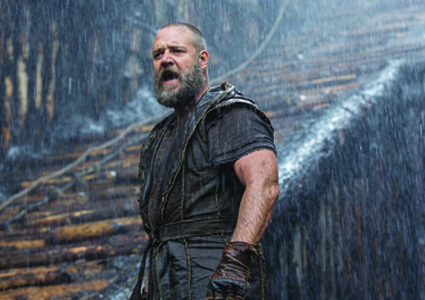
Tortured patriarch: Russell Crowe as Noah
Contemporary cinema is a powerful argument against the existence of God. No benevolent deity would create a universe in which films as bad as Darren Aronofsky's Noah could be made.
You might respond to the problem of tripe with the theologians' response to the problem of evil. You could say that God has given us free will. He allows us to choose to walk out of the cinema. But he has not given critics that choice: our professional duty obliges us to stay to the end. Nor, if you believe in the truth of the Bible, Torah and Koran, as alarming numbers of people still do, does he allow the rest of creation greater freedom.
Hollywood has never tackled the Noah story before, precisely because it destroys belief in a benevolent omnipotent deity. God kills every human on earth — except Noah and his family — and every animal, insect and bird — apart from a breeding pair from each species — in an act of . . . well, there is no word. "Genocide" is inadequate.
With an indifference that is hard to take in the circumstances, God barely bothers to explain himself. Genesis justifies mass extinction by saying: "And God saw that the wickedness of man was great in the earth, and that every imagination of the thoughts of his heart was only evil continually" — and leaves it there. God is meant to dwell in the detail. But the Old Testament leaves the detail of human wickedness unexplained. The Koran goes a little further and elucidates for a line or two. Noah warns the damned: "O my people! Worship God! You have no other God but Him. I fear for you the punishment of a dreadful day!"
This makes sense. The Ten Commandments do not condemn slavery or child abuse. Instead of recommending a moral life, four of the commandments are merely the instructions of a jealous, not to say vain God, on the importance of revering Him and Him alone, honouring his day and respecting his name. How could a Hollywood liberal tell the Noah story without casting God as the villain? He is a dictator who demands total obedience.
The God of Hollywood is therefore altogether more palatable to modern tastes, if no less brutal. The Lord is now a green God, who punishes humanity for its crimes against the environment.
The film's opening sequence tells a familiar story — Adam, Eve, garden, tree, snake and apple. But after Cain kills Abel, Aronofsky adapts it to suit our sensibilities. God does not wipe out humanity because it has worshipped false idols, or taken the Lord's name in vain, or even gone shopping on the sabbath. Instead, the film explains that the sin of the human race, and as far as I can see of the world's entirely blameless animal, insect and bird population, is to build an "industrial civilisation". (I know "industrial" is not a description anyone would apply to Bronze Age Palestine, but Aronofsky once said "my God is narrative film-making", so if the narrative demands an industrial civilisation thousands of years before Watt and Boulton invented the steam engine then an industrial civilisation is what we must have.)
Like this article? Share, save or print using the icons below:


- Shame On The Liberals Who Rationalise Terror
- The Cowardice Of John Le Carré
- The Establishment Is In Denial — Yet Again
- Is There A Right Way To Write?
- A Fascist Coup In Poland? Give Us Poles A Break
- Did Burke Betray The Cause Of Liberty?
- Double Games Of The UK Muslim Brotherhood
- Two Languages And The Chasm Between Them
8:05 AM
1:05 PM