



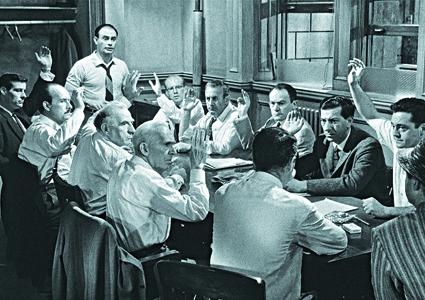
The rationalist's nightmare: Jurors decide the defendant's fate in the 1957 film "12 Angry Men"
Prosecutors, judges and governments have always disliked juries. They are expensive, unpredictable and uncontrollable. How much more convenient if they did not exist. In some ways the miniature democracy of a jury resembles another irritant to the governing class: the electorate as a whole. But while abolishing the electorate may be an unattainable dream, abolishing juries is a much more practical objective and every few years a government tries to do just that. Juries in most civil cases are now all but extinct. Yet repeated attacks on criminal juries — whether to try complex frauds or simple shoplifting cases — have generally been repulsed.
The current government's legal aid cuts will inflict terrible damage on the legal profession and the criminal courts but the Coalition has largely shied away from attacking the jury system itself.
Yet all but unnoticed by the press a new attack on juries has begun. The Crown Prosecution Service (CPS), the senior judiciary and the Labour Party are all set on a path that could lead to the emasculation and eventual extinction of the jury system.
Ostensibly the CPS has no anti-jury agenda. Indeed, no high-profile acquittal is complete without a ritual announcement from the police and CPS that they "respect the jury's verdict". In fact, however, prosecutors are getting increasingly exasperated at the refusal of juries to convict in sexual cases. The reason, they suggest, is not that the evidence is weak but that jurors are prejudiced and too easily swayed by "societal myths" about rape.
When the CPS is criticised for being trigger-happy it always responds that it does not prosecute unless a case meets the "evidential test". This means that there must be a "realistic prospect of conviction" before charges are brought. If there is no such prospect "the case must not proceed no matter how serious or sensitive it may be."
What does this actually mean? The CPS explains that it is the situation in which "an objective, impartial and reasonable jury . . . is more likely than not to convict the defendant". This sounds eminently sensible; only prosecute if you think you will probably win.
But that is no longer what the CPS means. It assumes, especially in rape cases, that actual juries are not necessarily "objective, impartial and reasonable", so it is wrong to base a decision to prosecute on what an actual jury would be likely to do. Instead, the CPS imagines what a notional jury would do if it was, in the words of the Director of Public Prosecutions Alison Saunders, "wholly unaffected by any myths or stereotypes of the type which, sadly, still have a degree of prevalence in some quarters".
It is almost a throwback to the days when only rich men were considered to be "objective, impartial and reasonable" enough to sit on juries. Women were too emotional and the poor were too stupid.
Like this article? Share, save or print using the icons below:


More Features
- Licence To Chill? Not Yet, Prime Minister
- Money Can't Buy Us Love: Profiting From Loneliness
- More Immigration Means Less Integration
- Is France As Doomed As Houellebecq Thinks?
- Compassion To Refugees, Not Capitulation To Islamic State
- How Mervyn King Got Northern Rock Wrong
- Fix Rotten Boroughs Or Risk Voting Wars
- Migrant Crisis? Europe Hasn't Seen Anything Yet
- Why Palmyra Should Matter To The West
- Corbyn's Rise Makes Cameron Redundant
- No, Jeremy: Politics Is All About Borders Now
- Why 'Lady Chatterley' Still Provokes Us
- For Climate Alarmism, The Poor Pay The Price
- Will Putin's Empire Outlast The Soviets?
- British Witnesses To Lenin's Revolution
- Bibliophiles Beware: Online Prices Are A Lottery
- How Jeremy Corbyn's Coup Hijacked Labour
- Corbyn's Signpost Back To The Ghetto
- Unionists, Don't Despair: Scotland Is Not Lost — Yet
- Britain's Apologists For Child Abuse
Popular Standpoint topics

1:06 PM