



After the 20th century's list of events of mass murder — from the Ukraine famine of the early 1930s and the Holocaust in the 1940s, to the Balkans wars and the Rwanda genocide of the 1990s — the cries of "never again" and the assertion of a "responsibility to protect" gave some hope that mass killing would not recur in the 21st century. Then came Darfur in the new century's first decade, and now Syria in the second. Mass killing has very clearly not been eliminated, nor has the "international community" developed a response that will avert it or bring it to a quick end. 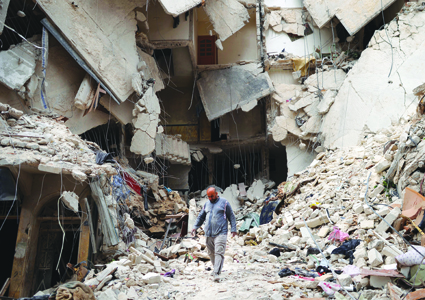
Responsibility to protect: Obama's 2012 decision not to send military aid to Syrian rebels was made against the advice of his officials (credit: Getty)
Simultaneously, Syria has become the test of another international agreement: to outlaw the use of chemical weapons. It is clear that the Assad regime used such a weapon — sarin gas — time after time, and on that basis the Obama administration prepared a military attack to punish the regime last summer to deter and prevent further use. At the last minute it turned from that attack to a deal, negotiated largely via Russia, under which the regime promised to eliminate its chemical weapons arsenal and never again to use chemical weapons. What portion of its chemical weapons it has in fact shipped out is open to debate, but the regime has been widely reported to have used a different form of chemical weapons repeatedly in 2014: this time, bombs laced with chlorine. So like mass killing, use of poison gas turns out to be a feature of this new century as well. If we face a new century in which the use of poison gas and mass killing recur regularly, Syria will be the place where they reappeared — and the policies of Barack Obama will be a central reason why they have returned.
The facts about the humanitarian situation in Syria are well-known. A minimum of 160,000 have been killed, according to the Syrian Observatory for Human Rights. 6.5 million Syrians have been forced to leave their homes and are displaced inside Syria, and 2.7 million are refugees in neighbouring countries — altogether, nearly half of Syria's population of 22 million. The refugee burden on neighbours is immense: there are a million Syrian refugees in Lebanon, whose population is only a bit over 4 million, and 600,000 in Jordan, with a population of just over 6 million. The official refugee figures may be far lower than the real numbers (there are almost certainly over a million Syrian refugees in Jordan), and do not begin to express the misery in which so many Syrians now live.
In the beginning of this conflict, when protests commenced in early 2011 as part of the Arab Spring, there were two sides: the Assad regime and its peaceful Syrian opponents. The regime quickly reacted with great violence, killing hundreds of demonstrators, and in August that year President Obama said: "The time has come for President Assad to step aside." The regime instead chose to increase the killing, and soon there was what amounted to a civil war between the regime and those Syrians rising in force against it. Iran and Hezbollah moved to back the regime fully, over time actually sending in fighting forces, and Russian arms shipments were readily made available. President Obama's demand that Assad must go was not matched by any actions to make him go, and the regime's slaughter of Sunnis — not only of rebels, but of civilians — only grew.


- The Spectre Of Mayor Khan's Islamist London
- Students Are Leading The Free Speech Fightback
- Fortress Europe Faces An African Migrant Tsunami
- Even If Trump Is Sunk, Republicans Can't Cruz
- Myth Of Stressed-Out Soldiers On The Street
- The Russian Love Affair With Palmyra Resumes
- How Russia Is Ruled By The Putin Doctrine
- The Doors Of Holocaust Memory Are Closing
- Rediscovering The Point Of Language
- The Novelist For Whom Small Was Beautiful
- A Recipe For Disaster
- Culture And Politics In The Age Of Trumpery
- Will Labour Listen To Its Eurosceptic Voters?
- Would Brexit Play Into Putin's Hands?
- Why Brexit Could Be A Blessing For Europe
- Will The Pollsters Get It Right On The Referendum?
- The Great Illusion: Why We Are Still Europe’s Fall Guys
- Make June 23 Britain’s Independence Day
- Don't Pit Generations Against Each Other
- Let Justice Be Done Though The Liberal Heavens Fall

- Shame On The Liberals Who Rationalise Terror
- The Cowardice Of John Le Carré
- The Establishment Is In Denial — Yet Again
- Is There A Right Way To Write?
- A Fascist Coup In Poland? Give Us Poles A Break
- The Long Shadow Of Malthus
- The Stalinist Past Of Corbyn’s Strategist
- The Spectre Of Mayor Khan's Islamist London
- Shame On The Liberals Who Rationalise Terror
- The Cowardice Of John Le Carré
- The Establishment Is In Denial — Yet Again
- Is There A Right Way To Write?
- A Fascist Coup In Poland? Give Us Poles A Break
- The Long Shadow Of Malthus
- The Stalinist Past Of Corbyn’s Strategist
- The Spectre Of Mayor Khan's Islamist London
- Shame On The Liberals Who Rationalise Terror
- The Cowardice Of John Le Carré
- The Establishment Is In Denial — Yet Again
- Is There A Right Way To Write?
- Did Burke Betray The Cause Of Liberty?
- A Fascist Coup In Poland? Give Us Poles A Break
- Double Games Of The UK Muslim Brotherhood
- Two Languages And The Chasm Between Them
2:11 PM
7:08 PM
9:07 AM
6:06 AM