



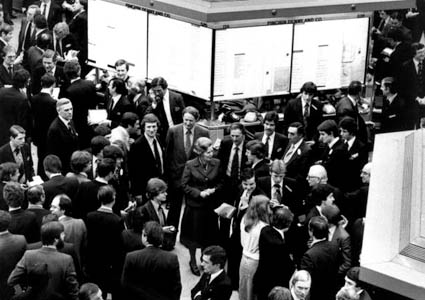
Before the Big Bang: Margaret Thatcher visits the London Stock Exchange in 1979. The City had yet to embrace globalisation (credit: Steve Burton/Getty)
When Nigel Farage left school in the early 1980s, he went to work in the City as a commodities trader. London was rather different back then. Those were the sleepy days before the Big Bang, the computerised revolution which modernised the ancient City and made it once again one of the world's leading financial centres. When Farage arrived the revival was still to come. Long lunches were compulsory and the market was lubricated with copious amounts of alcohol.
Farage was a natural. Not just because he could — and still can — consume a lot of beer, wine and nicotine while remaining alert and on top of his game. He was, say contemporaries, good at trading. The pin-striped youngster had an instinctive feel for buying and selling, pricing commodities, spotting the opportunity for margins and making money by oiling the wheels of global trade.
These skills — practised by generations of City traders — were what had helped make outward-looking London the dominant financial centre, before the First World War destroyed Britain's finances and hastened the transfer of power from the fading imperial capital to Wall Street.
By the early 1980s, when Farage arrived, London was in a curious position. On one hand, the City was a closed society, dominated by a web of old-boy networks that were conservative and slow to react to technological change of the kind that was by then making financiers in America so much more dynamic and acquisitive. But the sleepy old City had also shown that it was still capable of open thinking and of exploiting opportunities. It had come to dominate the Eurobond market, which from 1963 governments and companies used to issue bonds denominated in a currency other than their own.
Margaret Thatcher's ministers and advisers diagnosed the problem as follows: unless the City was modernised, with more innovation encouraged, it would be dragged down by hidebound traditionalists operating cartels and eclipsed all over again by foreign rivals. Long before the term entered popular usage, the Thatcherites decided that what the City needed to become more competitive was a strong dose of globalisation.
Through the reforms of 1986 (which ended the old distinctions between stockjobbers and stockbrokers), through the rise of electronic trading and by changes made to banking which enabled big foreign firms to move in, the City was transformed. By the time the euro was launched, resurgent London was so dominant that it could control much of the trade in the single currency, even though the UK had declined to join. Openness to free trade, foreign investment, disruptive technology, the importation of talent and rapid wealth creation had remade the City. Globalisation had worked.
From the mid-1980s onwards, the reinvention of the Square Mile was good news for traders, including Farage and his friends, who found they could make spectacular amounts of money by buying and selling. But Farage had another preoccupation. While many of his contemporaries stayed and became rich in the long boom that preceded the worst crash in seven decades, he decided to go into politics.
Like this article? Share, save or print using the icons below:


Post your comment
More Features
- Migrant Crisis? Europe Hasn't Seen Anything Yet
- Why Palmyra Should Matter To The West
- Corbyn's Rise Makes Cameron Redundant
- No, Jeremy: Politics Is All About Borders Now
- Why 'Lady Chatterley' Still Provokes Us
- For Climate Alarmism, The Poor Pay The Price
- Will Putin's Empire Outlast The Soviets?
- British Witnesses To Lenin's Revolution
- Bibliophiles Beware: Online Prices Are A Lottery
- How Jeremy Corbyn's Coup Hijacked Labour
- Corbyn's Signpost Back To The Ghetto
- Unionists, Don't Despair: Scotland Is Not Lost — Yet
- Britain's Apologists For Child Abuse
- Lift The Fee Cap And Set Universities Free
- The Story Behind One Dead Man's Penny
- Hitler's 'Ecological Panic' Didn't Cause The Holocaust
- Meet The Montalvos: The First Global Family
- Mr Gove, Here Is Our Statute of Liberty
- A British Bill Of Rights
- Something For Nothing Just Won't Do Any More
Popular Standpoint topics
