



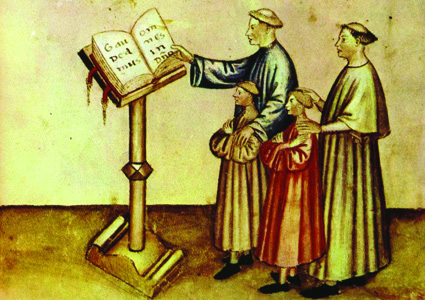
Church music: Seen here in the medieval treatise "Tacuinam Sanitatis", it forged the basis of classical music
It is a mystery to many people why so few contemporary classical composers seem capable of writing "a good tune". Surely, given the number of students who pursue composition in our universities and conservatoires, and the hugely increased access which technologies such as music-notation software give to prospective composers, we should expect to find at least one or two capable of making a popular impact? Why is it that, with more people than ever engaged in the activity of composing, our culture still seems incapable of fostering a contemporary Verdi or Stravinsky, with the celebrity and popular recognition that such great figures once garnered?
It is certainly true, as Simon Heffer has amusingly put it in Standpoint ("A Raspberry for Emetic Music", November 2014), that the musical establishment is "in hock to the crap merchants" and in thrall to the state, creating a tyrannical orthodoxy of ugliness, admission to which can only be gained by imitating the style of "orchestrated raspberries" currently in vogue. However, the underlying cause—though closely related to the over-reaching influence of the modern state—ultimately goes far deeper than this. To understand the deficit of successful contemporary classical music, what we need to uncover are the feelings which motivated the artistic instincts of the great composers of the past, but which are now absent in the minds of modern composers, thus accounting for their "emetic" output.
In the year 1900, the following composers were alive, and the majority of them active: Saint-Saëns, Debussy, Ravel, Stravinsky, Rimsky-Korsakov, Rachmaninoff, Prokofiev, Bartók, Elgar, Vaughan Williams, Holst, Mahler, Strauss, Sibelius, Grieg, Puccini, Dvořák and Janáček. This list of exalted and well-known figures is far from exhaustive, and should give us pause. We cannot possibly pretend that the world today can boast a similar number or calibre of composers; indeed, any one of these figures is of far more interest to most of us than any of today's most famous composers. Moreover, if one expands this categorisation to include any composer active between the years 1850 and 1950, one possesses pretty much a complete list of the works in the standard orchestral repertoire (save the old German masters), and hence those pieces which one would find overwhelmingly on offer in any events guide produced by today's professional orchestras.
On closer inspection, it is not hard to see the idée fixe that unites this vast array of varied talent: nationalism. To varying degrees of explicitness, whether through the deliberate inclusion of folk elements, or simply a general over-arching style suggestive of national sentiment, all of these figures would quite happily have thought of themselves, not just as composers, but as French, Russian, Hungarian, English, German, Finnish, Norwegian, Italian or Czech composers. It is in fact a statement of the obvious to point out that the feelings that underpin a good deal of what these composers set out to accomplish was driven by a passion for the language, history, customs, traditions, institutions and, perhaps most prominently, the countryside of their native lands.
This surge of nationalist output, produced during the long 19th century, was an obvious accompaniment to the growth of the nation state itself. However, there is another deeper set of convictions which the classical composers held in common, and upon which the nation states of Europe themselves were predicated: Christianity.
Even in opera, a seemingly secular arena, Christianity commonly frames the moral dilemmas of the characters on stage. Mozart's Don Giovanni is dragged off to Hell, Verdi's Leonora takes refuge in a monastery, and Janáček's Jenůfa is just one of the many characters from the operatic repertoire who offers up a Christian prayer in a moment of great despair and need. This isn't merely because the Church held the purse-strings, as some have argued, but because there is a profound and inseparable relationship between music and Christianity; in fact, I would go as far so to argue that there is a sense in which Western music is Christian. The very scales (originally church modes) and harmonies which musicians of any ilk take as a given were forged in the cathedrals and churches of the medieval world. Through a gradual process of setting liturgical texts to music, sonorities such as the dominant-seventh chord were discovered, which then became the basic material of all classical and popular music. Something of the wisdom of the Gospels and the Psalms shines out of the harmonies of Western music—which is that crucial balance between judgment and compassion—and this is why, even on the operatic stage, a Christian moral logic so naturally and fittingly flows forth from the voices of the characters and the machinations of their plots.
Two operas in particular strongly support this line of reasoning, both of which place the suffering of Christ on the cross as a central image around which their respective stories revolve: The Rape of Lucretia by Britten, in which a narrative chorus "view these human passions, and these years/through eyes which once have wept with Christ's own tears", and Wagner's last opera, Parsifal, with its profound insights into the relationship between religious communities and sexual desire. Both operas acknowledge the debt which music owes to Christianity by bringing it back into the realm of secular music-making, and the consequence in the instrumentation of both scores is a remarkable glowing luminosity.
To gain a proper and complete understanding of what we call "classical" music is to appreciate that it was all written within the context of societies which were predominantly Christian in nature, and where celebrations of traditional national attributes were not seen as old-fashioned or backward-looking as they often are today. This all changed, however, in the 1960s, with the old moral authority of Christianity and nationalism brought into question by two World Wars which had slain "half the seed of Europe one by one", and the dawning of the sexual revolution. Liberated from the traditional restraints of Christian society, not least because of the oral contraceptive pill which spread rapidly throughout the world during the early 1960s, there was a sudden seismic shift in young people's behaviour and attitude towards sex, and one of its many consequences was the beginning of an era of "popular" music which gave expression to the new feelings which they could now experience and communicate publicly without shame or censure.
Let's be honest with ourselves: except for a few tangents here and there, the 1960s, 70s, 80s and 90s were overwhelmingly the decades of popular music. If you ask anyone their choice favourites from the 60s and 70s, only a tiny fraction will say Boulez and Stockhausen—and even they are just kidding themselves. Classical music did not enter a fantastic new period of experimentation and innovation in the 1960s. It died. What really took place was a repositioning of the psychological focus of music from the mature feelings of reflective adults to the more impatient and direct feelings of the young. With its "oohs" and its "aahs", its "come-ons" and its "get-downs", its "rock me" this and its "baby" that, the three- minute pop song homes in on the cheap thrills of recreational sex. Popular music is primarily about the highs and lows of the casual relationship. Different popular songs capture the feelings of different stages along its rise and fall: the yearning for it to begin ("Love me do"), the exuberance and satisfaction of being in the relationship ("I feel fine"), the little jealousies involved within the relationship ("Tell me why") and the angst of the breakup ("I'll cry instead")—to name but a few early Beatles songs.
Two operas in particular strongly support this line of reasoning, both of which place the suffering of Christ on the cross as a central image around which their respective stories revolve: The Rape of Lucretia by Britten, in which a narrative chorus "view these human passions, and these years/through eyes which once have wept with Christ's own tears", and Wagner's last opera, Parsifal, with its profound insights into the relationship between religious communities and sexual desire. Both operas acknowledge the debt which music owes to Christianity by bringing it back into the realm of secular music-making, and the consequence in the instrumentation of both scores is a remarkable glowing luminosity.
To gain a proper and complete understanding of what we call "classical" music is to appreciate that it was all written within the context of societies which were predominantly Christian in nature, and where celebrations of traditional national attributes were not seen as old-fashioned or backward-looking as they often are today. This all changed, however, in the 1960s, with the old moral authority of Christianity and nationalism brought into question by two World Wars which had slain "half the seed of Europe one by one", and the dawning of the sexual revolution. Liberated from the traditional restraints of Christian society, not least because of the oral contraceptive pill which spread rapidly throughout the world during the early 1960s, there was a sudden seismic shift in young people's behaviour and attitude towards sex, and one of its many consequences was the beginning of an era of "popular" music which gave expression to the new feelings which they could now experience and communicate publicly without shame or censure.
Let's be honest with ourselves: except for a few tangents here and there, the 1960s, 70s, 80s and 90s were overwhelmingly the decades of popular music. If you ask anyone their choice favourites from the 60s and 70s, only a tiny fraction will say Boulez and Stockhausen—and even they are just kidding themselves. Classical music did not enter a fantastic new period of experimentation and innovation in the 1960s. It died. What really took place was a repositioning of the psychological focus of music from the mature feelings of reflective adults to the more impatient and direct feelings of the young. With its "oohs" and its "aahs", its "come-ons" and its "get-downs", its "rock me" this and its "baby" that, the three- minute pop song homes in on the cheap thrills of recreational sex. Popular music is primarily about the highs and lows of the casual relationship. Different popular songs capture the feelings of different stages along its rise and fall: the yearning for it to begin ("Love me do"), the exuberance and satisfaction of being in the relationship ("I feel fine"), the little jealousies involved within the relationship ("Tell me why") and the angst of the breakup ("I'll cry instead")—to name but a few early Beatles songs.
None of these remarks are intended to condemn popular music (I would far prefer to listen to a favourite track by Michael Jackson than suffer through another BBC Proms commission). What these observations do illuminate, however, is the connection between the profound changes which affected the regulation of our sexual conduct during the 1960s, and, at the very same time, the decline of enduring new classical works, and the explosion of popular music onto the cultural scene as a new expressive force. In a sense, popular music stole classical music's mojo. Of course, my analysis is a broad gesture that does not take jazz or minimalism into account—which provide, so to speak, a bridge between the world of classical and popular music—nor does it explain the many other popular styles which existed before the 1960s (although these themselves bear witness to a growing liberalism), but it nevertheless represents a key moment, and helps to demonstrate the gradual passing of the baton that took place in music as progressive societies entered modernity.
Musical modernism is what was left behind after the feelings which motivated the great classical composers had dissipated. What you are hearing in the dysfunctional harmony and unattractive groans of Harrison Birtwistle and his many imitators is a massive God-shaped hole, where once natural authority and faith resided. This is what "atonal" music really is: a loss of faith, and this is why anyone who counteracts its dominance is quickly condemned as "naive", in just the same manner as those who continue to hold religious convictions in a scientific age. It is what has led composers such as Robin Holloway to confess that "all we like sheep have dumbly concurred in the rightness of [Schoenberg's] stance; against the evidence of our senses and our instincts".
I would be the first to acknowledge the dramatic talents of Alban Berg, the brilliant textural instrumentation of György Ligeti or the accomplished musicianship of Thomas Adès, but what all these composers have in common—despite the stylistic differences and time which separate their work—is that lack of inspiration within the musical material itself which began with Schoenberg and persists to this day. They all suffer from that excruciatingly dreary, lifeless sound which turns audiences off for want of "a good tune" (even if this phrase doesn't quite capture what they mean), and which is why ultimately none of their music has entered the standard repertoire, or enjoys anything near the popular recognition of the composers I listed earlier. It is why modern orchestras and opera houses suffer an endlessly commissioned conveyor-belt of "world premieres", forgotten the moment they see the light of day, and it is why the money is now finally starting to run out, with the state less willing to pay for it all and private patronage (for the obvious reason that it is unlovable) unwilling to fill the gap.
All the phoney "outreach projects", pseudo-pop fusions or desperate appeals to political correctness cannot halt this inevitable financial decline, and, with the copyright on composers like Rachmaninoff and Vaughan Williams due to expire soon, an already ailing publishing industry—which has colluded for far too long in maintaining the illusion that musical modernism was ever worth much—is going to have its coffers hit hard. A list of the most popular rental titles offered by the major music publisher Boosey & Hawkes as of 2012 bears this contention out, since none of the works in question was written after 1960, nor could any of them be remotely considered atonal:
Musical modernism is what was left behind after the feelings which motivated the great classical composers had dissipated. What you are hearing in the dysfunctional harmony and unattractive groans of Harrison Birtwistle and his many imitators is a massive God-shaped hole, where once natural authority and faith resided. This is what "atonal" music really is: a loss of faith, and this is why anyone who counteracts its dominance is quickly condemned as "naive", in just the same manner as those who continue to hold religious convictions in a scientific age. It is what has led composers such as Robin Holloway to confess that "all we like sheep have dumbly concurred in the rightness of [Schoenberg's] stance; against the evidence of our senses and our instincts".
I would be the first to acknowledge the dramatic talents of Alban Berg, the brilliant textural instrumentation of György Ligeti or the accomplished musicianship of Thomas Adès, but what all these composers have in common—despite the stylistic differences and time which separate their work—is that lack of inspiration within the musical material itself which began with Schoenberg and persists to this day. They all suffer from that excruciatingly dreary, lifeless sound which turns audiences off for want of "a good tune" (even if this phrase doesn't quite capture what they mean), and which is why ultimately none of their music has entered the standard repertoire, or enjoys anything near the popular recognition of the composers I listed earlier. It is why modern orchestras and opera houses suffer an endlessly commissioned conveyor-belt of "world premieres", forgotten the moment they see the light of day, and it is why the money is now finally starting to run out, with the state less willing to pay for it all and private patronage (for the obvious reason that it is unlovable) unwilling to fill the gap.
All the phoney "outreach projects", pseudo-pop fusions or desperate appeals to political correctness cannot halt this inevitable financial decline, and, with the copyright on composers like Rachmaninoff and Vaughan Williams due to expire soon, an already ailing publishing industry—which has colluded for far too long in maintaining the illusion that musical modernism was ever worth much—is going to have its coffers hit hard. A list of the most popular rental titles offered by the major music publisher Boosey & Hawkes as of 2012 bears this contention out, since none of the works in question was written after 1960, nor could any of them be remotely considered atonal:
1. Bernstein: Symphonic Dances From "West Side Story"
2. Bernstein: Overture to "Candide"
3. Mussorgsky/Ravel: Pictures at an Exhibition
4. Britten: The Young Person's Guide to the Orchestra
5. Rachmaninoff: Piano Concerto No. 2
6. Britten: Four Sea Interludes
7. Copland: Appalachian Spring Suite
8. Copland: Clarinet Concerto
With all this in mind, therefore, we can start to comprehend those rare instances since the 1960s where some classical music worthy of our attention has been produced, and we should not be surprised to see that they have sprung most prominently from a Christian setting—in particular, the great tradition of choral music which continues in the Oxbridge colleges and cathedrals across England. The best examples include John Tavener's outstanding setting of Blake's "The Lamb", early insightful glances into what a composer like George Benjamin might have been in his magnificent "Twas in the year that King Uzziah died", the admirable liturgical output of Judith Bingham and Judith Weir, and the success of those two wonderful choral works, "Sleep" and "Lux Aurumque" by Eric Whitacre, suffused with his distinctive brand of American televangelism. In addition, another often-forgotten backwater is the world of wind and brass music which, given its ties to the Royal Family, the armed forces and (particularly in the case of brass bands) its commitment to the great Christian hymn tune, has allowed composers like Edward Gregson and Kenneth Hesketh to sneak past a few nationalist contributions which contrast starkly with their usual "squeaky-gate" output. With its tuba trills and macho melodies, Gregson's "The Plantagenets" for brass band masterfully evokes the passions and chivalry of the old English kings, whereas Hesketh's youthful "Masque" and "Whirlegigg"—which enjoy international renown—are straight out of the military banding traditions of Vaughan Williams and Holst. What all of the above examples go to prove is that modern composers do still have it in them, when they are brave enough (or innocent enough) to try; however, these examples still exist on the periphery of the musical establishment, which, as Glare—a new opera presented by the Royal Opera House last November—amply demonstrates, remains stuck in a self-hating modernist rut.
Things might be about to change, however, and I think I can suggest a few reasons why this might be: popular music has run out of steam. The young know this (several students of mine have testified to its truth); they admit that even the best that is on offer these days—the chilly sounds of Coldplay or the Arctic Monkeys—cannot compete with the energetic exuberance of, say, Abba, and that so much that is pumped out of the radio is now empty commercialism.
This decline, I suspect, relates back to the ongoing liberalisation of societies which began in the 1960s. The overthrowing of Christian chastity and discrediting of nationalism went hand in hand with the rights revolutions, which improved the freedoms of non-white races, homosexuals and women, and these causes were also reflected in popular music: hence, "[It doesn't matter if you're] Black or White" by Michael Jackson, "I want to break free" by Queen, or "Eleanor Rigby" by the Beatles. During this period, the young had a lot to rebel against, and many just causes to champion. Now, however, it is fair to say that, in the West. social norms have been established which condemn any form of discrimination based on race, gender or sexuality, and so the young have very little real to rebel against anymore, and the motivations and feelings which inspired so much great popular music, and which pushed the old authority of classical music to one side, have now run dry.
Instead, what has crept into our institutions of late—particularly in education—is a systemic lack of leadership and authority. So, in conservatoires and music departments, nobody teaches harmony and counterpoint any more, although this, as explained above, is fundamental to all Western music. What has happened here is that the baby has been thrown out with the bath-water, and an overshooting liberal agenda has jettisoned all that was of value from the past, as well as those things which needed changing—as Steven Pinker has aptly put it, the rights revolutions have now entered their "decadent phase".
We have now reached a point, however, where the rot has gone so deep that we can no longer afford to maintain the lie that modernism was ever worth much—and not just because the money is running out. With the many subversive and insidious forces of globalisation beginning seriously to undermine the legitimacy of the nation state, and with Christianity under attack from a new liberal bigotry which has made expressing Christian sentiments all but taboo in much public life, what we need now are forms of culture that will help us to shore up these foundations. However, this is only possible if we allow leadership and authority back into our artistic institutions, if we take a suitably compassionate pride in our national identity, and, without any awkwardness or shame, have belief in the value and virtue of our Judaeo-Christian roots.
Things might be about to change, however, and I think I can suggest a few reasons why this might be: popular music has run out of steam. The young know this (several students of mine have testified to its truth); they admit that even the best that is on offer these days—the chilly sounds of Coldplay or the Arctic Monkeys—cannot compete with the energetic exuberance of, say, Abba, and that so much that is pumped out of the radio is now empty commercialism.
This decline, I suspect, relates back to the ongoing liberalisation of societies which began in the 1960s. The overthrowing of Christian chastity and discrediting of nationalism went hand in hand with the rights revolutions, which improved the freedoms of non-white races, homosexuals and women, and these causes were also reflected in popular music: hence, "[It doesn't matter if you're] Black or White" by Michael Jackson, "I want to break free" by Queen, or "Eleanor Rigby" by the Beatles. During this period, the young had a lot to rebel against, and many just causes to champion. Now, however, it is fair to say that, in the West. social norms have been established which condemn any form of discrimination based on race, gender or sexuality, and so the young have very little real to rebel against anymore, and the motivations and feelings which inspired so much great popular music, and which pushed the old authority of classical music to one side, have now run dry.
Instead, what has crept into our institutions of late—particularly in education—is a systemic lack of leadership and authority. So, in conservatoires and music departments, nobody teaches harmony and counterpoint any more, although this, as explained above, is fundamental to all Western music. What has happened here is that the baby has been thrown out with the bath-water, and an overshooting liberal agenda has jettisoned all that was of value from the past, as well as those things which needed changing—as Steven Pinker has aptly put it, the rights revolutions have now entered their "decadent phase".
We have now reached a point, however, where the rot has gone so deep that we can no longer afford to maintain the lie that modernism was ever worth much—and not just because the money is running out. With the many subversive and insidious forces of globalisation beginning seriously to undermine the legitimacy of the nation state, and with Christianity under attack from a new liberal bigotry which has made expressing Christian sentiments all but taboo in much public life, what we need now are forms of culture that will help us to shore up these foundations. However, this is only possible if we allow leadership and authority back into our artistic institutions, if we take a suitably compassionate pride in our national identity, and, without any awkwardness or shame, have belief in the value and virtue of our Judaeo-Christian roots.
Like this article? Share, save or print using the icons below:


7:03 AM
4:03 AM
3:03 AM
1:02 PM
12:02 PM