


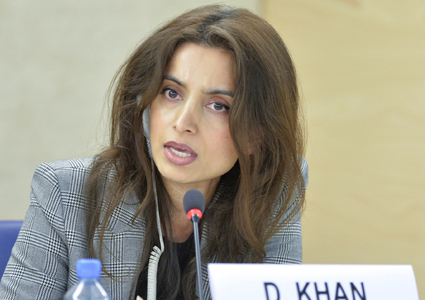
 Deeyah Khan: She succeeds in persuading British jihadis to open up about their motivations (photo: UN Geneva)
When confronted with radical Islamists who murder without limit, too many want to rationalise the irrational. Leftists say that the murderers cannot truly believe that they must slaughter non-Muslims and Muslims who do not follow their version of Islam to the letter. Rather, and rather conveniently, they explain away religious totalitarianism as an understandable response to Western foreign policy, Israeli oppression, racism and poverty; to, in other words, the very evils that were already agitating the Left. “Don’t say we didn’t warn you,” they say with grim satisfaction, as they make murderers their allies and turn corpses into debating points.
Conservatives also use crimes against humanity to shore up their barricades in the culture wars. To them, the distinction between Islam and Islamism must be a distinction without a difference. All Muslims are tainted because Islam is an alien and barbaric creed, which makes every believer a potential criminal. Once again, they conscript psychopaths, but in this instance they use them to justify immigration controls, law and order, and a recognition of the superiority of the “Judaeo-Christian” culture. (Given that the Christians spent two millennia persecuting the Judaeos, I am not sure conservatives should offer such a warring “culture” as an example to anyone.)
Not the smallest of the virtues of Deeyah Khan’s documentary Jihad: A British story (ITV) is that she provides evidence to back every attempt to rationalise Islamism and then knocks it away. I should declare an interest and say that I think Khan is completely bloody marvellous. She was originally a glamorous and gifted pop star; music critics predicted she would become the “Muslim Madonna”. But religious reactionaries do not take well to “their” women getting ideas above their station. Their threats to her and her family forced Khan to flee twice: first from her native Norway and then from Britain, which she naively believed was a liberal haven, whose citizens would not tolerate the violence of the Muslim far-Right. She abandoned her ambitions, and went into exile in America. Rather than go under, as many would have done, she came back — rejuvenated and reinvented — as a feminist filmmaker. Her first documentary on the “honour” killing of a Kurdish girl in Britain won all kinds of awards, and her Jihad: A British Story (ITV) shows her skill and insight once more.
Over 18 months she convinced two generations of jihadis, ex-jihadis, and men and women teetering on the edge of committing to jihad to open up. Her central character is the remarkable figure of Abu Muntasir, a Bangladeshi immigrant to Britain. In the 1980s and 1990s he was a vicious and charismatic Islamic extremist preacher, who went to fight in Kashmir, Burma and Afghanistan and inspired hundreds of young men to imitate him. How?
A simple but to my mind plausible answer is that the police never stopped him. Muntasir was never arrested, never even interviewed. Looking back on the policing of radical Islam in the last years of the 20th century, you can see that the authorities were as naive as the academics. Like the shallow theorists, they could not believe that Islamists meant what they said. Surely they were just letting off steam or striking poses?
Like this article? Share, save or print using the icons below:


- Shame On The Liberals Who Rationalise Terror
- The Cowardice Of John Le Carré
- The Establishment Is In Denial — Yet Again
- Is There A Right Way To Write?
- A Fascist Coup In Poland? Give Us Poles A Break
- Did Burke Betray The Cause Of Liberty?
- Double Games Of The UK Muslim Brotherhood
- Two Languages And The Chasm Between Them
2:08 PM
2:08 PM
4:07 PM
7:07 PM
4:06 PM
1:06 PM
1:06 PM
1:06 PM