



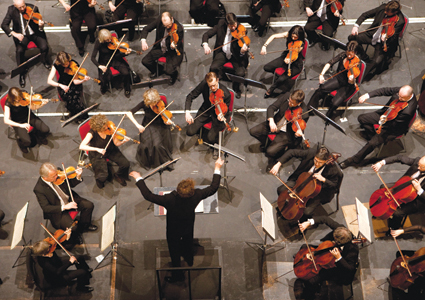
 Under threat: The BBC National Orchestra of Wales, who played six Proms this year (photo: BBC/Betina Skobro)
Enjoy this summer’s Proms? Then cherish the memory. They were the last of the BBC Proms as we knew them. Triple pressures are converging to distort and diminish the world’s largest orchestral festival. The first clicked in this summer when, in a regime-change power vacuum, six Proms were removed from Radio 3 editorial control and parcelled out around the BBC for corporate dumbing down.
Few would dream of objecting to having a Prom night devoted to television theme music from David Attenborough’s Life Story with animals fierce and fluffy running around on a big screen. Nothing to do with the Proms mission, but never mind. Where the bone stuck in this lion’s throat was Radio 1’s Ibiza night with the DJ Pete Tong, a neon sign of things to come.
A mantra is being parroted by BBC executives about the need to attract young people to “elitist” classical music. The Pete Tong audience was packed with middle-aged 1980s nostalgists, among them a heavy-metal fan in a sombre suit who turned out to be the Culture Secretary. Whatever John Whittingdale made of his Prom, it won’t have changed his life, or his mind about the future of the BBC.
Proms controllers for the past quarter-century — John Drummond, Nick Kenyon, Roger Wright — fought to protect the festival’s unique character from interference by the rest of the BBC. When Wright signed off on the first night of the 2014 Proms, the resistance ended. It will not be revived. The incoming Proms chief, David Pickard, is a former yes man to the Glyndebourne set. His boss, the Radio 3 controller, Alan Davey, is a career civil servant. Both are Musilian men without qualities, ill-equipped to withstand the coming storm.
The next phase is commercialisation. Year after year, Wright resisted BBC demands to exploit the Proms brand by taking on a sponsor. The Proms cost £9 million, of which half is recouped in ticket sales. The net BBC outlay of £4.5 million is a piffling sum in exchange for perpetual broadcast rights in 76 prime concerts and the glory of looking after a treasure of national heritage. Ignoring these benefits, BBC suits have pressed persistently for external finance. So stand by for next year’s Audi BBC Proms — or maybe a bigger betrayal, the Apple iTunes BBC Proms.
The third pressure, by far the most pernicious, affects the BBC orchestras and Radio 3. The five BBC musical ensembles — the London-based BBC Symphony and Concert orchestras, the BBC Philharmonic in Manchester, the Scottish in Glasgow and the National Orchestra of Wales in Cardiff — cost £25 million a year. Radio 3 reported a £38.4 million budget in the 2014/15 published accounts. Both orchestras and classical radio are now under intense scrutiny for immediate savings.
Past controllers have argued that the Proms depend on having BBC orchestras who can put in extra rehearsal hours on new and esoteric works at no extra charge. The new bosses cannot hold that line, which, truth be told, has been weakened by the rise of smart London start-ups like Aurora and South Bank Sinfonia who can play anything you put in front of them in the blink of an eye.
Like this article? Share, save or print using the icons below:


- Empty Seats At The Met
- Labour's Antisemitism Problem
- The Cowardice Of John Le Carré
- Why Only Countries Willing To Take Risks Will Survive And Prosper
- Double Games Of The UK Muslim Brotherhood
- Did Burke Betray The Cause Of Liberty?
- A Fascist Coup In Poland? Give Us Poles A Break
- Two Languages And The Chasm Between Them
12:09 PM
2:08 AM