



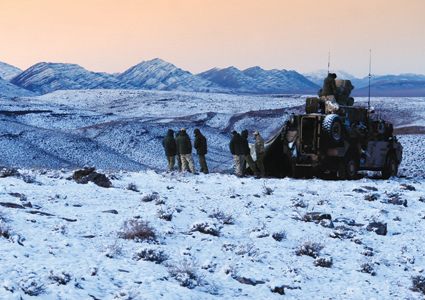
 Past the tipping point? Coalition forces in Uruzgan province as part of a Provincial Reconstruction Team (DOD CC BY-SA 3.0)
Afghanistan may have slipped off the daily-news radar recently, displaced by Syria, Iraq and other hotspots, yet every day my inbox fills with news from the country. The emails’ subject line generally relates either to a new atrocity, corruption, or the lack of American supervision over enormous amounts of money misspent on ludicrous development schemes. It seems it was ever thus.
I first went to Kabul as a journalist in 2007, the year of the “tipping point”. The post-2001 invasion optimism had evaporated. People were beginning to question what Nato’s mission was really achieving. Was it reforming the miserable state of Afghan women’s lives? Was it state-building? Was it finally on track to defeat the Taliban? Through all this we watched as the poppy crop grew exponentially while the US spent $7 billion to combat opium production.
All those questions remain unanswered today. Fourteen years and more than $1 trillion later, it is still unclear whether the situation is getting better or worse.
Saad Mohseni, dubbed the Rupert Murdoch of Afghanistan, launched his empire after the fall of the Taliban when he returned from Australia and invested the family fortune in a new media venture. Last November, he gave an interview to the Wall Street Journal in which discussed the many gains that had been made in his troubled country. It is true that there are more children in school, a lively and liberal media landscape, more women in the workforce and in parliament, more paved roads and more electricity. But that is only part of the picture. Often women MPs are just mouthpieces for male relatives, and most girls leave school when they reach puberty; 87.4 per cent of women are illiterate. Even among those aged 15-20 the figure is 80 per cent, and only 2 per cent of women are economically independent.
In January, two months after Mohseni’s interview, a suicide bomber targeted a bus taking 40 of his employees home. Seven were killed and 24 injured. It brings home the reality of Afghanistan: one step forward, several steps back.
Gloom is the overwhelming sentiment. Lieutenant General John W. “Mick” Nicholson Jr, the next US commander in Afghanistan, believes the security situation is worsening. It is difficult to find anyone who is positive. But it would also be a mistake to write the country off.
A generation of young Kabulis feel there is hope. The internet and social media have connected them to a world that the Taliban shut out. These men and women invest in their country with their hard work, but I sense a part of their optimism is a by-product of the fact that they have nowhere else to go. Afghanistan is their future. On the other hand, I remember an interview I did with a young liberal in 2009 shortly before the presidential elections. I asked him how likely he thought real reform was in his country. “Oh, yes,” he said, “it’s possible. You just have to wait 200 years.”
Like this article? Share, save or print using the icons below:


Post your comment
More Features
- Our EU Deal Gives Us The Best Of Both Worlds
- Brexit Would Save Us And Set Europe An Example
- Are Both Sides Playing By The Referendum Rules?
- Should We Stay Or Should We Go?
- Ignore Project Fear: Brexit Won't Ruin Us
- Uncontrolled Immigration Means Finis Britanniae
- The Next US President Must Carry A Big Stick
- Can Clinton Or Trump Crack The US Tax Code?
- How to Survive the Fourth Industrial Revolution
- The Spectre Of Mayor Khan's Islamist London
- Students Are Leading The Free Speech Fightback
- Fortress Europe Faces An African Migrant Tsunami
- Trump May Be Bad, But What Comes Next Will Be Worse
- Myth Of Stressed-Out Soldiers On The Street
- The Russian Love Affair With Palmyra Resumes
- How Russia Is Ruled By The Putin Doctrine
- The Doors Of Holocaust Memory Are Closing
- Rediscovering The Point Of Language
- The Novelist For Whom Small Was Beautiful
- A Recipe For Disaster
Popular Standpoint topics
