



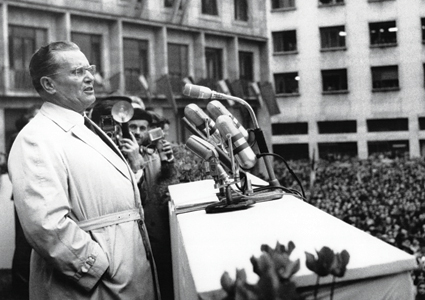
 The myths persist: Yugoslavia’s leader Josip Broz Tito in 1960 (© Keystone-France/Gamma-Rapho via Getty Images)
Progressive opinion affects to take symbols lightly. Thus public acceptance of blasphemous plays and obscene exhibitions, the burning of a national flag, and insults to heads of state are all supposed to be evidence of intellectual liberation. Particularly in former Communist countries, where symbolism has altered in ways that disorientate the new as well as the old Left, the cry quickly goes up that any concern for symbols is an “obsession” or a “distraction”.
In Eastern and Central Europe, though, the Left’s indifference to symbols is an affectation. The modern leftist turns in a flash into a snarling neo-Communist — lacking only a Party membership card and Kalashnikov to revert to the older variety — when his own myths are challenged. Moreover, his assumed indifference to tradition quickly becomes intolerance of “extremism”, if any unwholesome, or ambiguous, symbol emerges from shadows on the Right.
On Friday September 1, Zagreb City Council voted to change the name of one of the most prominent squares from “Marshal Tito Square” to the “Square of the Republic of Croatia”. The decision was greeted by some solemn shaking of heads in the Western media, where it was depicted as an assertion of reactionary nationalism. Credibility was lent to this by the fact that the campaign to change the name was spearheaded by Dr Zlatko Hasanbegović, the former Croatian culture minister, who fell foul, when in office, of agitation from George Soros-backed NGOs, whose tax-financed budgets he was minded to cut. Hasanbegović is a nationalist historian with a taste for controversy and what, for politicians in Croatia, is an unnerving willingness to argue intellectual positions. He is not, however, a fascist, anti-Semite, or racist (he is a Muslim, and so has received his fair share of Islamophobic abuse). In any case, the majority for the change was provided by the conservative Croatian Democratic Union (HDZ) and the centre-left party grouping attached to Zagreb’s mayor, Milan Bandić.
The square’s name change was historically significant. It clearly symbolised a break with the country’s past. But it became involved with another dispute about symbols, which has, despite the sound and fury, no historical significance at all. Near the Jasenovac concentration camp, where a large number of Serbs, Jews and political opponents of the quisling Independent State of Croatia (NDH) were killed by the Ustasha authorities, a private memorial was raised a year ago to members of the HOS (Croatian Defence Forces — a rightist paramilitary force) who died fighting in the war for Croatian independence in the early 1990s. On the memorial was inscribed the Ustasha salute “Za Dom Spremni” (“Ready for the Homeland”). The salute was apparently used by many HOS fighters — though who knows with what understanding of its true significance? The memorial plaque has since been moved a few miles away. What to do generally about totalitarian symbols — including the Communist five-pointed Red Star (“Petokraka”) positioned near the sites of mass graves of Communist Party victims — is now the thankless task of a government-appointed commission. Meanwhile, a well-funded, internationally-supported “antifascist” movement currently seeks to link cases of real or imagined nostalgia for the Ustasha regime — which collapsed 70 years ago — with the movement to cleanse Croatia of the remains of the Communist regime — which have a disconcerting degree of life in them still.
Like this article? Share, save or print using the icons below:


More Features
- May's blunders that led to Brexit chaos
- How not to deal with home-grown enemies
- Chronicle of a political disaster long foretold
- The cruel fleecing of our sheep farmers
- Amritsar: Beginning of the end of Empire
- Why good books could not deter bad leaders
- The dangers of dog in the manger democracy
- When the call of the wild can go too far
- Odds against life after the final whistle
- A beginner’s manual to grievance gibberish
- Cull the thinkers whose ideas have tanked
- Holier than thou: the hypocrisy of the zealot
- The way forward for Europe’s great outsider
- The woke gent’s guide to blurred lines
- The tricky business of gender identity
- “You’re really a man, aren’t you?”
- The ticking timebomb of internet porn
- A distinctive melody in the melodrama of our time
- A mysterious alchemy
- Corbyn's road map to a communist Britain
Popular Standpoint topics

- The inevitability of Fortress Europe
- The way forward for Europe’s great outsider
- The devout sceptic: hope for those of little faith
- Corbyn waves the flag of anti-Semitism
- In Corbyn’s mind, there is no place for the Jews
- Is the mental illness epidemic just a myth?
- Women storm the podium
- Corbyn's road map to a communist Britain
12:12 PM
8:11 PM
11:11 AM