



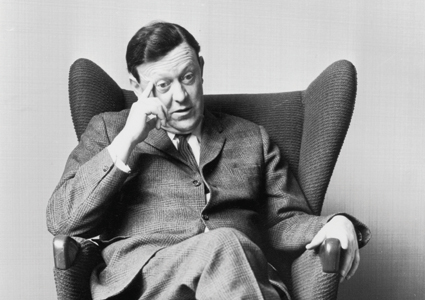
Conor Cruise O’Brien, pictured when he was Editor-in-Chief of “The Observer”, 1978-1981 (© Evening Standard/Getty Images)
It might be best to begin by saying how I came to be interested in the 1986 visit to South Africa of Conor Cruise O’Brien, the great Irish statesman, diplomat, writer and public intellectual. I was born on Merseyside but my father was later transferred to Durban by his employers, so I finished my schooling there and then attended the University of Natal, where I was heavily involved in anti-apartheid activities. A Rhodes Scholarship took me to Oxford just before the Security Police came to detain me. I was to stay in Oxford for many years as student and teacher, well aware that it would be unsafe to return to South Africa. I finally did so in 1978 and thereafter returned frequently to teach and to write about the evolving situation for The Times and Sunday Times. Ultimately I left Oxford in 1995 to return to South Africa where I ran the Helen Suzman Foundation. I have ended up living in Cape Town. Throughout these many years I have heard countless friends and colleagues discuss “the Conor Cruise O’Brien affair”, which was quite a landmark in South Africa, particularly for liberals. This always intrigued me, for I had got to know Conor a little through his son, Donal. The account which follows depends heavily on the oral testimonies of eye-witnesses.
Conor visited South Africa on a number of occasions and was considerably interested in its politics which he, among many others, compared with both Israel and Northern Ireland. During several of these visits he gave lectures at the University of Cape Town (UCT) — generally regarded as the country’s premier university — and these were sufficiently well received for him to be invited by Dr David Welsh to return as a Visiting Professor to the university’s political science department in 1986.
This was, however, the era of the academic boycott of South Africa called by the Anti-Apartheid Movement (AAM). The boycott was continuously controversial with those (like Conor) who felt there should never be any impediment to the free movement of people and ideas. Over time the AAM, which was always controlled by the African National Congress (ANC) and often by the South African Communist Party, had succeeded in getting apartheid branded by the UN General Assembly as a “crime against humanity”, a fact which served to heighten the AAM’s sense of self-righteousness. In turn, of course, the political atmosphere both within South Africa and outside was charged by the increasing tide of revolutionary protest led by the United Democratic Front (UDF), which acted as a surrogate for the banned ANC. On the English-speaking university campuses, student feeling had become increasingly shrill, a development much strengthened by the decision to open these universities to students of all races.
Like this article? Share, save or print using the icons below:


More Features
- May's blunders that led to Brexit chaos
- How not to deal with home-grown enemies
- Chronicle of a political disaster long foretold
- The cruel fleecing of our sheep farmers
- Amritsar: Beginning of the end of Empire
- Why good books could not deter bad leaders
- The dangers of dog in the manger democracy
- When the call of the wild can go too far
- Odds against life after the final whistle
- A beginner’s manual to grievance gibberish
- Cull the thinkers whose ideas have tanked
- Holier than thou: the hypocrisy of the zealot
- The way forward for Europe’s great outsider
- The woke gent’s guide to blurred lines
- The tricky business of gender identity
- “You’re really a man, aren’t you?”
- The ticking timebomb of internet porn
- A distinctive melody in the melodrama of our time
- A mysterious alchemy
- Corbyn's road map to a communist Britain
Popular Standpoint topics

- The inevitability of Fortress Europe
- The way forward for Europe’s great outsider
- The devout sceptic: hope for those of little faith
- In Corbyn’s mind, there is no place for the Jews
- Corbyn waves the flag of anti-Semitism
- Corbyn's road map to a communist Britain
- Is the mental illness epidemic just a myth?
- Viennese rooms with a point of view
10:12 PM