



Three separate questions compose the topic of US foreign policy under Donald Trump: what the policy has been since he took office, what parts of that are due to Trump’s decisions, and what may be those decisions’ root. I will examine these components with regard to each aspect of US policy, rather than in any chronological order of events.
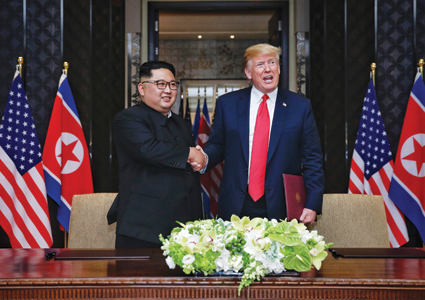
Trump and Kim Jong-un at their historic summit in Singapore: Declaring victories is easier than achieving them (©Kevin Lim / The Straits Times / Handout/Anadolu Agency/Getty Images)
First, we must understand how they interact with one another generically. This requires grasping why the American people’s dissatisfaction with foreign policy had reached a critical point by the 2016 election, and how Trump incorporated that dissatisfaction in his campaign.
Prior to running for President, Trump viewed international affairs with the not-so attentive, ordinary patriotism of ordinary Americans. That view has been at odds with official US policy for most of the past 100 years. During the past quarter-century, all of the foreign policy establishment’s constituent parts have become increasingly unpopular — each for its own reasons — so that, by 2016, US foreign policy had no constituency outside the establishment.
Ordinary Americans’ approach to foreign affairs has remained remarkably steady since the country’s founding: America and its way of life are uniquely precious. The oceans to the east and west, as well as non-threatening neighbours north and south, offer Americans the chance to live peacefully and productively in what Benjamin Franklin called “the land of labour”. The Declaration of Independence aimed to secure neither more nor less than a “separate and equal station” among the powers of the earth. To that end, American diplomats are to give no offence and to suffer none, while the US armed forces — the Navy foremost — are to keep danger far away. America has interests all over the world, which coincide with those of others occasionally. But they are never identical. Hence, America is to mind its own business, aggressively, while steering clear of others’ business. As John Quincy Adams said, America “enters the lists in no cause but its own”. Bothering no one, Americans will make short, brutal work of whomever bothers them. As General Douglas MacArthur put it: “In war there is no substitute for victory.” But like him, the few major figures who have championed this point of view in the past hundred years — Henry Cabot Lodge, Robert Taft, Jr., and Barry Goldwater — have been damned at once as isolationists and warmongers.
The writings of America’s most prominent theorists and practitioners of foreign affairs (Ronald Reagan excepted — “We win, they lose”) are replete with scorn for the popular approach. Nor does this approach describe US foreign policy since 1917, guided as it has been by an unbroken, bipartisan line of great names that links the turn-of-the-20th-century Progressive movement to our time. Elihu Root, who became Secretary of War in 1899 and of State in 1904, taught Charles Evans Hughes, the Secretary of State responsible for the Washington Treaties of 1921, and mentored Henry L. Stimson, who followed him and who ended his career as Secretary of War in 1941-45. He in turn mentored McGeorge Bundy, John F. Kennedy’s National Security Adviser, who mentored Anthony Lake, who did that for Bill Clinton after having served Henry Kissinger, and who advised Barack Obama. Another chain stretches from Woodrow Wilson to Cordell Hull, America’s longest-serving Secretary of State, to Franklin Roosevelt, Dean Acheson, John Foster Dulles, Arthur Schlesinger Jr, and George Shultz.
Trump and Kim Jong-un at their historic summit in Singapore: Declaring victories is easier than achieving them (©Kevin Lim / The Straits Times / Handout/Anadolu Agency/Getty Images)
First, we must understand how they interact with one another generically. This requires grasping why the American people’s dissatisfaction with foreign policy had reached a critical point by the 2016 election, and how Trump incorporated that dissatisfaction in his campaign.
Prior to running for President, Trump viewed international affairs with the not-so attentive, ordinary patriotism of ordinary Americans. That view has been at odds with official US policy for most of the past 100 years. During the past quarter-century, all of the foreign policy establishment’s constituent parts have become increasingly unpopular — each for its own reasons — so that, by 2016, US foreign policy had no constituency outside the establishment.
Ordinary Americans’ approach to foreign affairs has remained remarkably steady since the country’s founding: America and its way of life are uniquely precious. The oceans to the east and west, as well as non-threatening neighbours north and south, offer Americans the chance to live peacefully and productively in what Benjamin Franklin called “the land of labour”. The Declaration of Independence aimed to secure neither more nor less than a “separate and equal station” among the powers of the earth. To that end, American diplomats are to give no offence and to suffer none, while the US armed forces — the Navy foremost — are to keep danger far away. America has interests all over the world, which coincide with those of others occasionally. But they are never identical. Hence, America is to mind its own business, aggressively, while steering clear of others’ business. As John Quincy Adams said, America “enters the lists in no cause but its own”. Bothering no one, Americans will make short, brutal work of whomever bothers them. As General Douglas MacArthur put it: “In war there is no substitute for victory.” But like him, the few major figures who have championed this point of view in the past hundred years — Henry Cabot Lodge, Robert Taft, Jr., and Barry Goldwater — have been damned at once as isolationists and warmongers.
The writings of America’s most prominent theorists and practitioners of foreign affairs (Ronald Reagan excepted — “We win, they lose”) are replete with scorn for the popular approach. Nor does this approach describe US foreign policy since 1917, guided as it has been by an unbroken, bipartisan line of great names that links the turn-of-the-20th-century Progressive movement to our time. Elihu Root, who became Secretary of War in 1899 and of State in 1904, taught Charles Evans Hughes, the Secretary of State responsible for the Washington Treaties of 1921, and mentored Henry L. Stimson, who followed him and who ended his career as Secretary of War in 1941-45. He in turn mentored McGeorge Bundy, John F. Kennedy’s National Security Adviser, who mentored Anthony Lake, who did that for Bill Clinton after having served Henry Kissinger, and who advised Barack Obama. Another chain stretches from Woodrow Wilson to Cordell Hull, America’s longest-serving Secretary of State, to Franklin Roosevelt, Dean Acheson, John Foster Dulles, Arthur Schlesinger Jr, and George Shultz.
Like this article? Share, save or print using the icons below:


More Features
- The inevitability of Fortress Europe
- Why the World Cup is a game of tribes
- Why Israel needs its new nation-state law
- The devout sceptic: hope for those of little faith
- After Draghi departs, eurozone deluge looms
- The poor need the rich to always be with us
- Is the mental illness epidemic just a myth?
- No need to sell your oil shares just yet
- Can Macron wear the General's uniform?
- Trump prefers energy dominance to Paris
- A spectre haunting Europe: Karl Marx
- The battle for British Muslims' integration
- Did Winnie's crimes open Nelson's eyes?
- Belated revenge of the 1968 generation
- Jean-Paul Sartre: the supernova of the far Left
- Presidents for life Putin and Xi menace the West
- Nation states could save the Middle East
- The Trump Presidency is bigger than the man
- Great power politics means greater dangers
- The new project fear shames Whitehall
Popular Standpoint topics

- Cyril Ramaphosa's poisoned chalice
- Is South Africa about to fall apart?
- The onslaught against the West's moral codes
- Technology menaces childhood and culture
- Will the genius of the common law survive?
- Presidents for life Putin and Xi menace the West
- How Monet created motion pictures
- Is the mental illness epidemic just a myth?
9:08 AM
9:07 AM