



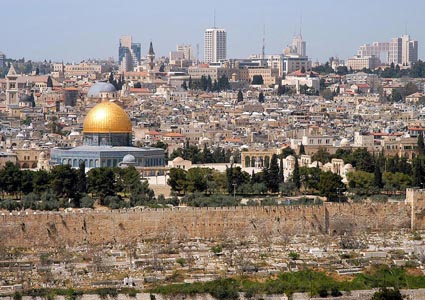
Irreconcileable differences: Jerusalem has become no less holy to either side
President Obama's latest attempt to cajole Israel and the Palestinian Authority into reaching a historic peace accord has floundered. Predictably, the blame game has now begun. Adding a new twist to the familiar script of failure in Middle East diplomacy, this time the US administration has chosen to join its European allies' instinctive reaction of pointing the finger at Jerusalem, while Israel has publicly blamed the US Secretary of State John Kerry.
Each attempt no doubt has its peculiar qualities — the usual mixture of bad timing, clash of personalities and outside imponderables that make each round of failed peacemaking the stuff of lectures, essays, memoirs and recriminations.
Yet they all have much in common. For once one has replaced names or dates — US special envoy Martin Indyk for George Mitchell, 2008 for 2014 — the dynamics, stumbling blocks and predictable negative outcomes are the same.
Western diplomats, who seem keener than anyone else involved — Israelis and Palestinians included — to bring an end to this conflict, should ask the reason why. Why does peace remain elusive?
After all, it is these same diplomats who have insisted for more than 20 years that the contours of a peace deal are known to all and that the two sides always get to a point where they are "closer to a deal than ever before", as John Kerry optimistically said last December, echoing Ehud Olmert's almost identical statement in July 2008.
Funny, we are always so close, but we never get there. And that is part of the problem.
After 20 years of trying to find the perfect point of equilibrium in a complex algorithm of territorial, identity, and religious and material claims, it should be obvious that the peace-process formula has the wrong ingredients. Scientists would readily understand that repeating the same experiment over and over again without changing its elements or their quantities will always yield the same result.
Diplomats seem to miss this point. It is easier to blame "the extremists on both sides" or the craven pressure groups lurking in the shadows; the evils of nationalism or the perils of a fractious coalition; the shadows of the past or the narrative of the victor. Every time, something stands in the way whose nefarious influence could be removed or mitigated if only x, y or z were altered.
Europeans are fond of blaming America's presumed bias towards Israel, forgetting, conveniently, that their lukewarm, fair-weather friendship for Israel can never replace American security guarantees. The liberal commentariat loves to go after Israeli hawks — it gives them a chance to let off their subconscious anti-Semitism by variously relabelling the object of their hatred with such anodyne terms as "the Israel lobby", "neocons" and "settlers", while downplaying terrorism, Islamic radicalism and the Arab world's internal dynamics.
The BBC can wash its hands of the obligation to represent a complex story fairly, by embracing the morally neutered terminology of "bystanderism", whereby fault lies with "the extremists on both sides" and other such invented "blame-both-sides" categories that only inhabit the moral equivalence of a liberal newsroom's world.
Nobody, on the other hand, seems to have grasped the obvious, because it is unpalatable and inconvenient, especially to those who have spent a lifetime believing in Middle East peace both as an end in itself and a panacea for other problems. There is no deal because the cost of peacemaking far outweighs its benefits for either side.
After all, consider this. For Israelis and Palestinians alike the stumbling blocks, over the years, remain the same. The Palestinian demand for refugees to be granted a right of return, the Israeli demand for Palestinians to recognise Israel as a Jewish state and their mutually exclusive demands over sovereignty in Jerusalem are unlikely to change, because if compromised they would irreparably damage the core components of the national identity of each side.
Israel is unlikely to relinquish the strategic depth afforded by territorial control over the Jordan Valley and provided by the West Bank in exchange for vague international guarantees. Palestinian nationalism cannot leave behind, at least notionally, the millions of descendants of refugees who escaped the 1948 war, yet it is doubtful that it could accommodate them physically in a territory as small as the West Bank and Gaza and financially in an economy as tiny as the Palestinian one. And though Israel's enemies would love to impose such an outcome, Israel is unlikely to commit national suicide.
As if this were not enough, past failures and regional developments compound the problem. Why should either side trust their negotiating partner when each previous attempt collapsed? What has changed to make it better?
Are the Palestinians less determined on resettling refugees? Have they renounced delegitimising Israel? Have settlements shrunk in size and demography? Are their inhabitants streaming back to pre-1967 Israel? Has Islam declared Jerusalem no longer holy? Has Judaism forgotten it? And how can Israel negotiate a final deal with the Palestinian Authority while Gaza remains under Hamas rule? Why should Israel take "risks for peace" when the entire region is in turmoil? Who can believe that a Palestinian government which signs a peace deal will survive long enough to make it stick, given the Islamic resurgence currently shaking the Arab world?
The Arab-Israeli conflict defies solution. It has always done so. It will continue to do so in the near future. Trying once more what failed before is doomed to beget more failure.
It is time the West recognised that the differences between the two sides are irreconcilable — and the sooner the better.
Like this article? Share, save or print using the icons below:


- Empty Seats At The Met
- Labour's Antisemitism Problem
- Why Only Countries Willing To Take Risks Will Survive And Prosper
- Did Burke Betray The Cause Of Liberty?
- Culture And Politics In The Age Of Trumpery
- The Spectre Of Mayor Khan's Islamist London
- Islam and the French Republic
- Rediscovering The Point Of Language
5:05 PM
4:05 PM
2:05 PM
10:05 PM
6:05 PM