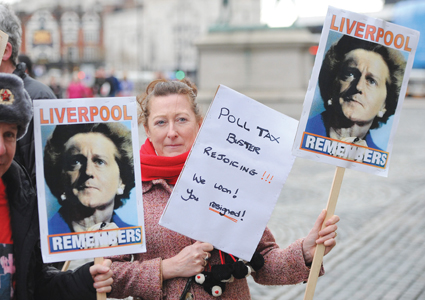
 Unforgiving: Protestors in Liverpool celebrate the death of Lady Thatcher, who was blamed for the city's industrial decline
Glance at a constituency map of England and things don't look too bad for the Conservatives. Pockets of red and flecks of yellow interrupt an overwhelmingly blue country. Adjust the map to take account of demography as well as geography, however, and the Conservative Party's northern problem comes into sharp focus.
In 2010, just 31 per cent of northerners voted Conservative compared to 43 per cent across England. Of 158 seats in the three northern regions— the north west, the north east and Yorkshire Humber — just 43 are Conservative, fewer than after the Labour landslides of 1945 and 1966. Significantly, the political gap between north and south is not merely a reflection of economic difference. The north's economy lags behind the south's, but the political gap is wider still. Polling done by YouGov in 2012 for the think-tank Policy Exchange extracts the essence of the Conservatives' northern woes. It found that a middle-class northerner is less likely to vote Conservative than a working-class southerner and that an unskilled southerner is more likely to vote Conservative than professionals and managers in the north. The problem, then, is a cultural one.
The different strategies adopted by UKIP in each region further illustrates the north-south political divide. In last month's by-election in Wythenshawe and Sale East, near Manchester, UKIP campaigned to take votes from Labour rather than the Conservatives, beating the latter into third place. "Labour politicians try to portray themselves as ordinary people but . . . they are an elite political club of millionaires who have lost touch with the working-class voters of Wythenshawe and Sale East," read one UKIP leaflet that was notable for its lack of the party's gold and purple colours. This is a far cry from the southern image of UKIP as a middle-class protest party led by a Barbour-clad retired stockbroker.
Most of those 43 northern Conservative MPs represent rural areas. There are some with seats in the North's more affluent suburbs — the Employment Minister Esther McVey in the Wirral Valley and the Chancellor of the Exchequer, George Osborne in Tatton, near Manchester, for example — but not as many as there should be. If it's grim up north for the Tories, things are particularly grim in the north's cities. There are 348 councillors on the city councils of Liverpool, Newcastle, Manchester and Sheffield; not one of them is a Conservative. These cities have not returned a Conservative MP for a generation.
Nowhere has the party's northern decline been more rapid than in Liverpool. Hard as it is to believe, Liverpool was a predominantly Conservative city until the 1960s. This was in part because of the city's religious divide: Catholics voted Labour or Liberal, Protestants voted Conservative. The city returned a majority of Labour MPs for the first time in 1964. When Liverpool's docks declined in the 1970s due to the shift of British trade away from the Commonwealth and towards Europe, the Tories were blamed, especially under Mrs Thatcher. Despite Michael Heseltine's much-publicised urban renewal programme, the last Conservative MP in the city lost his seat in 1983. By 2010, four of the six safest Labour seats in the country were in Liverpool. Steve Rotherham won a whopping 72 per cent of the vote in Liverpool Walton in 2010, the highest share of the vote won by any MP that year.
Andrew Garnett, 42, stood for the Conservatives in Liverpool Wavertree at the last general election. He won just 7.5 per cent of the vote and came third. He told me Liverpudlians blame the Tories for the city's decline and are not ready to forgive them. "People would take leaflets from me if they were emblazoned with something about the NHS or the police but when they realised it was from the Tories, they'd throw it on the floor in disgust. That was it. Whatever you said next would fall on deaf ears."
The son of a dockworker and grandson of an "ardent trade unionist", Garnett says he realised he was a Conservative in 1985 "when the Labour Party had led the city into a situation where they couldn't even pay their teachers". He joined the Young Conservatives and says he "was thought of as being very odd, very, very strange. It's pretty odd to join a political party generally but there was a social cost to being a teenage Tory in Liverpool in the Eighties."
How can the Tories make electoral inroads in a city where being a Conservative does not just put you in a minority but makes you seem weird? How to make a city trust your party again when, 32 years ago, a Conservative chancellor recommended it be left to "managed decline"?
Tony Caldeira, 43, has decided to look for answers to these questions. The Conservative candidate in Liverpool's 2012 mayoral election, he runs Britain's largest cushion manufacturer, a business he started on a market stall in the city two decades ago. He's an optimist, probably a prerequisite for being Liverpool's foremost Tory. "We're enjoying a mini-revival here," he tells me as we sit in a pub on a road off Church Street, the city's shopping hub, watching Liverpool — Caldeira is "fanatical" about the team — beat Bournemouth in the FA cup. At the last general election, 116,285 Liverpudlians voted Labour and just 19,553 voted Conservative. This, to the outsider, would seem a fairly measly showing.
Caldeira, however, says he was encouraged by the party's performance. He points out that they increased their vote by 50 per cent across Merseyside, albeit from a very low base, and, says Conservative campaign headquarters, are looking to learn from this relative success, "replicating what we have done in other cities". Caldeira came seventh in the mayoral contest with 4.5 per cent of the vote. He blames a strong independent candidate and the timing of the municipal election, in the wake of the politically catastrophic 2012 "pasty-tax" Budget, for this blip.
But the party's modest revival in the city should not be measured simply in terms of ballot-box success. Five years ago, the Conservatives were not even part of the local political debate. The Liverpool Echo — a "very red top" according to Caldeira — didn't bother to ask the party for comment, while debates on BBC Merseyside tended to be between Labour and the Liberal Democrats. Now Caldeira appears on local radio regularly. "The mood is much more conciliatory," he says. "People say the guy with the cushions has got a point." Of course, the city's media is consumed not only by city constituents but commuters from more rural seats too. There are nine marginal seats along the Mersey where the Echo is read and BBC Merseyside is listened to. The message for the Conservatives is clear: they cannot hope to do better in the north without re-establishing themselves in cities like Liverpool, whose sphere of influence extends past their borders.
Parts of Liverpool remain poor. Toxteth, an area south of the city centre containing street after street of derelict terraced housing, is one of the most deprived parts of Britain. But Liverpool's economy is sturdier than it once was. In the recession, unemployment in the city peaked at 7 per cent. That number was as high as 20 per cent in the 1980s. According to the Centre for Cities annual Cities Outlook report, published in January, Liverpool created twice as many jobs in the private sector as it lost in the public sector between 2010 and 2012. In 2012 Liverpool's economy grew by 3.2 per cent, faster than the economy as a whole.
The worry is that the party that took the blame for the city's past economic woes is not getting credit for recent good news. Michael Heseltine, who was awarded the freedom of the city in 2012, is credited by Liverpudlians with kick-starting the city's revival. When he came to Liverpool, the derelict Albert Dock stood as an awkward reminder of the city's industrial decline. Thanks to the "minister for Merseyside", the docks have been redeveloped and house, among other things, Tate Liverpool. (The Labour-run council wanted to knock them down.) Yet little of the praise Lord Heseltine has received has rubbed off on his party.
Andrew Garnett recalls campaigning in rundown parts of the city in 2010. "Part of it is tribal," he says. "People would say ‘We're a Labour family. I vote Labour because my granddad voted Labour.' Others would say ‘At least Labour are trying. The Tories don't try.' How do you cut through that?"
Tellingly, Liverpool Conservatives are a youthful bunch. "Scousers have long memories," says Caldeira. But for a few pensioners, he is the oldest person in the Liverpool Conservatives. "People in their twenties and early thirties dominate the party up here," he says. The chairman of Liverpool Conservatives, Hannah Withey, is in her thirties and at the time of the last general election, Liverpool's Young Conservatives were the fastest growing branch of the party's youth organisation. A lot of these recruits were students from elsewhere studying in Liverpool, but there was a sizeable local contingent too. While the youthfulness of Liverpool's Conservatives is an indictment of the party's history there, it is also an opportunity for future electoral success.
Chris Kerr, an undergraduate at the London School of Economics and deputy chairman of Liverpool Conservatives, tells me it is easier to be a young Conservative today than it was for the likes of Garnett. Why, I ask Kerr, does he think more young Scousers are voting Conservative? "I think people see them as the party of aspiration. Very few people in the city who are my age have a real problem with the Tories — we are a generation that isn't scarred by the Thatcher years."
Promising to fix the party's northern problem has become de rigeur for a new Conservative leader. In 1997, William Hague announced that there would be "no no-go" areas for Conservatives; Cameron did the same in 2005. Yet this promise is made with little appreciation of how steep a climb the party faces in places like Liverpool. Garnett describes the challenge as "Everest-like" in complexity. Tempting as it will be for the Conservatives to divert resources elsewhere as next year's election draws closer, they should not ignore the north's cities. Dismal performance there spills over into important marginals.
At present, Labour's poor showing in the south cancels out the Conservative's northern problem. But the south's aversion to Labour is not as deep-seated as anti-Tory sentiment in the north. Tony Blair's electoral success was proof of that. His victory in 1997 was so emphatic that seats thought to be comfortably Conservative returned Labour MPs and some have never reverted. What ended with success for Labour in affluent places like Hove began with the prawn-cocktail offensive; the city schmoozing paid off, Labour regained economic credibility and southern voters eventually warmed to them. George Osborne, who is also the Tories' election strategist, calls Blair "the master" and listens to an audio book of his memoirs, A Journey, on his jogs around St James's Park. He should seek to do in the north what Blair did in the south. Labour needed a prawn-cocktail offensive; the Conservatives need a chips-and-gravy strategy.
A truly one-nation party cannot write off cities like Liverpool. A party that seeks to govern the country as a whole must persuade northern voters, urban and rural, that it has their interests at heart. If the Tories can do that, a parliamentary majority could be theirs for the first time in decades.