Scottish independence is a solution in search of a problem. Rather than the cogent conclusion of a rigorous analysis of particular woes afflicting the Scottish people, it's an article of faith. That's why its supporters struggle to make a clear profit out of the empirical data, why they are wont to distort history, and why they so often react to criticism by tackling the man and not the ball.
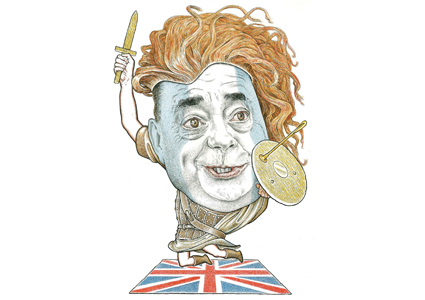
The nationalists have over-simplified history and let anti-English resentment fester (illustration by Michael Daley)
It's also why the latest policies of the separatists — to keep the Queen, the pound, and membership of Nato — are so opportunistic. None of this will surprise readers of David Torrance's biography of SNP leader Alex Salmond, Salmond: Against the Odds (Birlinn, £20), in which a former colleague observes: "When you went through all the arguments you were left with the impression that he didn't know if Scotland would be better or worse off as an independent country. All that mattered was that Scots should rule themselves."
There could be a problem, of course. Membership of the United Kingdom's multinational state could have inflicted some grave and chronic injustice on Scotland, for which remedy had long been sought but never found. The Scots could have been under-represented at Westminster. Their legitimate concerns could have been seriously neglected and their needs unfairly met. Their culture could have been suppressed.
But none of this is so. Since the Scottish Parliament was established in 1999, the Scots have enjoyed representation both in Edinburgh and in London. Indeed, Scottish MPs vote on matters that concern other parts of the UK, whereas the representatives of those other parts cannot vote on matters devolved to Edinburgh. Scots receive more public spending per capita than the English, and whatever strikes visitors to Edinburgh and Glasgow it is not a lack of cultural vitality.
How, then, do members of the Yes campaign in the run-up to September's referendum on independence try to justify their support for it? What stories do they tell to make their visceral conviction plausible? Their strongest tale is that the Scots prefer a left-of-centre, social democratic polity with a more generous welfare state, whereas, judging by its propensity to elect Conservative governments, the English electorate's centre of gravity is markedly farther to the right and more favourable to the free market. As a consequence, the Scots' legitimate aspiration for a fairer, more equal society has been consistently stymied by a neoliberal Westminster.
If this were true, it would certainly be a reason for greater Scottish autonomy and a further devolution of powers from Westminster to Edinburgh, although not necessarily for outright secession from the UK. As it happens, however, the narrative of nationalist politicians doesn't tally with the hard evidence of the social scientific data. According to analysis of the British Social Attitudes survey of 2010:
. . . it seems that Scotland is not so different after all. Scotland is somewhat more social democratic than England. However, for the most part the difference is one of degree rather than of kind — and is no larger now than it was a decade ago. Moreover, Scotland appears to have experienced something of a drift away from a social democratic outlook during the course of the past decade, in tandem with public opinion in England.
From this the authors — including the doyen of Scottish psephologists, John Curtice — conclude that "the task of accommodating the policy preferences of people in both England and in Scotland within the framework of the Union is no more difficult now than it was when devolution was first introduced". Awkwardly for the Yes campaign the late Stephen Maxwell, nationalist intellectual and founder of the modern SNP, agreed, writing shortly before his death in 2012 that there is "nothing in Scotland's recent political record to suggest a pent-up demand for radical social and economic change waiting to be released by independence". The fact that the current nationalist government in Edinburgh has declined to use the Scottish Parliament's existing power to raise the rate of income tax, so as to increase funding for public services, suggests that they know that Maxwell spoke the truth.
Beyond the spurious assertion of a major difference in political preferences between Scotland and England, another plank in the Yes campaign's platform comprises the claims that membership of the UK inhibits Scotland's economic growth and that an independent Scotland's standard of living would be higher. Here Scottish nationalists descend to the not-so-noble level of their Catalan and Lombard equivalents in adopting a regionally egocentric, pounds-and-pence rationale for independence. In Scotland's case, the claims depend for their truth upon a number of variable and (in the crucial matter of the price of oil) volatile factors. They are also highly speculative and fiercely contested. As we have seen over the past 12 months, the economic debate goes back and forth and appears quite finely balanced. The very least that can be said is that it isn't certain that independence would make the Scots better off economically, that there is no reason at all to be confident that it would make them dramatically wealthier, and that there is considerable reason to suppose that it would actually make them poorer.
If tales about higher political ideals and greater wealth are planks too weak to bear the weight of the Yes campaign, then what stronger alternatives might there be? One recurring theme in nationalist talk is the vision of a Scottish future purified of the taint of oppressive empire and of aggressive foreign policy. Thus Alex Salmond has written of Scottish independence as a happy surrender of Britain's post-imperial delusion about global influence, and in his 2012 visit to Dublin he tried to dissociate the Scots from empire's agents and align them with its victims, claiming that the people of Ireland would know that "bullying and hectoring the Scottish people from London ain't going to work". (His opportunistic misreading of history was rebuked by Seamus Mallon, former leader of Northern Ireland's moderate Irish nationalist party, the SDLP, who gently reminded Salmond that the Scots had been among the perpetrators of British bullying in Ireland.)
This anti-imperialist rationale for Scottish independence has achieved greater sophistication in a recent book by the Glasgow churchman, academic and Yes campaigner, Doug Gay. In Honey from the Lion: Christianity and the Ethics of Nationalism (SCM Press, £19.99), Gay reads Scotland's history in the 19th century as a tale of normal national development arrested by greed for the economic benefits and political power of the British Empire. Correspondingly, secession from the UK would be a morally purifying act of repentance from imperialist sin. For this reason Gay reckons that "the question of defence displays the contrast between unionism and independence like no other issue". As he and other Scottish post-colonialists see it, British identity is essentially bound up with empire, and empire is by definition culturally oppressive and politically aggressive — as is confirmed by Britain's continuing tendency to involve itself in American military interventions overseas. Independence, therefore, would mean Scotland's penitent withdrawal from the role of imperialist global policeman; and if it would also force Britain's early retirement from that role and the loss of its permanent seat on the UN Security Council, then that would be good for the rest of the UK.
This moralistic reading of imperial history and international relations is facile. Of course it's true that the imperial British were usually convinced of the moral superiority of their own culture — which is sufficient to damn them in the eyes of multiculturalist Yes campaigners. But I doubt that many multiculturalists approve of cultural customs and social institutions such as female genital mutilation, forced marriage, honour killing, the self-immolation of widows or slavery. In those cases, they presume to stand in moral judgment upon cultures that do. Then arises the question of whether or not to tolerate such appalling practices in one's own national community. I wouldn't tolerate them in Britain, and I very much doubt that self-styled "progressive" nationalists would tolerate them in an independent Scotland. If so, the further question arises of why we should tolerate among others what we will not tolerate among ourselves. This is a morally complex matter, but if the decision to intervene is a morally fraught one, then so is the decision to turn a blind eye. Christian and liberal imperialists sometimes decided to take the risks of intervening and I, for one, admire them for it. Ideological multiculturalists and anti-capitalists might want to repent of David Livingstone's Scottish efforts to encourage the production of cash crops in central Africa. Others, however, will be proud of him, when they learn that his motive was to enable the Africans to trade in something other than slaves. Yes, the British Empire presided over the infamous massacre at Amritsar in 1919 and the outrages of the Black and Tans in Ireland in 1920-22; but it also pioneered the suppression of the slave trade in the 19th century and was the only opponent of fascism in the field from May 1940 until June 1941. The existence of the Commonwealth is evidence that the empire's historical record was not simply execrable. Rather, it was morally mixed — as was Scotland's before the Union and as it would be after it.
If tales about higher political ideals and greater wealth are planks too weak to bear the weight of the Yes campaign, then what stronger alternatives might there be? One recurring theme in nationalist talk is the vision of a Scottish future purified of the taint of oppressive empire and of aggressive foreign policy. Thus Alex Salmond has written of Scottish independence as a happy surrender of Britain's post-imperial delusion about global influence, and in his 2012 visit to Dublin he tried to dissociate the Scots from empire's agents and align them with its victims, claiming that the people of Ireland would know that "bullying and hectoring the Scottish people from London ain't going to work". (His opportunistic misreading of history was rebuked by Seamus Mallon, former leader of Northern Ireland's moderate Irish nationalist party, the SDLP, who gently reminded Salmond that the Scots had been among the perpetrators of British bullying in Ireland.)
This anti-imperialist rationale for Scottish independence has achieved greater sophistication in a recent book by the Glasgow churchman, academic and Yes campaigner, Doug Gay. In Honey from the Lion: Christianity and the Ethics of Nationalism (SCM Press, £19.99), Gay reads Scotland's history in the 19th century as a tale of normal national development arrested by greed for the economic benefits and political power of the British Empire. Correspondingly, secession from the UK would be a morally purifying act of repentance from imperialist sin. For this reason Gay reckons that "the question of defence displays the contrast between unionism and independence like no other issue". As he and other Scottish post-colonialists see it, British identity is essentially bound up with empire, and empire is by definition culturally oppressive and politically aggressive — as is confirmed by Britain's continuing tendency to involve itself in American military interventions overseas. Independence, therefore, would mean Scotland's penitent withdrawal from the role of imperialist global policeman; and if it would also force Britain's early retirement from that role and the loss of its permanent seat on the UN Security Council, then that would be good for the rest of the UK.
This moralistic reading of imperial history and international relations is facile. Of course it's true that the imperial British were usually convinced of the moral superiority of their own culture — which is sufficient to damn them in the eyes of multiculturalist Yes campaigners. But I doubt that many multiculturalists approve of cultural customs and social institutions such as female genital mutilation, forced marriage, honour killing, the self-immolation of widows or slavery. In those cases, they presume to stand in moral judgment upon cultures that do. Then arises the question of whether or not to tolerate such appalling practices in one's own national community. I wouldn't tolerate them in Britain, and I very much doubt that self-styled "progressive" nationalists would tolerate them in an independent Scotland. If so, the further question arises of why we should tolerate among others what we will not tolerate among ourselves. This is a morally complex matter, but if the decision to intervene is a morally fraught one, then so is the decision to turn a blind eye. Christian and liberal imperialists sometimes decided to take the risks of intervening and I, for one, admire them for it. Ideological multiculturalists and anti-capitalists might want to repent of David Livingstone's Scottish efforts to encourage the production of cash crops in central Africa. Others, however, will be proud of him, when they learn that his motive was to enable the Africans to trade in something other than slaves. Yes, the British Empire presided over the infamous massacre at Amritsar in 1919 and the outrages of the Black and Tans in Ireland in 1920-22; but it also pioneered the suppression of the slave trade in the 19th century and was the only opponent of fascism in the field from May 1940 until June 1941. The existence of the Commonwealth is evidence that the empire's historical record was not simply execrable. Rather, it was morally mixed — as was Scotland's before the Union and as it would be after it.
As with the imperial past, so with present global policing: nationalists like Gay would be happy to see Scotland (and England) withdraw from it. What is not clear is whether they think that it doesn't need doing or that others would do it better. Unless they have bought entirely into a sunny Enlightenment view of human beings, they will acknowledge that malevolent leaders can sometimes move nation states (like empires) to do atrocious things. And unless they are pacifist, they will also acknowledge that sometimes atrocious things must be stopped by force. Perhaps they think that the UN should do the policing — but the UN has only as many regiments as nation states choose to loan it. No doubt an independent Scotland, like Ireland, would lend its modest troops for peacekeeping purposes. But who, then, would fight the wars to make the just peace to be kept? Perhaps it is not that Gay wants the United States and the UK to stop making war altogether, but rather that he wants them to make it only when authorised by the UN. If so, he would be content for the enforcement capacity of the UN to be at the mercy of the threat of veto by Putin's Russia and Communist Party-run China, neither of whose records of humanitarian concern are exactly enviable. He would also join Alex Salmond in condemning Nato's 1999 military intervention to end ethnic cleansing in Kosovo as a "misguided" policy of "dubious legality and unpardonable folly". Embarrassingly, however, the result would be to align Scottish nationalism against former UN Secretary-General, Kofi Annan, and most contemporary international lawyers, who view Nato's action as at once illegal but morally legitimate.
The irony here — and it's a damning one — is that the issue that is supposed to make the rationale for Scottish independence clearest is one to which Gay has evidently given little serious thought. And this is symptomatic of Scottish nationalism more generally. David Torrance observes of Salmond that he has "no obvious interest in the world beyond Scotland". And Stuart Crawford, army officer and former SNP candidate, has commented that "the SNP hasn't got a foreign policy apart from being nice to everybody". Notwithstanding smug claims to morally superior internationalism, Scottish separatism actually suffers from marked narcissistic tendencies.
The sense of Scottish independence as an article of faith in search of sufficient reason deepens. What other options remain? As Alex Salmond's Dublin speech shows, anti-imperialism can be turned to more than one nationalist use. On the one hand, we're told, British empire is an enterprise from which the Scots should repent; on the other hand, English empire is an oppression from which they should liberate themselves. Here the Scots get to swap the role of perpetrator for that of victim. Thus Doug Gay represents the post-colonial school of Scottish nationalists, when he draws on Frantz Fanon's ideology of "inferiority complex", whereby the colonised internalise an image of themselves as inferior to the coloniser, to explain the psycho-social costs of being a minority partner within the Union. As empirical examples of "colonising" behaviour by the English he lists the tendency to speak of "England" when Britain or the UK is meant, the naming of the UK central bank as the Bank of England, the complacent domination of coronation rituals and House of Lords representation by the Church of England, the designation of Queen Elizabeth as the Second, and the appropriation of "God Save the Queen" and the Union flag by English sporting teams.
It is true that Scotland has always had to fight for its status as an equal partner in a Union where it usually lies in the shadow of its larger and more powerful neighbour. To some extent, the Scottish experience of being regularly overlooked is but an instance of the perennial plight of small countries adjacent to larger neighbours: we can be sure that Berlin would have less political reason to pay attention to an independent Scotland than London now does to (a semi-independent) North Britain. Nevertheless, English obliviousness is slighting and hurtful even when inadvertent; and if English people think Scottish irritation overblown, that is only because they have not had to listen to themselves being habitually written out of the story. The English do have something to repent of here, and I hope that the current debate about Scottish independence will have the beneficial effect of inducing English institutions to make some appropriate and generous adjustments. In particular, I hope that my own (and Alex Salmond's) Church of England will make a point of going far beyond the call of duty in supporting the Church of Scotland's formal representation in a reformed House of Lords, and in ceding sole ecclesiastical control of the next coronation service. Symbols and gestures of acknowledgement really do matter.
The irony here — and it's a damning one — is that the issue that is supposed to make the rationale for Scottish independence clearest is one to which Gay has evidently given little serious thought. And this is symptomatic of Scottish nationalism more generally. David Torrance observes of Salmond that he has "no obvious interest in the world beyond Scotland". And Stuart Crawford, army officer and former SNP candidate, has commented that "the SNP hasn't got a foreign policy apart from being nice to everybody". Notwithstanding smug claims to morally superior internationalism, Scottish separatism actually suffers from marked narcissistic tendencies.
The sense of Scottish independence as an article of faith in search of sufficient reason deepens. What other options remain? As Alex Salmond's Dublin speech shows, anti-imperialism can be turned to more than one nationalist use. On the one hand, we're told, British empire is an enterprise from which the Scots should repent; on the other hand, English empire is an oppression from which they should liberate themselves. Here the Scots get to swap the role of perpetrator for that of victim. Thus Doug Gay represents the post-colonial school of Scottish nationalists, when he draws on Frantz Fanon's ideology of "inferiority complex", whereby the colonised internalise an image of themselves as inferior to the coloniser, to explain the psycho-social costs of being a minority partner within the Union. As empirical examples of "colonising" behaviour by the English he lists the tendency to speak of "England" when Britain or the UK is meant, the naming of the UK central bank as the Bank of England, the complacent domination of coronation rituals and House of Lords representation by the Church of England, the designation of Queen Elizabeth as the Second, and the appropriation of "God Save the Queen" and the Union flag by English sporting teams.
It is true that Scotland has always had to fight for its status as an equal partner in a Union where it usually lies in the shadow of its larger and more powerful neighbour. To some extent, the Scottish experience of being regularly overlooked is but an instance of the perennial plight of small countries adjacent to larger neighbours: we can be sure that Berlin would have less political reason to pay attention to an independent Scotland than London now does to (a semi-independent) North Britain. Nevertheless, English obliviousness is slighting and hurtful even when inadvertent; and if English people think Scottish irritation overblown, that is only because they have not had to listen to themselves being habitually written out of the story. The English do have something to repent of here, and I hope that the current debate about Scottish independence will have the beneficial effect of inducing English institutions to make some appropriate and generous adjustments. In particular, I hope that my own (and Alex Salmond's) Church of England will make a point of going far beyond the call of duty in supporting the Church of Scotland's formal representation in a reformed House of Lords, and in ceding sole ecclesiastical control of the next coronation service. Symbols and gestures of acknowledgement really do matter.
That said, there is evidence that the Union is not necessarily harmful to Scottish self-esteem. As nationalists themselves admit, Scotland has enjoyed a significant measure of cultural renaissance in literature and music, especially since the Eighties, but with roots reaching back into the Fifties. The significance of this, of course, is that the renewal of cultural self-confidence, which is so obvious to visitors to contemporary Scotland, has taken place within the Union — just as it did in Ireland before the Easter Rising and the War of Independence. In other words, the British connection has evidently been host, not hostile, to a revival of Scotland's cultural vitality.
What is more, if the English have something to repent of, so do Scottish nationalists. Victims, too, have a responsibility to keep their resentment within the bounds of justice, and not to let it fester and distort and scapegoat. I write from experience. I was born in Kirkcudbrightshire in 1955 and went to a boarding-school near Ayr. There in 1965 I watched the original broadcast of Peter Watkins's classic television docudrama, Culloden, about the military defeat of the last Jacobite rebellion in 1746. Afterwards, I dragged myself up to my dormitory, sobbing, "Why, oh why, do we Scots always lose to the English?" A few years ago I saw Culloden again, and I was shocked to see how very clearly it presents the battle, not at all as a fight between the Scots and the English, but rather as one between, on the one hand, feudal, Catholic, Gaelic-speaking, cattle-rustling Highlanders and, on the other hand, government forces made up of Protestant and English-speaking troops drawn from both sides of the Anglo-Scottish border. At Culloden, my people — the Lowland Scots — had worn redcoats, not kilts. Nevertheless, notwithstanding an English mother, an English-educated father, and a school largely manned by English teachers, ten years of growing up in Scotland had been sufficient to infect me with such an overdose of Scottish victimhood and such a reflexive tendency to scapegoat the English that I just couldn't see what was put before my eyes.
For sure, my experience is almost 50 years old and the leaders of contemporary Scottish nationalism have worked hard, I am told, at making it pro-Scottish rather than anti-English. But only last year a friend of mine, whose cut-glass English accent disguises her Northern Irish parentage, reported the verbal assault of her taxi-driver as they drove past the battlefield of Culloden: "That's where your people slaughtered mine!" These are only anecdotes, of course, but given Alex Salmond's own recent attempt at twisting Irish history to anti-English advantage, it seems that the disease remains widespread, corrupting generals as well as foot-soldiers. Scottish nationalist repentance still has some way to go.
Quite what benefits independence would bring to Scotland remains elusive. There's no certainty that it would make it much wealthier. There's no reason to think that the Scots would use their new-found sovereignty to create a significantly different balance between free enterprise and public provision. They're already enjoying an upsurge in cultural vitality and confidence. And the movement toward a more "Nordic" defence and foreign policy would be a retreat from responsibility in international affairs, where hard power sometimes should be used and someone has to take the risks and bear the costs of using it.
What is more, if the English have something to repent of, so do Scottish nationalists. Victims, too, have a responsibility to keep their resentment within the bounds of justice, and not to let it fester and distort and scapegoat. I write from experience. I was born in Kirkcudbrightshire in 1955 and went to a boarding-school near Ayr. There in 1965 I watched the original broadcast of Peter Watkins's classic television docudrama, Culloden, about the military defeat of the last Jacobite rebellion in 1746. Afterwards, I dragged myself up to my dormitory, sobbing, "Why, oh why, do we Scots always lose to the English?" A few years ago I saw Culloden again, and I was shocked to see how very clearly it presents the battle, not at all as a fight between the Scots and the English, but rather as one between, on the one hand, feudal, Catholic, Gaelic-speaking, cattle-rustling Highlanders and, on the other hand, government forces made up of Protestant and English-speaking troops drawn from both sides of the Anglo-Scottish border. At Culloden, my people — the Lowland Scots — had worn redcoats, not kilts. Nevertheless, notwithstanding an English mother, an English-educated father, and a school largely manned by English teachers, ten years of growing up in Scotland had been sufficient to infect me with such an overdose of Scottish victimhood and such a reflexive tendency to scapegoat the English that I just couldn't see what was put before my eyes.
For sure, my experience is almost 50 years old and the leaders of contemporary Scottish nationalism have worked hard, I am told, at making it pro-Scottish rather than anti-English. But only last year a friend of mine, whose cut-glass English accent disguises her Northern Irish parentage, reported the verbal assault of her taxi-driver as they drove past the battlefield of Culloden: "That's where your people slaughtered mine!" These are only anecdotes, of course, but given Alex Salmond's own recent attempt at twisting Irish history to anti-English advantage, it seems that the disease remains widespread, corrupting generals as well as foot-soldiers. Scottish nationalist repentance still has some way to go.
Quite what benefits independence would bring to Scotland remains elusive. There's no certainty that it would make it much wealthier. There's no reason to think that the Scots would use their new-found sovereignty to create a significantly different balance between free enterprise and public provision. They're already enjoying an upsurge in cultural vitality and confidence. And the movement toward a more "Nordic" defence and foreign policy would be a retreat from responsibility in international affairs, where hard power sometimes should be used and someone has to take the risks and bear the costs of using it.
If supporters of the Yes campaign are deluded about the benefits of independence, they are deliberately negligent of its risks — thus following a trend among separatist movements elsewhere in Europe. Quite apart from the permanent damage to the UK's international prestige and power (which they see as no loss at all), there is the risk of a serious souring of relations between the Scots and the English. Contrary to what the Panglossian separatists pretend, while the Scots alone could choose separation, they alone would not dictate its terms. Nor should they, since theirs would not be the only interests involved. Nor would the interests of an independent Scotland and the remaining UK be identical. It is a practical certainty, therefore, that the separating Scots would not get all that they want, that they would be frustrated, and that their traditional resentment of England would only deepen. Moreover, given recent evidence that the complacent mood in England is changing toward alarm at the prospect of the UK's break-up, it is also likely that English resentment of the Scots would be kindled to a degree we have never seen. Perhaps the mutual alienation would only last a generation or two, perhaps no blood would be shed — but perhaps not. One of the nobler intentions of the Union was precisely to end "the centuries — long struggle" between Scotland and England, and it has been one of its finest achievements to make bloody conflict so unimaginable as to appear impossible. But appearances deceive: imagination is no constraint upon possibility. Contrary to appearances, Anglo-Scottish peace (like European peace) is a fragile historical achievement — not an immortal part of the cosmic furniture. And as we know from the troubles in Northern Ireland, history can roll alarmingly backwards. The process of separation carries real and serious risks, which its supporters recklessly ignore.
What is worse, Yes campaigners deliberately dismiss every doubt and criticism as "negative", subtly slurring them as a slander upon hope. But hope without grounds will certainly disillusion and it could well lead to shipwreck. The claimed benefits of Scottish independence are either doubtful or irresponsible, and the risks (for all of us) are considerable. Only a fool would place his faith in it.
The attractiveness of bold and reckless adventure is exaggerated, of course, by underplaying current advantages — and the benefits of the Union are as easy to overlook as the very ground we stand on. So the first act of Scottish (and English) political wisdom is to recall them with gratitude. The Union has succeeded in putting an end to centuries of Anglo-Scottish blood-letting and it continues to uphold that achievement. It has always allowed the Scots a measure of sovereignty — especially over their Church and their law — and since the creation of the Scottish Parliament in 1999, it has increased that measure and will probably increase it further. It has made its citizens among the most prosperous in the world. Its greater resources provide greater security — from defence through finance to pensions. And its imperial past, for all its moral flaws, has left the United Kingdom with a responsible awareness of the need sometimes to use hard power in the enforcement of international law and order, and so with the integrity not to lean back upon the American shield and then to pretend that it isn't necessary.
But what hope for Scotland within the United Kingdom? Not the false hope of quick, revolutionary fixes. Rather the slow-burning hope of incremental but substantial improvement, once all the intellectual and political energies now squandered on the fool's gold of independence have been refocused on analysing the country's economic, social and political problems and addressing them with all the sovereign powers already in Scottish hands.
What is worse, Yes campaigners deliberately dismiss every doubt and criticism as "negative", subtly slurring them as a slander upon hope. But hope without grounds will certainly disillusion and it could well lead to shipwreck. The claimed benefits of Scottish independence are either doubtful or irresponsible, and the risks (for all of us) are considerable. Only a fool would place his faith in it.
The attractiveness of bold and reckless adventure is exaggerated, of course, by underplaying current advantages — and the benefits of the Union are as easy to overlook as the very ground we stand on. So the first act of Scottish (and English) political wisdom is to recall them with gratitude. The Union has succeeded in putting an end to centuries of Anglo-Scottish blood-letting and it continues to uphold that achievement. It has always allowed the Scots a measure of sovereignty — especially over their Church and their law — and since the creation of the Scottish Parliament in 1999, it has increased that measure and will probably increase it further. It has made its citizens among the most prosperous in the world. Its greater resources provide greater security — from defence through finance to pensions. And its imperial past, for all its moral flaws, has left the United Kingdom with a responsible awareness of the need sometimes to use hard power in the enforcement of international law and order, and so with the integrity not to lean back upon the American shield and then to pretend that it isn't necessary.
But what hope for Scotland within the United Kingdom? Not the false hope of quick, revolutionary fixes. Rather the slow-burning hope of incremental but substantial improvement, once all the intellectual and political energies now squandered on the fool's gold of independence have been refocused on analysing the country's economic, social and political problems and addressing them with all the sovereign powers already in Scottish hands.