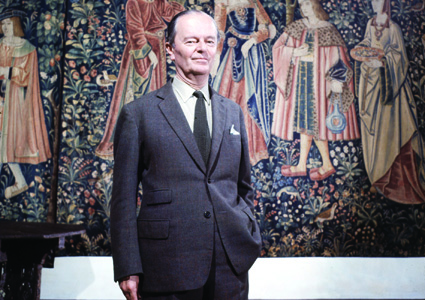
Kenneth Clark: Would civilisation endure? (credit: BBC)
Thirty years after his death in 1983, Kenneth Clark is back in the news. Tate Britain is hosting a major exhibition, Kenneth Clark: Looking for Civilisation (until August 10). And Tony Hall, the BBC's new director-general, has spoken of reinventing Civilisation for the digital age. He means two things: first, a landmark series which will show that the BBC is open for business again as a cultural force; but also a series which will be more "relevant" to multicultural, 21st-century Britain, less elitist, less, well, posh and patrician.
These two aspects of Civilisation were debated when it was first shown in 1969. It was a huge success for the BBC, not necessarily in terms of ratings, but of impact and prestige. It was the first lengthy documentary series in colour for the new BBC2, which had only started in 1964. This was how it was always conceived by David Attenborough, then controller of BBC2, who commissioned the series. "Colour had a bad name among those who had never seen our programmes," wrote Attenborough in his memoir, Life on Air. "In part this was due to the staggeringly garish quality of the first colour programmes shown in the United States . . . something was needed to show off its quality and demonstrate to its sceptics."
Civilisation was intended not just to show that BBC2 would be a cultural channel of the highest quality, but to sell colour television in Britain and, as important, new colour sets and the more expensive colour TV licences which helped fund the expansion of the BBC in the following years. Civilisation, triumphantly, did both. It was the first of a number of presenter-led documentary series which redefined the BBC as a public service broadcaster in the Seventies, thoughtful and serious but also hugely popular and accessible: Alistair Cooke's America (1972), Jacob Bronowski's The Ascent of Man (1973), J.K. Galbraith's The Age of Uncertainty (1977) and Robert Hughes's The Shock of the New (1980). Beautifully filmed on 35mm film, Civilisation sold colour television. Those astonishing images of Michelangelo and Raphael, lovingly created by the directors Michael Gill, Peter Montagnon and Ann Turner, and by their lighting cameraman A. Arthur Englander, showed what colour television could do. "At times," wrote the Guardian's art critic, Jonathan Jones, in 2007, "it rises to a cinematic brilliance rarely rivalled since: a scene in which Clark is seen walking away down a grandiose corridor in the Vatican while the camera pans backwards away from him — an effect designed to emphasise the chill of authority and power in the Baroque age — is worthy of Rossellini or Visconti."
From the start, however, Civilisation had its critics. Ways of Seeing (1972), written by John Berger and directed by Mike Dibb, was conceived as a response to Clark's "great men" art history. Irreverent, polemical, with its Marxist politics largely influenced by Walter Benjamin, its emphasis on the nude and the representation of women and the relation between high art and popular culture, especially new mass media, Ways of Seeing influenced how a new generation saw art and its history. To this generation of feminist and left-wing art historians, Civilisation seemed the enemy. Take Clark's opening quotation from his beloved Ruskin, "Looking at those great works of Western man". Western? Where were other, non-Western civilisations? India, China, Central and South America, Africa? There are a few passing references, but they remained on the margins. And what of Jewish and Islamic art? Again, a few passing references. Clark's references to Jews were often, troublingly, in the context of trading centres like Renaissance Florence and 17th-century Amsterdam — very different to Simon Schama's loving account of the visual beauty of early modern European synagogues in The Story of the Jews. Islam is referred to as "a new agent of destruction" in episode one on the Dark Ages, reappears briefly in the Crusades and rarely later.
And where were women? A few references to Dorothy Wordsworth, Teresa of Avila and the cult of the Virgin Mary. There is, in episode six, a powerful encomium to the great art of what Clark calls "the female religions" contrasted with the lack of religious imagery in Judaism, Protestantism and Islam, but that was it. This was a series about a small number of male geniuses, from Giotto to Beethoven, who were the great creative figures of Western art. These were the dreaded DWEMs — dead white European males — who became such figures of contention in late-20th-century humanities departments, and Clark was their great spokesman.
And what a spokesman: posh, old (Clark was in his mid-sixties when the series was filmed), patrician, in those immaculate suits. He spoke in the tones of Edwardian Winchester and interwar Oxford. Perhaps this is why so many of the best-known presenters who followed Clark and Cooke were foreign: Bronowski, Galbraith, Robert Hughes and Carl Sagan. The only other English presenter, David Attenborough, who came from a later generation, was a grammar school boy from Leicester, born in the mid-Twenties. Not a Savile Row suit in sight.
Art historians had other criticisms. Where were the close readings of individual works of art? They were unhappy with Clark's generalities, such as when he asks, "What is civilisation?" and answers, "I think I can recognise it when I see it," gesturing airily towards Notre Dame. Where were the explorations of the connections between individual works of art and their social and historical context? Clark's sweeping generalisations rankled. For example, when he says in the programme on the 18th century, "From Bach to Mozart, music expressed the deepest thoughts and feelings of the time, just as painting had done in the early 16th century," isn't that a little soft as art history? And his hierarchies, that run confidently through Civilisation, are now viewed with great suspicion. For example, the moment in the opening episode when he says, "The Apollo [Belvedere] surely embodies a higher state of civilisation than the Viking prow. The northern imagination takes shape in an image of fear and darkness. The Hellenistic imagination is an image of harmonised proportion and human reason." This kind of art history does not sit well in present-day lecture rooms.
So when Tony Hall calls for a remaking of Civilisation, he doesn't just mean a huge new watershed arts series. He also means one which will include — perhaps foreground — women and other cultures, and which will sound less posh and exclusive. Somewhere on his list of possible presenters will be women broadcasters like Mary Beard and Lisa Jardine. He will certainly be thinking of the inclusiveness and range of Neil MacGregor's Radio 4 series, A History of the World in 100 Objects, beginning with the mummy of Hornedjitef and the Olduvai handaxe, continuing with a Maya maize god statue, the statue of Rameses II and Chinese Tang tomb figures, and ending with the credit card and a solar-powered lamp and charger. This is a long way from the Apollo Belvedere. Clark, it may be worth noting, did not get a mention in MacGregor's series.
But should we be so quick to drop Clark in the trashcan of history? Clark was a far more complex figure than this strawman image suggests. First, he was not Eurocentric. "What is civilisation?" he asks in The Other Half, the second volume of his memoirs.
And what a spokesman: posh, old (Clark was in his mid-sixties when the series was filmed), patrician, in those immaculate suits. He spoke in the tones of Edwardian Winchester and interwar Oxford. Perhaps this is why so many of the best-known presenters who followed Clark and Cooke were foreign: Bronowski, Galbraith, Robert Hughes and Carl Sagan. The only other English presenter, David Attenborough, who came from a later generation, was a grammar school boy from Leicester, born in the mid-Twenties. Not a Savile Row suit in sight.
Art historians had other criticisms. Where were the close readings of individual works of art? They were unhappy with Clark's generalities, such as when he asks, "What is civilisation?" and answers, "I think I can recognise it when I see it," gesturing airily towards Notre Dame. Where were the explorations of the connections between individual works of art and their social and historical context? Clark's sweeping generalisations rankled. For example, when he says in the programme on the 18th century, "From Bach to Mozart, music expressed the deepest thoughts and feelings of the time, just as painting had done in the early 16th century," isn't that a little soft as art history? And his hierarchies, that run confidently through Civilisation, are now viewed with great suspicion. For example, the moment in the opening episode when he says, "The Apollo [Belvedere] surely embodies a higher state of civilisation than the Viking prow. The northern imagination takes shape in an image of fear and darkness. The Hellenistic imagination is an image of harmonised proportion and human reason." This kind of art history does not sit well in present-day lecture rooms.
So when Tony Hall calls for a remaking of Civilisation, he doesn't just mean a huge new watershed arts series. He also means one which will include — perhaps foreground — women and other cultures, and which will sound less posh and exclusive. Somewhere on his list of possible presenters will be women broadcasters like Mary Beard and Lisa Jardine. He will certainly be thinking of the inclusiveness and range of Neil MacGregor's Radio 4 series, A History of the World in 100 Objects, beginning with the mummy of Hornedjitef and the Olduvai handaxe, continuing with a Maya maize god statue, the statue of Rameses II and Chinese Tang tomb figures, and ending with the credit card and a solar-powered lamp and charger. This is a long way from the Apollo Belvedere. Clark, it may be worth noting, did not get a mention in MacGregor's series.
But should we be so quick to drop Clark in the trashcan of history? Clark was a far more complex figure than this strawman image suggests. First, he was not Eurocentric. "What is civilisation?" he asks in The Other Half, the second volume of his memoirs.
It was lunching with Georges Salles [director of the French Musées Nationaux] . . . The walls of his sitting-room were lined with books to the ceilings. The pictures, as is usual with French amateurs, were on easels — examples of Matisse and Picasso . . . and a superb late Renoir. On the tables were Maya carvings and Islamic pots, and there was a splendid mask from the Torres Straits, which had been given to Georges by Guillaume Apollinaire, and had been the inspiration of Picasso's tête nègre period.
Here are the Modernist masters who barely appear in Civilisation. But, above all, here are the "Maya carvings and Islamic pots" and "a splendid mask from the Torres Straits" — three civilisations in a sentence, all mentioned with great reverence — and the personal and artistic connections between these and Picasso. Here are exactly the kind of cultural range and, above all, connections, that were missing in Civilisation. And, as the book continues, there are moving tributes to art from India, Japan and Egypt. "My enjoyment," he writes, "covers a very wide field — Egyptian, Byzantine, Indian, Chinese, Japanese", though he admits that they are not his primary pleasures. "Mr Berenson used to say that we all have only a very few pennies to rattle about in our tins" and these non-European works "are not pennies that I can rattle in my tin". Nevertheless, he insists that "the finest works of Moghul art, whether in architecture or in such exacting media as jade, achieve a perfection that has never been surpassed." The Pearl Mosque and the Taj Mahal are "sublime works of art". Japanese art was his first love "and an album of Japanese drawings my most precious possession". Japanese artists "are supreme portraitists. As for the portrait of the priest Chogin (Shunjo) in the Todai-ji, I cannot think of anything in European art that so movingly unites realism with a profound feeling of veneration." Japanese temples and gardens "will always be an endless joy". Civilisation was by no means Clark's only venture into broadcasting. He presented more than 50 programmes on art, mainly for ITV but also for the BBC, over 20 years, between 1958 and 1977. Most were about European art, but they also included a three-part series on Japanese art (1963) and Great Temples of the World (1964-66), which included Luxor as well as Chartres.
There's no denying the focus on European art in Civilisation. Not just European art but Western European art. It is a series about the great masterpieces of France, Holland, Germany, Italy and Britain. Spain barely appears — no Velázquez, Goya or Picasso. Eastern Europe and Russia don't feature. Like The World at War, produced just a few years later, the focus is on the West, not on Eastern Europe, still in the deep freeze of the Cold War. But slicing the cake is always the problem for any large TV documentary series. Thirteen hours is not long to evoke 1,300 years of art and Clark's successors will find it a challenge to fit many other civilisations into one series. MacGregor's Radio 4 series, after all, had a hundred programmes.
These passages from Clark's memoir remind us of something else: his tremendous erudition. Not only was he well travelled (he saw these Indian buildings and Japanese temples in person). He was enormously well read and thoughtful. Take the title of the first volume of his memoirs, Another Part of the Wood. It conflates, he later wrote, "the stage directions in A Midsummer Night's Dream (Another Part of the Forest) with the opening of Dante's Inferno . . . (I found myself in a dark wood where the straight way was lost)." This isn't just more DWEMs, Shakespeare and Dante. It is what great art, in this case literature, means to someone's life.
Civilisation is full of such erudition. Confident assertions and generalisations, a great sweep of knowledge. "Three or four times in history," he says in episode two, "man has made a leap forward that would have seemed unthinkable under ordinary evolutionary circumstances." He compares the "extraordinary outpouring of energy" in 12th-century France with the appearance of civilisation in Egypt, Mesopotamia and the Indus Valley around 3000 BC; the moment in late sixth-century Greece and India when there was an explosion of knowledge and spiritual enlightenment; and 1000AD when in India, China, Byzantium and Western Europe, "an intensification of existence" took place. "People sometimes wonder why the Italian Renaissance didn't make more of a contribution to philosophy," he argues later in the series. This may sometimes seem a little grand. But the sweep of knowledge, the ambition of the claims, is a world away from the TV history of broadcasters and journalists like Paxman and Marr today.
There's no denying the focus on European art in Civilisation. Not just European art but Western European art. It is a series about the great masterpieces of France, Holland, Germany, Italy and Britain. Spain barely appears — no Velázquez, Goya or Picasso. Eastern Europe and Russia don't feature. Like The World at War, produced just a few years later, the focus is on the West, not on Eastern Europe, still in the deep freeze of the Cold War. But slicing the cake is always the problem for any large TV documentary series. Thirteen hours is not long to evoke 1,300 years of art and Clark's successors will find it a challenge to fit many other civilisations into one series. MacGregor's Radio 4 series, after all, had a hundred programmes.
These passages from Clark's memoir remind us of something else: his tremendous erudition. Not only was he well travelled (he saw these Indian buildings and Japanese temples in person). He was enormously well read and thoughtful. Take the title of the first volume of his memoirs, Another Part of the Wood. It conflates, he later wrote, "the stage directions in A Midsummer Night's Dream (Another Part of the Forest) with the opening of Dante's Inferno . . . (I found myself in a dark wood where the straight way was lost)." This isn't just more DWEMs, Shakespeare and Dante. It is what great art, in this case literature, means to someone's life.
Civilisation is full of such erudition. Confident assertions and generalisations, a great sweep of knowledge. "Three or four times in history," he says in episode two, "man has made a leap forward that would have seemed unthinkable under ordinary evolutionary circumstances." He compares the "extraordinary outpouring of energy" in 12th-century France with the appearance of civilisation in Egypt, Mesopotamia and the Indus Valley around 3000 BC; the moment in late sixth-century Greece and India when there was an explosion of knowledge and spiritual enlightenment; and 1000AD when in India, China, Byzantium and Western Europe, "an intensification of existence" took place. "People sometimes wonder why the Italian Renaissance didn't make more of a contribution to philosophy," he argues later in the series. This may sometimes seem a little grand. But the sweep of knowledge, the ambition of the claims, is a world away from the TV history of broadcasters and journalists like Paxman and Marr today.
He may, at times, seem too at ease with his hierarchies. "It was," he says about the art of Ancient Greece, "without doubt, the most extraordinary creation in the whole of history. So complete, so convincing, so satisfying to the mind and the eye, that it lasted, practically unchanged, for about 600 years." "Without doubt"? "In the whole of history"? Well, why not? This is where the most interesting discussions begin, not where they end. Why shouldn't BBC viewers have the opportunity to hear and reflect on such claims? And, after all, Clark is just as clear about what he doesn't know, as about what he does. An engaging modesty ran through the series: "I don't know enough about Persian literature to say if this is true"; "I can't pretend that I've read the Principia. If I did I wouldn't understand it." He knows civilisation when he sees it, but he doesn't claim to know everything about civilisation — only what matters and what matters to him. This is, after all, Civilisation: A Personal View.
And what is wrong with confidence? At crucial moments, at the beginning and end of the series, Clark talks about the importance of confidence and energy for civilisations. "It is lack of confidence that kills a civilisation." In that extraordinary closing speech at the end of the series, he quotes Yeats (whom he had known personally). "Things fall apart, the centre cannot hold." We forget that Civilisation was filmed as tear gas was fired in the streets of Paris, as Soviet tanks rolled into Prague, as students rioted and wanted to burn down libraries in the United States. Civilisation, like the letters of Isaiah Berlin about Turgenev and liberalism written between 1968-70 and Saul Bellow's Mr. Sammler's Planet, is a key moment of doubt and uncertainty about where Western civilisation is going at the end of the Sixties. Consider Clark's closing words: "One may be optimistic, but one cannot exactly be joyful at the prospect before us."
We are wrong to mistake Clark's erudition for the confidence of a class or a culture. Throughout the series, and much of his writing, there is an unmistakable sense of pessimism, both personal and cultural. Civilisation begins not with confidence or superiority but with a profound sense of the fragility of civilisations, how easily they can collapse. He starts with Rome. "That world must have seemed indestructible. However complex and solid it seems [my emphasis], it is actually quite fragile." Is he talking about the Edwardian world of his childhood, the Thirties or the late Sixties?
And then at the end he concludes: "The trouble is that there is still no centre." The final sequence of Civilisation shows Clark closing his copy of Yeats (not a researcher's set of notes), walking into his library at Saltwood Castle, replacing the book on one of several towering bookcases and walking towards the camera, pausing only to lovingly caress a sculpture by Henry Moore, lit up as Clark opens a door and walks out. This is beautifully filmed by Michael Gill, one of the great visual sequences in the history of British television. But it is a mistake to think that this is simply a moment of confidence in art — the books, the paintings, Moore's sculpture. It is a moment of assertion in the face of doubt and pessimism. Moore but also Yeats. The greatness of modern art but also "the best lack all conviction". Clark had conviction but he also had doubts about the biggest issue of all: the power of civilisation to endure.
And what is wrong with confidence? At crucial moments, at the beginning and end of the series, Clark talks about the importance of confidence and energy for civilisations. "It is lack of confidence that kills a civilisation." In that extraordinary closing speech at the end of the series, he quotes Yeats (whom he had known personally). "Things fall apart, the centre cannot hold." We forget that Civilisation was filmed as tear gas was fired in the streets of Paris, as Soviet tanks rolled into Prague, as students rioted and wanted to burn down libraries in the United States. Civilisation, like the letters of Isaiah Berlin about Turgenev and liberalism written between 1968-70 and Saul Bellow's Mr. Sammler's Planet, is a key moment of doubt and uncertainty about where Western civilisation is going at the end of the Sixties. Consider Clark's closing words: "One may be optimistic, but one cannot exactly be joyful at the prospect before us."
We are wrong to mistake Clark's erudition for the confidence of a class or a culture. Throughout the series, and much of his writing, there is an unmistakable sense of pessimism, both personal and cultural. Civilisation begins not with confidence or superiority but with a profound sense of the fragility of civilisations, how easily they can collapse. He starts with Rome. "That world must have seemed indestructible. However complex and solid it seems [my emphasis], it is actually quite fragile." Is he talking about the Edwardian world of his childhood, the Thirties or the late Sixties?
And then at the end he concludes: "The trouble is that there is still no centre." The final sequence of Civilisation shows Clark closing his copy of Yeats (not a researcher's set of notes), walking into his library at Saltwood Castle, replacing the book on one of several towering bookcases and walking towards the camera, pausing only to lovingly caress a sculpture by Henry Moore, lit up as Clark opens a door and walks out. This is beautifully filmed by Michael Gill, one of the great visual sequences in the history of British television. But it is a mistake to think that this is simply a moment of confidence in art — the books, the paintings, Moore's sculpture. It is a moment of assertion in the face of doubt and pessimism. Moore but also Yeats. The greatness of modern art but also "the best lack all conviction". Clark had conviction but he also had doubts about the biggest issue of all: the power of civilisation to endure.
This is what makes Civilisation great. It is the tension between belief in the greatness of art and creativity, from the Dark Ages to the present, and the sense of how close this has come to utter disaster. "It does seem hard to believe that European civilisation could ever vanish," he says at the beginning of the series, "and yet, you know, it has happened once."
Tony Hall and whomever is chosen to produce a new Civilisation should remember this. The false pieties and sentimentalities of our age should not be mistaken for confidence. There is something troubling about our own lack of conviction about our identity and traditions. Whom do we trust today to match Clark's erudition, his range of interests and enthusiasm, but also this dark sense of fragility and pessimism? Among scholars with comparable broadcasting experience, only Neil MacGregor comes close. Paxman, Marr, Mary Beard, Lisa Jardine, Waldemar Januszczak, even Simon Schama, are all either too narrow in their interests, are current affairs journalists and broadcasters rather than cultural historians or lack the sense of darkness that Clark shared with his directors.
Think of the great moments of Civilisation — the images of the Crucifixion in early medieval art, the Vatican Map Room as Clark walks away from the camera, Michelangelo's Prisoners, Rodin's sculpture of Balzac. They are not moments of confidence or grandeur. They are moments of supreme pathos or moments when that grandeur is fatally undermined. Perhaps such a series could only be made by people who had known the war and could think that a series about Western civilisation should begin with a programme called The Skin of our Teeth and end with Yeats.
Tony Hall and whomever is chosen to produce a new Civilisation should remember this. The false pieties and sentimentalities of our age should not be mistaken for confidence. There is something troubling about our own lack of conviction about our identity and traditions. Whom do we trust today to match Clark's erudition, his range of interests and enthusiasm, but also this dark sense of fragility and pessimism? Among scholars with comparable broadcasting experience, only Neil MacGregor comes close. Paxman, Marr, Mary Beard, Lisa Jardine, Waldemar Januszczak, even Simon Schama, are all either too narrow in their interests, are current affairs journalists and broadcasters rather than cultural historians or lack the sense of darkness that Clark shared with his directors.
Think of the great moments of Civilisation — the images of the Crucifixion in early medieval art, the Vatican Map Room as Clark walks away from the camera, Michelangelo's Prisoners, Rodin's sculpture of Balzac. They are not moments of confidence or grandeur. They are moments of supreme pathos or moments when that grandeur is fatally undermined. Perhaps such a series could only be made by people who had known the war and could think that a series about Western civilisation should begin with a programme called The Skin of our Teeth and end with Yeats.