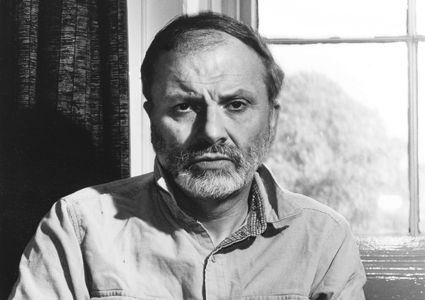
Laureate of language: Geoffrey Hill, photographed by Christopher Barker for his book "Portraits of Poets" in 1986
It was drizzling and already dusk when I arrived at the Examination Schools in Oxford one afternoon in March to hear Sir Geoffrey Hill lecture on poetry. Entering that forbidding Victorian pile, mounting the long staircase and arriving in the South School triggered a buried, decades-old recollection of the agonies of Finals. More than 60 years ago, my mother had also sat Finals here, alongside Geoffrey Hill; they were both reading English and might have attended the same lectures by (among others) C.S. Lewis and J.R.R. Tolkien. A little later, in London, they might have been to the same readings by such luminaries of the day as T.S. Eliot and Dylan Thomas. But they never met. My daughter, now also reading English and about to sit Finals in her turn, was waiting for me, having saved me a seat.
Inside that unprepossessing auditorium, presided over by a portrait of Kaiser Bill in academic scarlet, the lecture had just begun. There, silver-bearded and sonorous-voiced, was the Professor of Poetry. Already he held the large audience under his spell; apart from the occasional ripple of laughter at his sallies against his fellow poets, respect bordering on reverence prevailed. It could have been — perhaps it was — the Ancient of Days. Now in his early eighties, Geoffrey Hill has all the gravitas that attaches to his chair, but remains quixotic, impish and irreverent. His purpose in giving these lectures was evidently not to flatter his audience of dons, undergraduates and interlopers like me, but to do what he could to provoke us.
As I entered, the Professor of Poetry was reciting: not verses, but extracts from Lincoln's Gettysburg Address and Martin Luther King's "I have a dream" speech. He went on to explain that his theme was "Monumentality and Bidding" — terms of art taken from one of his heroes of prosody, Gerard Manley Hopkins — and that his argument was that enduring, not to say great, poetry and prose must combine these two qualities. Monumentality speaks for itself, but by "bidding" Hopkins meant speaking directly to the reader and keeping his attention, "making it everywhere an act of intercourse" — "social intercourse", Hill interjected with a wry smile. (I suspect Hopkins the Jesuit also had in mind the sense of supplication, as in the "bidding prayers" offered up to God in every Mass.) The great speeches of Lincoln and King, a sonnet by Hopkins, the music of Purcell: each was analysed minutely, with frequent reference to the Oxford English Dictionary. It was all of a piece and, in its endearingly idiosyncratic way, "Hillian".
Last month, I returned to Oxford for another dose, drawn irresistibly by the magnetism of this voice versifying in the wilderness. There is no denying that his lectures, like his poems, are difficult — but they are not so for the sake of exclusiveness. Hill addressed himself on this occasion to "any reader of intelligent goodwill" and in a line from one of his Expostulations on the Volcano, he insists: "I do not establish the recondite as Hill-school."
This entire May lecture was dedicated to resolving a single question in a single poem, "The Windhover" by Gerard Manley Hopkins: to whom was his vivid evocation of the "lyric flight" of the bird addressed? Was "thee" the bird or the poem's dedicatee, Jesus Christ? (Long after writing it, the poet added the title "To Christ our Lord", but there is no obvious solution.) In the hour spent answering this question, Hill offered a defence not only of poet and poem, but also of the "earnestness of spirit" — saturated in Classical culture and Catholic theology — that had made it possible for Hopkins to "find his way right at last to the true functions of his mind" and in doing so to create the new prosody of sprung rhythm. The very artificiality of such an "abrupt metre" creates naturalness, Hill argued, with a characteristic sideswipe at contemporary poets: "If only that were better understood at the present time."
For Hill, a poem must be "at once spontaneous and exacting". To use an analogy he had used in March: poetry must, like the chaconnes and passacaglias beloved of the Baroque, be "simultaneously wild and strict. This is a quality which somehow must be brought back into English poetry this century, or English poetry will die." (The composer David Matthews was inspired by Hill's "Funeral Music" to write his gigantic orchestral Chaconne, evoking the Battle of Towton in the Wars of the Roses.)
It was evident that Hill identified strongly with Hopkins, while confessing himself perplexed by his methods and humbled by his sacrifices. But the poet in Hill, weary of the charge that his work is too obscure, rejoiced in the "good-humoured irascibility" of Hopkins's response to his friend Robert Bridges, who asked what he meant by his poem "Henry Purcell": "My sonnet means Purcell's music is none of your damned subjective rot, so to speak."
To hear Geoffrey Hill speak — and the Oxford lectures are all available as podcasts — is an exhilarating experience. His delivery is almost, but not quite, theatrical — especially when compared to the dry, monotonous manner of most modern academics. But Hill is not, despite having spent the greater part of his life teaching at Leeds, Cambridge and Boston, primarily an academic. His declamatory style of oratory, rising to incantation in the recitation of verse, is indebted, rather, to the great poets of the past: to Yeats and Eliot.
Poetry as transfiguration of language: Hill has pursued this project with iron consistency for more than 60 years, ever since his first slim volume (a pamphlet of five poems, now extremely rare) appeared in 1950 while he was still a 20-year-old undergraduate at Keble College, Oxford. But for Hill the poetical has always been the political. In his Oxford lecture he thinks foul scorn that politicians should presume to be above criticism in their use and abuse of language. Indeed, the prophetic mode comes naturally to him in verse and prose.
Hill has on occasion come under attack for his allegedly reactionary tendencies, notably from Tom Paulin — the Northern Irish poet and Oxford don notorious for an interview in which he appeared to encourage Palestinians to kill Jewish settlers in the West Bank. Paulin took exception to Hill's Mercian Hymns, which had the temerity to allude to Virgil's prophetic vision of civil war, since 1968 associated to English ears with Enoch Powell's "Rivers of blood" speech and hence for Paulin — but not Hill — now fatally compromised in perpetuity. Hill has never explicitly defended his choice of this line, but the Mercian hymn in question has nothing to do with immigration. It actually describes a "visitation of some sorrow" to the dungeon of Boethius, the Roman author of The Consolation of Philosophy who was tortured to death, concluding thus: "He set in motion the furtherance of / his journey. To watch the Tiber foaming out / much blood." This is not the dog whistle of demagogy, but a valiant attempt to reclaim Virgil's line for the realm of literature.
Nor may Hill be accused of sycophancy towards politicians with patronage: there is nothing unctuous about his verse, no eulogies of or dedications to living leaders, though he is generous with his praise of the dead and the dying. Some of his collections have political titles, including the one chosen for his entire oeuvre, Broken Hierarchies. Hill's mental landscape was shaped by the two world wars, and the "backlog of monsters" they bequeathed. But he is devoted to the preservation of what he calls "intrinsic value", values embodied in poetry, which are not relative or arbitrary.
It was evident that Hill identified strongly with Hopkins, while confessing himself perplexed by his methods and humbled by his sacrifices. But the poet in Hill, weary of the charge that his work is too obscure, rejoiced in the "good-humoured irascibility" of Hopkins's response to his friend Robert Bridges, who asked what he meant by his poem "Henry Purcell": "My sonnet means Purcell's music is none of your damned subjective rot, so to speak."
To hear Geoffrey Hill speak — and the Oxford lectures are all available as podcasts — is an exhilarating experience. His delivery is almost, but not quite, theatrical — especially when compared to the dry, monotonous manner of most modern academics. But Hill is not, despite having spent the greater part of his life teaching at Leeds, Cambridge and Boston, primarily an academic. His declamatory style of oratory, rising to incantation in the recitation of verse, is indebted, rather, to the great poets of the past: to Yeats and Eliot.
Poetry as transfiguration of language: Hill has pursued this project with iron consistency for more than 60 years, ever since his first slim volume (a pamphlet of five poems, now extremely rare) appeared in 1950 while he was still a 20-year-old undergraduate at Keble College, Oxford. But for Hill the poetical has always been the political. In his Oxford lecture he thinks foul scorn that politicians should presume to be above criticism in their use and abuse of language. Indeed, the prophetic mode comes naturally to him in verse and prose.
Hill has on occasion come under attack for his allegedly reactionary tendencies, notably from Tom Paulin — the Northern Irish poet and Oxford don notorious for an interview in which he appeared to encourage Palestinians to kill Jewish settlers in the West Bank. Paulin took exception to Hill's Mercian Hymns, which had the temerity to allude to Virgil's prophetic vision of civil war, since 1968 associated to English ears with Enoch Powell's "Rivers of blood" speech and hence for Paulin — but not Hill — now fatally compromised in perpetuity. Hill has never explicitly defended his choice of this line, but the Mercian hymn in question has nothing to do with immigration. It actually describes a "visitation of some sorrow" to the dungeon of Boethius, the Roman author of The Consolation of Philosophy who was tortured to death, concluding thus: "He set in motion the furtherance of / his journey. To watch the Tiber foaming out / much blood." This is not the dog whistle of demagogy, but a valiant attempt to reclaim Virgil's line for the realm of literature.
Nor may Hill be accused of sycophancy towards politicians with patronage: there is nothing unctuous about his verse, no eulogies of or dedications to living leaders, though he is generous with his praise of the dead and the dying. Some of his collections have political titles, including the one chosen for his entire oeuvre, Broken Hierarchies. Hill's mental landscape was shaped by the two world wars, and the "backlog of monsters" they bequeathed. But he is devoted to the preservation of what he calls "intrinsic value", values embodied in poetry, which are not relative or arbitrary.
Hence his attachment to the idea of hierarchy: not in a political but a moral sense. In an essay making the case for Hopkins as a true democrat, he writes with reference to the Catholic Church: "It will be objected that a hierarchical institution cannot be democratic, but what it cannot be, in the world's terms, is egalitarian, even though it teaches equality before God." Hill is democratic but not egalitarian. "Bless hierarchy, dismiss hegemony," he declares in the last poem of his Liber Illustrium Virorum, his "Book of Illustrious Men". The moral hierarchies broken by war and tyranny live on in poetry.
It is evident, then, that Hill takes poetry, his vocation and his obligations to the muse, with the utmost seriousness. Not so apparent, until one has heard him out, is the fact that he does not take himself too seriously. My evidence for this is circumstantial but cumulative: sly little digs at the carapace of authority that inevitably surrounds a man long since wearied by hearing himself feted as "our greatest living poet"; a lively awareness of the contradictions and limitations of his critical theories; no hint of vanity about his own poetic achievement; and a readiness to engage with anybody who had turned up to hear him, even if their only purpose in doing so was to get him to sign copies of his books.
He is, though, evidently hurt by the lack of attention paid to his collected poems, Broken Hierarchies, which appeared at the end of last year. When I mentioned that I would be writing this article about him, he looked mildly reproachful: "A footnote about my book would be nice." I am conscious of my inadequacy for this task — but how does one do justice to a collection that is not so much a book as a cosmos? A glance at the voluminous literature on Geoffrey Hill, however, should suffice to put such authorial anxieties to rest. Besides the bibliography, a remarkable range of composers have set Hill's poems to music, while his fame extends to America and France.
Asked if he liked a particularly severe photograph of himself, he replied: "It terrifies me." While he believes strongly in the poet's need to understand and justify his own methods, he accepts that poetics must never tyrannise over poetry. His doctrine that "the grammar of the poem decides the grammar of belief" must be suspended to grasp what is going on in "The Windhover": the "chevalier" to whom Hopkins speaks is Christ, but only Hill's theological intuition, not the internal evidence of the poem, tells him so. Hill cheerfully admits to his own eclecticism: "I am a walking example of the marvels of serendipity."
Yet the two great volumes of his poetry and prose — Broken Hierarchies: Poems, 1952-2012 and Collected Critical Writings, both edited by Kenneth Haynes and published by OUP — represent a corpus of achievement, at once literary and intellectual, that is unparalleled in our time. One has to go back half a century, to T.S. Eliot and W.H. Auden, to find adequate comparisons. Eliot (born 1888) and Auden (born 1907) were each the dominant poetic voices of their respective generations; each produced major works of criticism as an integral part of his life's work. But the generation of poets that succeeded Eliot and Auden had not one but several voices, of which the outstanding ones were Philip Larkin (born 1922), Ted Hughes (born 1930) and Geoffrey Hill (born 1932). Although Larkin was a fine jazz critic, he had no desire to write a substantial body of literary criticism. Hughes did write a work of criticism, Shakespeare and the Goddess of Complete Being, but although it mattered greatly to him — as literary editor of The Times I published his riposte to his critics — few would deny that it is great only in its self-indulgence. Thus Hill is the only poet of his generation to lay claim to the mantle of Eliot and Auden — to the vocation of the poet as, in Shelley's words, "the unacknowledged legislator of the world".
It is evident, then, that Hill takes poetry, his vocation and his obligations to the muse, with the utmost seriousness. Not so apparent, until one has heard him out, is the fact that he does not take himself too seriously. My evidence for this is circumstantial but cumulative: sly little digs at the carapace of authority that inevitably surrounds a man long since wearied by hearing himself feted as "our greatest living poet"; a lively awareness of the contradictions and limitations of his critical theories; no hint of vanity about his own poetic achievement; and a readiness to engage with anybody who had turned up to hear him, even if their only purpose in doing so was to get him to sign copies of his books.
He is, though, evidently hurt by the lack of attention paid to his collected poems, Broken Hierarchies, which appeared at the end of last year. When I mentioned that I would be writing this article about him, he looked mildly reproachful: "A footnote about my book would be nice." I am conscious of my inadequacy for this task — but how does one do justice to a collection that is not so much a book as a cosmos? A glance at the voluminous literature on Geoffrey Hill, however, should suffice to put such authorial anxieties to rest. Besides the bibliography, a remarkable range of composers have set Hill's poems to music, while his fame extends to America and France.
Asked if he liked a particularly severe photograph of himself, he replied: "It terrifies me." While he believes strongly in the poet's need to understand and justify his own methods, he accepts that poetics must never tyrannise over poetry. His doctrine that "the grammar of the poem decides the grammar of belief" must be suspended to grasp what is going on in "The Windhover": the "chevalier" to whom Hopkins speaks is Christ, but only Hill's theological intuition, not the internal evidence of the poem, tells him so. Hill cheerfully admits to his own eclecticism: "I am a walking example of the marvels of serendipity."
Yet the two great volumes of his poetry and prose — Broken Hierarchies: Poems, 1952-2012 and Collected Critical Writings, both edited by Kenneth Haynes and published by OUP — represent a corpus of achievement, at once literary and intellectual, that is unparalleled in our time. One has to go back half a century, to T.S. Eliot and W.H. Auden, to find adequate comparisons. Eliot (born 1888) and Auden (born 1907) were each the dominant poetic voices of their respective generations; each produced major works of criticism as an integral part of his life's work. But the generation of poets that succeeded Eliot and Auden had not one but several voices, of which the outstanding ones were Philip Larkin (born 1922), Ted Hughes (born 1930) and Geoffrey Hill (born 1932). Although Larkin was a fine jazz critic, he had no desire to write a substantial body of literary criticism. Hughes did write a work of criticism, Shakespeare and the Goddess of Complete Being, but although it mattered greatly to him — as literary editor of The Times I published his riposte to his critics — few would deny that it is great only in its self-indulgence. Thus Hill is the only poet of his generation to lay claim to the mantle of Eliot and Auden — to the vocation of the poet as, in Shelley's words, "the unacknowledged legislator of the world".
By the time Hill came on the scene, however, the landscape had been transformed: the line between poetry and prose had been blurred, the laws of prosody had been suspended and poets were marginalised by or subsumed into other art forms, such as popular music. Poems too became primarily vehicles of self-expression. Like everybody else, poets had to compete for attention and celebrity. As schools no longer taught their pupils poetry by heart, the handful of verses that retained public affection acquired the status of secular icons. New poetry seldom achieves such recognition, for the very good reason that is rarely memorised or indeed memorable. Poets instead strove to reinvent their functions: as performance art for highbrows, icing on the secular wedding cake, or therapy for the deserted, the desolated and the dumped. Occasionally a work combines all these functions: Ted Hughes's collection Birthday Letters, for instance, acquired canonical status overnight, rendering it above criticism — not on account of its quality, which was uneven, but of its subject-matter. The appeal to sentimentality of this epilogue to the Hughes/Plath relationship trumped all other considerations.
Geoffrey Hill will have none of it. In his March Oxford lecture, he scandalises the audience by questioning the most revered of the war poets: "To say that [Wilfred] Owen wrote two of the great poems of the 20th century, in ‘Sensibility' and ‘Spring Offensive', but that some of his poetry, even some of the most loved, is a bit sloppy . . . well, if one had a career to lose it would lose one one's career, I suppose." If language is, as he believes, the last repository of meaning, "it is essential to apply the most rigorous technical demands to these sanctified objects of public worship."
This leads Hill to the gravamen of his charge against much of the poetry of today: "It is public knowledge that the newest generation of poets is encouraged to think of poems as Facebook or Twitter texts — or now, I suppose, much more recently, as selfies." The mention of such an improbable neologism from such a source elicited an embarrassed titter from the audience, as if Hill had caught his academic peers indulging a secret vice. "The poem as selfie is the aesthetic criterion of contemporary verse," he continued. "And, as you know, in my malign way I want to put myself in opposition to this view. That is to say, the poem should not be a spasmodic issue from the adolescent or even the octogenarian psyche, requiring no further form or validation." Hill came back to the theme in his vindication of Hopkins, whose sonnets did not, he expostulated, deserve the condescension of posterity: "I do not think that they are Hopkins's selfies."
The underlying reason for Hill's rejection of poetry as pure self-expression is that he sees such narcissism as beneath the dignity of his calling. He preaches, rather, what he has practised ever since his youth: a poetry of ideas. It is this determination to place ideas at the heart of his work that sets him apart from even his most celebrated contemporaries. Disputing Auden's claim that "art is a product of history, not a cause", he argues that the true poem is "alienated from its existence as historical event". To capture the realm in which it exists over and above history, he proposes the notion of "alienated majesty", the invisible repository of ideas, values and faith. "Alienated majesty signifies a reality, however, even if not an actuality."
Hill's life has followed a trajectory that was commoner in his time than in later generations. Born in Bromsgrove, Worcestershire, he was the son of a police constable. Grammar school nurtured a love of literature that blossomed at Oxford into a firm resolution to live the intellectual life. From the first, Hill's poetry has been the most important but by no means the only manifestation of a voracious appetite for ideas. Indeed, for the first five decades, his poetic output was interrupted by long periods of sterility and despair. The first Collected Poems of 1985 was less than a fifth of the length of Broken Hierarchies; it was followed by another decade of silence.
Geoffrey Hill will have none of it. In his March Oxford lecture, he scandalises the audience by questioning the most revered of the war poets: "To say that [Wilfred] Owen wrote two of the great poems of the 20th century, in ‘Sensibility' and ‘Spring Offensive', but that some of his poetry, even some of the most loved, is a bit sloppy . . . well, if one had a career to lose it would lose one one's career, I suppose." If language is, as he believes, the last repository of meaning, "it is essential to apply the most rigorous technical demands to these sanctified objects of public worship."
This leads Hill to the gravamen of his charge against much of the poetry of today: "It is public knowledge that the newest generation of poets is encouraged to think of poems as Facebook or Twitter texts — or now, I suppose, much more recently, as selfies." The mention of such an improbable neologism from such a source elicited an embarrassed titter from the audience, as if Hill had caught his academic peers indulging a secret vice. "The poem as selfie is the aesthetic criterion of contemporary verse," he continued. "And, as you know, in my malign way I want to put myself in opposition to this view. That is to say, the poem should not be a spasmodic issue from the adolescent or even the octogenarian psyche, requiring no further form or validation." Hill came back to the theme in his vindication of Hopkins, whose sonnets did not, he expostulated, deserve the condescension of posterity: "I do not think that they are Hopkins's selfies."
The underlying reason for Hill's rejection of poetry as pure self-expression is that he sees such narcissism as beneath the dignity of his calling. He preaches, rather, what he has practised ever since his youth: a poetry of ideas. It is this determination to place ideas at the heart of his work that sets him apart from even his most celebrated contemporaries. Disputing Auden's claim that "art is a product of history, not a cause", he argues that the true poem is "alienated from its existence as historical event". To capture the realm in which it exists over and above history, he proposes the notion of "alienated majesty", the invisible repository of ideas, values and faith. "Alienated majesty signifies a reality, however, even if not an actuality."
Hill's life has followed a trajectory that was commoner in his time than in later generations. Born in Bromsgrove, Worcestershire, he was the son of a police constable. Grammar school nurtured a love of literature that blossomed at Oxford into a firm resolution to live the intellectual life. From the first, Hill's poetry has been the most important but by no means the only manifestation of a voracious appetite for ideas. Indeed, for the first five decades, his poetic output was interrupted by long periods of sterility and despair. The first Collected Poems of 1985 was less than a fifth of the length of Broken Hierarchies; it was followed by another decade of silence.
Then the dam burst: beginning with Canaan in 1996, Hill published seven volumes of poetry in the next 15 years. Finally, in Broken Hierarchies, another eight titles appeared, mostly for the first time, last year: Pindarics, Ludo and all six of the Daybooks. It is a bumper harvest later and richer than anybody dared hope for.
What, though, does Hill mean by a poetry of ideas? Unlike philosophy, poetry deals in concrete rather than abstract concepts; unlike history, poetry is not limited to reconstructing what we know about the past, but can allow the imagination free rein. Ideas fit into Hill's poetry, but they are never free-floating ideas: they always belong in a human setting. Ideas, for Hill, bear the imprint of the personality who created them. The ideas that drive us to action and shape our lives are such stuff as dreams are made on.
To illustrate what I mean, let us consider a poem by Hill's contemporary Derek Walcott (born 1930). Walcott, a Nobel laureate, was a candidate for the Oxford chair in 2009, but withdrew after allegations that he was a womaniser who preyed on his students. A year later he published a new collection, White Egrets, the title poem of which is a riposte to his critics. In what was widely seen as a gesture of solidarity by his fellow poets, the book was awarded the T.S. Eliot Prize. One passage reads thus:
Compare this with Hill's valediction in one of his Daybooks:
Clearly these are not only different voices, but addressed to different recipients: Walcott's to his ageing self; Hill's to an unnamed beloved. The references are in even greater contrast. Walcott evokes a specific place, an island near his native St Lucia. Hill invokes mathematical, historical and literary images of constancy: the Fibonacci sequence (with, by implication, the Golden Ratio) and Stonehenge; then, teasingly, Ovid's Metamorphoses, in which a narrative sequence on the mutability of mortals and immortals ends in the apotheosis of Julius Caesar. Walcott's ostensible theme is renunciation, but his metaphor of the egrets implies that he is still potent, for his "torn poems" will outlive him; the underlying emotion is one of defiance, both of his critics and of old age. Hill speaks softly to his beloved, all passion spent, in a tone of acceptance and gratitude. Walcott's egret metaphor is vivid and its appeal obvious. Hill's glimpse of the past — the may-tree, the meadow and the girl — is more subtle. The ideas of the first stanza are transfigured in the vision of bliss in the second. Its evanescent flashback culminates in the last line, memorable in its simplicity and reminiscent of Eliot's Four Quartets. Walcott's poem is what Hill calls a "selfie": it speaks to himself about himself. Hill's is a poem of ideas: it speaks to us all, sub specie aeternitatis, in the individual persona of the poet's "old love".
What, though, does Hill mean by a poetry of ideas? Unlike philosophy, poetry deals in concrete rather than abstract concepts; unlike history, poetry is not limited to reconstructing what we know about the past, but can allow the imagination free rein. Ideas fit into Hill's poetry, but they are never free-floating ideas: they always belong in a human setting. Ideas, for Hill, bear the imprint of the personality who created them. The ideas that drive us to action and shape our lives are such stuff as dreams are made on.
To illustrate what I mean, let us consider a poem by Hill's contemporary Derek Walcott (born 1930). Walcott, a Nobel laureate, was a candidate for the Oxford chair in 2009, but withdrew after allegations that he was a womaniser who preyed on his students. A year later he published a new collection, White Egrets, the title poem of which is a riposte to his critics. In what was widely seen as a gesture of solidarity by his fellow poets, the book was awarded the T.S. Eliot Prize. One passage reads thus:
[. . .] so walk to the cliff's edge and soar above it,
the jealousy, the spite, the nastiness with the grace
of a frigate over Barrel of Beef, its rock;
be grateful that you wrote well in this place,
let the torn poems sail from you like a flock
of white egrets to a long last sigh of release.
Compare this with Hill's valediction in one of his Daybooks:
What I have so invoked for us is true
As invocation. The Fibonacci range
Of numbers is a constant, like Stonehenge.
Like Ovid's book of changes to construe.
I can see someone walking there, a girl,
And she is you, old love. Edging the meadow
The may-tree is all light and all shadow.
Coming and going are the things eternal.
Clearly these are not only different voices, but addressed to different recipients: Walcott's to his ageing self; Hill's to an unnamed beloved. The references are in even greater contrast. Walcott evokes a specific place, an island near his native St Lucia. Hill invokes mathematical, historical and literary images of constancy: the Fibonacci sequence (with, by implication, the Golden Ratio) and Stonehenge; then, teasingly, Ovid's Metamorphoses, in which a narrative sequence on the mutability of mortals and immortals ends in the apotheosis of Julius Caesar. Walcott's ostensible theme is renunciation, but his metaphor of the egrets implies that he is still potent, for his "torn poems" will outlive him; the underlying emotion is one of defiance, both of his critics and of old age. Hill speaks softly to his beloved, all passion spent, in a tone of acceptance and gratitude. Walcott's egret metaphor is vivid and its appeal obvious. Hill's glimpse of the past — the may-tree, the meadow and the girl — is more subtle. The ideas of the first stanza are transfigured in the vision of bliss in the second. Its evanescent flashback culminates in the last line, memorable in its simplicity and reminiscent of Eliot's Four Quartets. Walcott's poem is what Hill calls a "selfie": it speaks to himself about himself. Hill's is a poem of ideas: it speaks to us all, sub specie aeternitatis, in the individual persona of the poet's "old love".
Two farewells by two grand old poets — but only one of them has been awarded the Nobel Prize. True, Hill has belatedly been knighted; and his election to the Oxford chair — the same one that provoked Walcott's line about "the jealousy, the spite, the nastiness" — has provided him with the platform he needs to expound his poetics. Yet Hill is still, even as an octogenarian, writing against the tide in his lone struggle to bring "the energy of intelligence" created by poetry and its criticism to bear on public life. For his mythopoeic archaism, Hill has been mercilessly, perhaps deservedly, mocked, notably by Wendy Cope in her parody of the first of his Mercian Hymns, "Duffa Rex". Here is Hill:
And this is Cope:
Yet Hill is no obscurantist and his tireless advocacy occasionally breaks through. The late Seamus Heaney, in his 1995 Nobel acceptance speech, echoed Hill's connection between form and value. For Heaney: "Poetic form is the ship and the anchor." In tempestuous times — in his case the Troubles that tore apart his homeland — Heaney invoked poetry to remind us "that we are hunters and gatherers of values". He entitled the speech Crediting Poetry and so he did. But Hill has devoted, not just a speech, but his whole life to the pursuit of an altogether more ambitious and demanding conception of what Michael Oakeshott called "the voice of poetry in the conversation of mankind". The Nobel prizes will always go to the Walcotts and Heaneys, who delight the ear but are content to go with the flow. Hill is an ancient mariner who will not let us go so easily: his manner is importunate and even his beard is rebarbative.
For Hill, we who are privileged to dwell in the land of Shakespeare and Milton are in danger of squandering our most precious inheritance: our literature, and especially our poetry, which is the enduring source of our national identity. "The writing and criticism in depth of poetry is an essential, even a vital practice," he told the Oxford audience. "We are in our public life desperately in need of the energy of intelligence created by these pursuits." Only poetry and its rigorous criticism can discern "how the uncommon work moves within the common dimension of language". Politics is no less dependent on language than poetry, but it is a great deal less attuned to the uncommon work. Poets, if they could only raise their sights from their navel-gazing, could and should be the unacknowledged legislators of our hearts.
The gauntlet he throws down to those in the public square is a moral imperative: speak as though your words mattered so much that even if they were never to be forgotten, you would still stand by them. Geoffrey Hill speaks like that. So should we all.
King of the perennial holly-groves, the riven sandstone: overlord of the M5: architect of the historic rampart and ditch, the citadel at Tamworth, the summer hermitage in Holy Cross: guardian of the Welsh Bridge and the Iron Bridge: contractor to the desirable new estates: saltmaster: moneychanger: commissioner for oaths: martyrologist: the friend of Charlemagne.
"I liked that," said Offa, "sing it again."
And this is Cope:
King of the primeval avenues, the municipal parklands: architect of the Tulse Hill Poetry Group: life and soul of the perennial carousals: minstrel: philatelist: long-serving clerical officer: the friend of anyone who's anyone.
"Pack it in," said Duffa, "and buy me a drink."
Yet Hill is no obscurantist and his tireless advocacy occasionally breaks through. The late Seamus Heaney, in his 1995 Nobel acceptance speech, echoed Hill's connection between form and value. For Heaney: "Poetic form is the ship and the anchor." In tempestuous times — in his case the Troubles that tore apart his homeland — Heaney invoked poetry to remind us "that we are hunters and gatherers of values". He entitled the speech Crediting Poetry and so he did. But Hill has devoted, not just a speech, but his whole life to the pursuit of an altogether more ambitious and demanding conception of what Michael Oakeshott called "the voice of poetry in the conversation of mankind". The Nobel prizes will always go to the Walcotts and Heaneys, who delight the ear but are content to go with the flow. Hill is an ancient mariner who will not let us go so easily: his manner is importunate and even his beard is rebarbative.
For Hill, we who are privileged to dwell in the land of Shakespeare and Milton are in danger of squandering our most precious inheritance: our literature, and especially our poetry, which is the enduring source of our national identity. "The writing and criticism in depth of poetry is an essential, even a vital practice," he told the Oxford audience. "We are in our public life desperately in need of the energy of intelligence created by these pursuits." Only poetry and its rigorous criticism can discern "how the uncommon work moves within the common dimension of language". Politics is no less dependent on language than poetry, but it is a great deal less attuned to the uncommon work. Poets, if they could only raise their sights from their navel-gazing, could and should be the unacknowledged legislators of our hearts.
The gauntlet he throws down to those in the public square is a moral imperative: speak as though your words mattered so much that even if they were never to be forgotten, you would still stand by them. Geoffrey Hill speaks like that. So should we all.