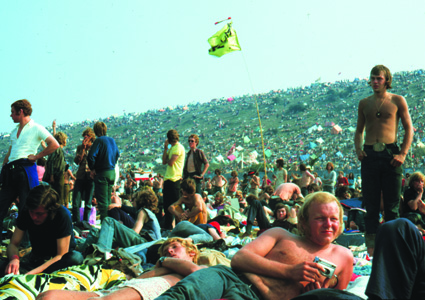
Baby-boom bliss: The Isle of Wight rock festival, 1970 (credit: Roland Godefroy)
Richard Littlejohn, P.J. O'Rourke and Rod Liddle have had remarkably similar careers. They have all been successful reporters and broadcasters, and are now highly-paid and extremely popular columnists of a similar political tinge: libertarian, sceptical and fiercely opposed to political correctness. Now, to their surprise and occasional alarm at having reached their fifties or sixties, they have written memoirs of growing up in the postwar era and critiques of the society their generation has shaped in Britain and America.
Littlejohn (born 1954) is an Essex boy whose family migrated to Peterborough when he was five. His book takes us up to his departure from grammar school at 16, interspersed with the sort of pithy and unfavourable comparisons with today's Britain that make his twice-weekly Daily Mail column so entertaining. Liddle (born 1960) comes from a similar background: a family that slowly moved from the working to the lower middle class, in his case in and around Middlesborough. He takes the opposite course to Littlejohn: his book is a savage indictment of his generation and of today's Britain, with occasional reflections on his own childhood and upbringing. O'Rourke (born 1947) also takes us through his childhood years in middle America and then broadens his scope to provide a succinct and witty analysis of the impact of the baby boomers, of whom he is a classic example.
Although Littlejohn and O'Rourke grew up on different sides of the Atlantic, the similarity between the childhoods they describe is quite remarkable. (As another baby boomer, born in 1948, I can attest to their accuracy, as well as admiring their powers of recall.) It was a world where children were expected and encouraged to be self-reliant and to make their own entertainment.
Littlejohn is the son of a former policeman who became a railway officer worker and worked his way up the management ladder. Richard learnt his alphabet by the age of two and could read and write by the time he went to primary school at four, taught by his mother and grandmothers. There was nothing abnormal about this: that was my experience too, minus the grandmothers. Not that he was a sheltered child: "My young body bore the self-inflicted battle scars which resulted from running at doors with my head; falling out of trees; and clattering down the stairs on a tea tray doubling as a toboggan."
Childhood in the Fifties seemed closer to the era of Tom Sawyer than to today's pampered and protected youngsters, ferried to endless organised activities in SUVs, or getting fat (sorry, obese) playing video games. When the Littlejohn family moved to a half-built estate on the outskirts of Peterborough, young Richard found "a paradise of endless adventures" in the cornfields onto which his new home backed and the building site that comprised the rest of the estate. Inspired by the building of the Berlin Wall in 1961, he and his friends even built their own Checkpoint Charlie with builders' materials. Armed with toy guns, they stopped all cars on the road and were apparently treated with amused tolerance by the drivers. Today, the police would probably send in a helicopter and a Swat team.
At the local primary school "twisted ankles, sprained wrists, scuffed knees, split lips, black eyes, scraped elbows, the odd fracture" were the order of the day. Yet the school topped the table of 11-plus passes to the area's grammar schools every year, thanks to an inspirational headmaster.
In his teenage years he (we) listened to Radio Luxembourg and then the pirate radio ships which suddenly brought a refreshingly anarchic alternative to the bland broadcasting diet of the hitherto monopolist BBC. Equally swiftly, they were banned thanks to that great friend of the people, Tony Benn. Littlejohn attributes his lifelong distrust of big government to this spiteful and unnecessary act. It was "a valuable political lesson: governments exist to find out what people like and then stop them doing it."
Over in suburban Toledo, Ohio (though he never names it), O'Rourke was getting up to much the same sort of thing as Littlejohn, albeit a few years earlier. Children were expected to play outside and the war was also the chief inspiration of games. For other games, the grass seemed to be greener on the other side of the Atlantic. While English kids played cowboys and Indians and Davy Crockett, the young Ohians impersonated Robin Hood and the Knights of the Round Table. Curiously, the same applied in musical taste to Littlejohn and O'Rourke as teenagers: while Littlejohn fell in love with American soul and Motown, O'Rourke liked John Lennon and even skiffle, for heaven's sake. In one respect Littlejohn outdoes O'Rourke: he got to the Isle of Wight rock festival (as a precocious teenager), while O'Rourke failed to make Woodstock because his girlfriend had made a half-hearted suicide attempt (as he says, a very Sixties sort of event).
There is a deeper divide between the two writers. Littlejohn has written an engaging memoir describing a Britain that seems as distant from our country today as Camelot. He hates much of what Britain has become because it has jettisoned the beliefs which underpinned the society in which he grew up: family, independence, and adventurousness. O'Rourke, on the other hand, sets up similar scenarios to Littlejohn and then tries to knock them down. Are today's kids really any less daring than his generation? He looks outside and they seem to be much the same, scooting up and down the pavement. What about the boomers? He looks at his closest childhood buddies, and realises that far from being drop-outs and junkies, all have led deeply conventional lives.
You won't find the words "baby boomer" in Littlejohn's memoir but O'Rourke, like so many of his contemporaries, whether American or British, is obsessed with his generation. Whatever else we are, we're certainly the world's finest navel-gazers. O'Rourke was a standard-issue boomer: he went to college (unlike Littlejohn), worked for an "alternative" magazine, took industrial quantities of drugs and dodged the draft by persuading a gullible psychiatrist he was a hopeless addict (my guess is that he still feels guilty about this, understandably when 58,000 of his contemporaries died in Vietnam).
His endlessly jokey style can become wearisome: "We grew up. We got married. We found true love. This wrecked the marriage. But we're a caring generation. We sometimes take care of the kids on weekend." Ho, ho. But many will agree with his verdict on the boomers: "We're wilful, careless, rash, indulged and entitled." It could be David Willetts speaking. For all their faults, O'Rourke believes the boomers, both American and European, brought down the Berlin Wall by the sheer force of ridicule, have seen the world economy triple in size, and will never cause another world war because of their love of pleasure and self-indulgence. He might just be right there: the boomers were never good on self-sacrifice.
There is a deeper divide between the two writers. Littlejohn has written an engaging memoir describing a Britain that seems as distant from our country today as Camelot. He hates much of what Britain has become because it has jettisoned the beliefs which underpinned the society in which he grew up: family, independence, and adventurousness. O'Rourke, on the other hand, sets up similar scenarios to Littlejohn and then tries to knock them down. Are today's kids really any less daring than his generation? He looks outside and they seem to be much the same, scooting up and down the pavement. What about the boomers? He looks at his closest childhood buddies, and realises that far from being drop-outs and junkies, all have led deeply conventional lives.
You won't find the words "baby boomer" in Littlejohn's memoir but O'Rourke, like so many of his contemporaries, whether American or British, is obsessed with his generation. Whatever else we are, we're certainly the world's finest navel-gazers. O'Rourke was a standard-issue boomer: he went to college (unlike Littlejohn), worked for an "alternative" magazine, took industrial quantities of drugs and dodged the draft by persuading a gullible psychiatrist he was a hopeless addict (my guess is that he still feels guilty about this, understandably when 58,000 of his contemporaries died in Vietnam).
His endlessly jokey style can become wearisome: "We grew up. We got married. We found true love. This wrecked the marriage. But we're a caring generation. We sometimes take care of the kids on weekend." Ho, ho. But many will agree with his verdict on the boomers: "We're wilful, careless, rash, indulged and entitled." It could be David Willetts speaking. For all their faults, O'Rourke believes the boomers, both American and European, brought down the Berlin Wall by the sheer force of ridicule, have seen the world economy triple in size, and will never cause another world war because of their love of pleasure and self-indulgence. He might just be right there: the boomers were never good on self-sacrifice.
Rod Liddle is what O'Rourke calls a freshman, i.e. last-generation baby boomer, who takes for granted the personal freedoms the older boomers fought (or sulked) for. Barack Obama is a freshman boomer too, which says it all. Liddle's take on modern Britain (subtitled "How we ended up greedy, narcissistic and unhappy") is not so different to Littlejohn's. He loathes lawyers, educators, the liberal elite (about whom he is extremely funny), the new generation of politicians, the Archbishop of Canterbury, consumerism, people who think they're ill when they aren't, David Starkey, the cultural Marxists of the Frankfurt School and the free-market economists of the Chicago School. I doubt, though, that Littlejohn shares his preferred solution: more state intervention, even nationalisation, which indicates that he, like Littlejohn, yearns for an idealised Britain that can never be re-created.
Reading Liddle is a bit like being stuck in the pub with a cantankerous stranger who has some interesting things to say but goes on rather too long. His book is laced with four-letter words which, like O'Rourke's jokes, start to grate after a few pages; perhaps foul-mouthed jokiness is a baby-boomer characteristic. (Interestingly, the best-written of these three books is Littlejohn's: he is the only one of the authors not to have gone to university.)
For what it's worth, like O'Rourke, I'm inclined to defend my generation while, like Littlejohn and Liddle, mourning the loss of the certainties that governed our parents' lives. I don't think we're so different to them except that we have a much closer relationship with our children. But the vast majority of us settled down after our youthful rebellions, worked hard and lived lives of blameless respectability. Even though many of us have reached retirement age some of us are still helping to look after our children and grandchildren (and sometimes even our parents). For all the local conflicts smouldering around the globe and the many dangers to our hard-won freedoms, mainly from Islamist fanatics, the world is much more prosperous and peaceful than the one we were born into. Perhaps we can take a little of the credit for that.
Reading Liddle is a bit like being stuck in the pub with a cantankerous stranger who has some interesting things to say but goes on rather too long. His book is laced with four-letter words which, like O'Rourke's jokes, start to grate after a few pages; perhaps foul-mouthed jokiness is a baby-boomer characteristic. (Interestingly, the best-written of these three books is Littlejohn's: he is the only one of the authors not to have gone to university.)
For what it's worth, like O'Rourke, I'm inclined to defend my generation while, like Littlejohn and Liddle, mourning the loss of the certainties that governed our parents' lives. I don't think we're so different to them except that we have a much closer relationship with our children. But the vast majority of us settled down after our youthful rebellions, worked hard and lived lives of blameless respectability. Even though many of us have reached retirement age some of us are still helping to look after our children and grandchildren (and sometimes even our parents). For all the local conflicts smouldering around the globe and the many dangers to our hard-won freedoms, mainly from Islamist fanatics, the world is much more prosperous and peaceful than the one we were born into. Perhaps we can take a little of the credit for that.