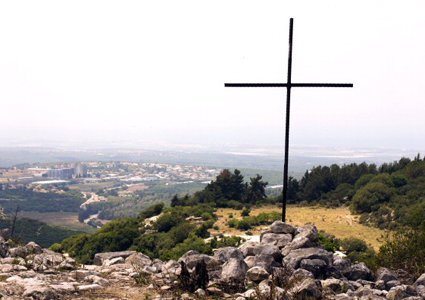
Gone from the Galilee: The Christian residents of Igrit were ordered out of their homes in November 1948
For a few days this May, the little town of Bethlehem faced a publicity onslaught. Quiet alleyways and subdued streets became a bustle of activity. Seemingly every wall in the town centre was adorned with posters, signs and giant photographs, as pilgrims and press from all over the world flocked to the West Bank city to catch a glimpse of Pope Francis on his first official visit to the Holy Land. Itineraries were scrutinised for political bias, detailed discussions over the wearing of religious insignia were held, while religious tourists and curious onlookers cheered and posed for numerous selfies. Yet, among the Pope's core constituency, the local Christians, there was a noticeable lack of enthusiasm for the visit.
"The Pope is not coming for us, a shopkeeper tells me bitterly, dozens of strings of the rosary beads he sells jangling on his wrists. "He is coming for the Muslims. He gives them legitimacy, not us, by coming here. I'm going crazy here, I don't like it. Tell me, why doesn't the Pope give legitimacy to us?"
What possible legitimacy could be needed for the Christians who live in the town celebrated every Christmas by church congregations and choirs the world over? The reality for Christians in the West Bank today is far removed from greetings card images. For one thing, they are disappearing.
While Bethlehem remains the most populous Christian city in the West Bank, its Christian population, as in the West Bank generally, is shrinking dramatically. Only 50 years ago, Christians constituted 70 per cent of Bethlehem's population. Today they make up just 15 per cent. Christians number approximately 38,000 people in the West Bank, representing 2 per cent of the population.
"We used to be many. Now there are so few of us left. Everyone is trying to leave," says Samir, another salesman in a neighbouring shop selling Orthodox icons. Worrying about the consequences of complaining about the situation, Samir declined to use his real name.
"My mother doesn't like to walk in the street at night because her hair is uncovered, and people come up behind her and make rude comments," he tells me. During Christmas celebrations last December, women in their twenties on a visit from London with their parents and siblings complained of being harassed by a gang of male youths as they stood watching a festive performance in Manger Square. The gang did not desist until some local women came to stand nearby and told the boys to stop.
Everyone agrees that economic hardship and the low birthrate of the Christian community are the primary causes for decline. Yet in recent years Christians in Bethlehem also complain of a growing climate of intimidation from Islamic extremists.
"We announce to the nation joyously that with the grace of God the ideology of global jihad has attained a foothold in the West Bank, after everyone had tried to abort every seed planted there," stated the message from the Mujahideen Shura Council, an al-Qaeda-linked group as it declared its presence in the West Bank last December. Three of its members were killed by the Israeli Shin Bet (security service) after they were suspected of planning a terror attack.
"The Pope is not coming for us, a shopkeeper tells me bitterly, dozens of strings of the rosary beads he sells jangling on his wrists. "He is coming for the Muslims. He gives them legitimacy, not us, by coming here. I'm going crazy here, I don't like it. Tell me, why doesn't the Pope give legitimacy to us?"
What possible legitimacy could be needed for the Christians who live in the town celebrated every Christmas by church congregations and choirs the world over? The reality for Christians in the West Bank today is far removed from greetings card images. For one thing, they are disappearing.
While Bethlehem remains the most populous Christian city in the West Bank, its Christian population, as in the West Bank generally, is shrinking dramatically. Only 50 years ago, Christians constituted 70 per cent of Bethlehem's population. Today they make up just 15 per cent. Christians number approximately 38,000 people in the West Bank, representing 2 per cent of the population.
"We used to be many. Now there are so few of us left. Everyone is trying to leave," says Samir, another salesman in a neighbouring shop selling Orthodox icons. Worrying about the consequences of complaining about the situation, Samir declined to use his real name.
"My mother doesn't like to walk in the street at night because her hair is uncovered, and people come up behind her and make rude comments," he tells me. During Christmas celebrations last December, women in their twenties on a visit from London with their parents and siblings complained of being harassed by a gang of male youths as they stood watching a festive performance in Manger Square. The gang did not desist until some local women came to stand nearby and told the boys to stop.
Everyone agrees that economic hardship and the low birthrate of the Christian community are the primary causes for decline. Yet in recent years Christians in Bethlehem also complain of a growing climate of intimidation from Islamic extremists.
"We announce to the nation joyously that with the grace of God the ideology of global jihad has attained a foothold in the West Bank, after everyone had tried to abort every seed planted there," stated the message from the Mujahideen Shura Council, an al-Qaeda-linked group as it declared its presence in the West Bank last December. Three of its members were killed by the Israeli Shin Bet (security service) after they were suspected of planning a terror attack.
Members of the Salafi movement — an ultra-conservative current within the Sunni branch of Islam — have been based in the Gaza Strip for the past decade or so, but in recent months their presence has spread to the West Bank. While most Salafis are non-violent, the extremist fringes have a strong jihadist element that borrows from al-Qaeda's ideology, as can be witnessed in Gaza, Syria and the Sinai, where in recent years such groups have thrived. The stated endgame of the extremists is to establish an Islamic caliphate — and Christians, Jews and others are considered infidels.
In Bethlehem, residents talk about an increasingly antagonistic climate between faiths. Just weeks prior to the Pope's visit, a proselytising group of Muslims stood near the entrance of the Church of the Nativity, handing out copies of the Koran in multiple languages, and telling people on their way to the church to pray to Allah instead. "It was insulting. I feel like I don't live in a Christian place any more," says Samir, adding that such events are happening more and more often.
A few days after the incident outside the Church of the Nativity, he describes celebrating the feast of St George in another church a few miles outside Bethlehem when a violent brawl between Christian and Muslim worshippers broke out. Stones were thrown, and a video of the event shows people running away in fear. Samir said the event was terrifying. "They will throw us out of our own country."
About 60 miles away in northern Israel, a must-stop site for Christian pilgrims is the Basilica of the Annunciation in Nazareth, the largest church in the Middle East. Surrounded by stained-glass windows and mosaics from all over the world, the airy nave of the church leads you eventually down a dimly-lit stairway to a sunken enclosure which marks the spot where Mary was famously visited by the Angel Gabriel, who told her that she was expecting "the Son of God".
Yet to step inside the church, worshippers must pass large posters hung outside, decorated with a warning triangle and stating: "Allah is the one and only God". Rejecting Jesus, the signs go on to proclaim that "his holiness is far above having a son".
No one knows exactly who is responsible for the posters. "Some tried to take the signs down and burn them several times already," explains Leon Barra, a 30-year-old who has lived in Nazareth all his life. "But two weeks later they were back up."
"We wrote to the Pope, asking him to come here because we need his support," says one shopkeeper selling jewellery at a nearby stall. "He replied saying that he did not have enough time, but that the time to visit Nazareth will come."
Christians in Israel are a minority within a minority. Approximately 20 per cent of Israel's population of 8 million are Arabs — of whom ten percent are Christians. Although the number of Christians living in Israel between 1949 and 2013 has more than quadrupled, according to Israel's Central Bureau of Statistics, the overall Christian share of Israel's population has decreased over the years because of migration and low birthrates — from 2.5 per cent in 1950 to 1.6 per cent now.
In the winding alleys of Nazareth's old city market, several Christian shopkeepers confide on condition of anonymity that criminal gangs subject some of the local businesses to intimidation and death threats if they do not pay monthly protection money.
In Bethlehem, residents talk about an increasingly antagonistic climate between faiths. Just weeks prior to the Pope's visit, a proselytising group of Muslims stood near the entrance of the Church of the Nativity, handing out copies of the Koran in multiple languages, and telling people on their way to the church to pray to Allah instead. "It was insulting. I feel like I don't live in a Christian place any more," says Samir, adding that such events are happening more and more often.
A few days after the incident outside the Church of the Nativity, he describes celebrating the feast of St George in another church a few miles outside Bethlehem when a violent brawl between Christian and Muslim worshippers broke out. Stones were thrown, and a video of the event shows people running away in fear. Samir said the event was terrifying. "They will throw us out of our own country."
About 60 miles away in northern Israel, a must-stop site for Christian pilgrims is the Basilica of the Annunciation in Nazareth, the largest church in the Middle East. Surrounded by stained-glass windows and mosaics from all over the world, the airy nave of the church leads you eventually down a dimly-lit stairway to a sunken enclosure which marks the spot where Mary was famously visited by the Angel Gabriel, who told her that she was expecting "the Son of God".
Yet to step inside the church, worshippers must pass large posters hung outside, decorated with a warning triangle and stating: "Allah is the one and only God". Rejecting Jesus, the signs go on to proclaim that "his holiness is far above having a son".
No one knows exactly who is responsible for the posters. "Some tried to take the signs down and burn them several times already," explains Leon Barra, a 30-year-old who has lived in Nazareth all his life. "But two weeks later they were back up."
"We wrote to the Pope, asking him to come here because we need his support," says one shopkeeper selling jewellery at a nearby stall. "He replied saying that he did not have enough time, but that the time to visit Nazareth will come."
Christians in Israel are a minority within a minority. Approximately 20 per cent of Israel's population of 8 million are Arabs — of whom ten percent are Christians. Although the number of Christians living in Israel between 1949 and 2013 has more than quadrupled, according to Israel's Central Bureau of Statistics, the overall Christian share of Israel's population has decreased over the years because of migration and low birthrates — from 2.5 per cent in 1950 to 1.6 per cent now.
In the winding alleys of Nazareth's old city market, several Christian shopkeepers confide on condition of anonymity that criminal gangs subject some of the local businesses to intimidation and death threats if they do not pay monthly protection money.
"They are demanding money only from the Christians. No Christian can open a shop on the main road without being required to pay," says one shopkeeper, nervously looking out of his window to check for eavesdroppers.
The price for not paying is made clear. One owner who had refused to pay had his shop peppered with bullets. Another's shopfront was set on fire. The crimes, the locals explain, are perpetrated by gangs "without religion" and started several years ago. Those affected remain too scared to seek help from the police, who they say have neglected the city.
Leon Barra describes how he was "chased, knifed and threatened" by "fundamentalists" who, he says, tried to kill him several years ago. "No one protected me — not until the same gang killed a Jewish taxi driver. Only then did the police put them in jail." He says no one is immune from the criminals, but the Christians constitute the majority of those targeted: "Christians are always the weaker party here, due to our smaller families."
Elsewhere in Israel, action is being taken over a spate of hate crimes directed at both Christians and Muslims. Jerusalem, along with other cities in Israel and the West Bank, has seen a spike in so-called "price tag attacks". Graffiti on houses, churches and mosques, vandalism and arson are just some of the actions taken by Jewish extremists in recent years. The trend was begun in the West Bank in 2009 by radical settlers angry at measures intended to curb settlement growth. Since then the movement has spilled over into Israel. In recent months, the Israeli police have cracked down on the perpetrators, establishing a special price tag unit and even using drone technology to capture the criminals.
But in Nazareth intimidation is still rife. "The residents are afraid to go to the police, because if they do, the next day their houses and car will be attacked," says Father Nadaf, a local Greek Orthodox priest, noting that there is increasing violence among Israeli Arabs generally.
Father Nadaf is no ordinary priest. For one thing, there is a "wanted" poster with his photograph and a hefty price on his head circulating on the internet.
The reason for this is that many object to Nadaf's stance on integration within Israeli society. Because the majority of Israel's Christians are Arabs, they are exempt from military service. But Nadaf and others say that this is not the way forward. He advocates what he calls "full engagement with the Jewish community".
Full engagement means serving in the Israeli Defence Forces, which is compulsory for male and female Jewish Israelis (except for the majority of the ultra-Orthodox until now).
"Israeli Christians are a minority," says Nadaf. "There is a good and stable relationship between Jews and Christians in Israel. It's a cause of great pride." But in Syria, Egypt, Iraq and elsewhere, Christians are being persecuted, he says.
In March, Nadaf led a 150-strong demonstration of Christian Arabs outside the European Union mission in Tel Aviv. "According to the statistics, a Christian is murdered every five minutes in the Middle East, and the Western world is silent about this," he said to his fellow demonstrators.
Today Nadaf encourages other Christians in Israel to realign with the Jewish majority instead. In 2012, he became head of the Israeli Christian Recruitment Forum, a joint government-community group founded by members of the clergy and prominent Israeli Christians already serving in the IDF, police and border police, with the aim of encouraging Christian youth to enlist.
The price for not paying is made clear. One owner who had refused to pay had his shop peppered with bullets. Another's shopfront was set on fire. The crimes, the locals explain, are perpetrated by gangs "without religion" and started several years ago. Those affected remain too scared to seek help from the police, who they say have neglected the city.
Leon Barra describes how he was "chased, knifed and threatened" by "fundamentalists" who, he says, tried to kill him several years ago. "No one protected me — not until the same gang killed a Jewish taxi driver. Only then did the police put them in jail." He says no one is immune from the criminals, but the Christians constitute the majority of those targeted: "Christians are always the weaker party here, due to our smaller families."
Elsewhere in Israel, action is being taken over a spate of hate crimes directed at both Christians and Muslims. Jerusalem, along with other cities in Israel and the West Bank, has seen a spike in so-called "price tag attacks". Graffiti on houses, churches and mosques, vandalism and arson are just some of the actions taken by Jewish extremists in recent years. The trend was begun in the West Bank in 2009 by radical settlers angry at measures intended to curb settlement growth. Since then the movement has spilled over into Israel. In recent months, the Israeli police have cracked down on the perpetrators, establishing a special price tag unit and even using drone technology to capture the criminals.
But in Nazareth intimidation is still rife. "The residents are afraid to go to the police, because if they do, the next day their houses and car will be attacked," says Father Nadaf, a local Greek Orthodox priest, noting that there is increasing violence among Israeli Arabs generally.
Father Nadaf is no ordinary priest. For one thing, there is a "wanted" poster with his photograph and a hefty price on his head circulating on the internet.
The reason for this is that many object to Nadaf's stance on integration within Israeli society. Because the majority of Israel's Christians are Arabs, they are exempt from military service. But Nadaf and others say that this is not the way forward. He advocates what he calls "full engagement with the Jewish community".
Full engagement means serving in the Israeli Defence Forces, which is compulsory for male and female Jewish Israelis (except for the majority of the ultra-Orthodox until now).
"Israeli Christians are a minority," says Nadaf. "There is a good and stable relationship between Jews and Christians in Israel. It's a cause of great pride." But in Syria, Egypt, Iraq and elsewhere, Christians are being persecuted, he says.
In March, Nadaf led a 150-strong demonstration of Christian Arabs outside the European Union mission in Tel Aviv. "According to the statistics, a Christian is murdered every five minutes in the Middle East, and the Western world is silent about this," he said to his fellow demonstrators.
Today Nadaf encourages other Christians in Israel to realign with the Jewish majority instead. In 2012, he became head of the Israeli Christian Recruitment Forum, a joint government-community group founded by members of the clergy and prominent Israeli Christians already serving in the IDF, police and border police, with the aim of encouraging Christian youth to enlist.
"We see the army as the first step in becoming more integrated with the state," Nadaf says.
"Due to our connection to the land, our roots, and in light of what is happening in the neighbouring countries and the daily suffering of Christians, our youth feels they must sacrifice for the state of Israel that is protecting them. Now we are following in the footsteps of the Druze."
The Druze are followers of a mystical faith that is an offshoot of Islam. Though the Druze are exempt from conscription, members of the sect in Israel have served in the IDF for generations and are known for their loyalty to the state. Israel's economy minister Naftali Bennett credits a Druze soldier with saving his life when he prevented him from stepping on a landmine during the 2006 war with Hezbollah.
The Druze in the Golan Heights are an exception. The area was conquered by Israel from Syria in the 1967 war and the Druze there usually align themselves with Syria. Yet the massacres being perpetrated by President Assad on his own people have changed the minds of Golan Druze, and for the first time some of them have taken up Israeli citizenship. Some of the Arab bedouins in Israel are also opting to serve in the IDF. Nadaf and others seek to follow the same precedent.
In 2012 just 35 Christian soldiers joined the army; in 2013 the number was 150. By March this year, 105 had enlisted, according to figures cited by the Israeli Christian Recruitment Forum. Nadaf predicts the numbers will hit new records by the end of 2014. "This year there is going to be a big surprise, both for the Israeli and the Arab leadership," he says.
Serving in the IDF is a taboo topic for most Israeli Arabs, but Nadaf does not stop there. He also vigorously promotes the idea that the Christian minority should rid itself of its identity as "Arab" altogether. The Arab identity, he says, was forcefully imposed upon the Christians and has done them no favours. "The Arab leadership has been stealing for years the Christian community's rightful place. The Arab leadership only created unnecessary conflicts between the Christians and the Jews."
In place of their Arab identity, others in the Israeli Christian community are working to resurrect their previous Christian identity as Aramaeans, by teaching Aramaic, the language spoken by Jesus.
One school in the village of Gush Halav (also known as Jish), perched on Israel's border with Lebanon, has recently become the first Israeli school to teach Aramaic as part of its curriculum. This came about after members of the community created a group with the goal of reviving Aramaic as a means of reconnecting local people with their roots. Israel's Education Ministry agreed to allocate some teaching hours for Aramaean heritage to be taught to pupils aged six to 14.
Teaching a nearly extinct language is no easy feat, admits Amir Haloul, an Aramaic teacher who commutes to the village every week from the coastal city of Haifa.
"In Israel, we have about 50 people who know how to speak, read and write in Aramaic," he says, although many others "know how to read and sing songs" in the language. Still, he says that reviving it is vital for the future.
"Due to our connection to the land, our roots, and in light of what is happening in the neighbouring countries and the daily suffering of Christians, our youth feels they must sacrifice for the state of Israel that is protecting them. Now we are following in the footsteps of the Druze."
The Druze are followers of a mystical faith that is an offshoot of Islam. Though the Druze are exempt from conscription, members of the sect in Israel have served in the IDF for generations and are known for their loyalty to the state. Israel's economy minister Naftali Bennett credits a Druze soldier with saving his life when he prevented him from stepping on a landmine during the 2006 war with Hezbollah.
The Druze in the Golan Heights are an exception. The area was conquered by Israel from Syria in the 1967 war and the Druze there usually align themselves with Syria. Yet the massacres being perpetrated by President Assad on his own people have changed the minds of Golan Druze, and for the first time some of them have taken up Israeli citizenship. Some of the Arab bedouins in Israel are also opting to serve in the IDF. Nadaf and others seek to follow the same precedent.
In 2012 just 35 Christian soldiers joined the army; in 2013 the number was 150. By March this year, 105 had enlisted, according to figures cited by the Israeli Christian Recruitment Forum. Nadaf predicts the numbers will hit new records by the end of 2014. "This year there is going to be a big surprise, both for the Israeli and the Arab leadership," he says.
Serving in the IDF is a taboo topic for most Israeli Arabs, but Nadaf does not stop there. He also vigorously promotes the idea that the Christian minority should rid itself of its identity as "Arab" altogether. The Arab identity, he says, was forcefully imposed upon the Christians and has done them no favours. "The Arab leadership has been stealing for years the Christian community's rightful place. The Arab leadership only created unnecessary conflicts between the Christians and the Jews."
In place of their Arab identity, others in the Israeli Christian community are working to resurrect their previous Christian identity as Aramaeans, by teaching Aramaic, the language spoken by Jesus.
One school in the village of Gush Halav (also known as Jish), perched on Israel's border with Lebanon, has recently become the first Israeli school to teach Aramaic as part of its curriculum. This came about after members of the community created a group with the goal of reviving Aramaic as a means of reconnecting local people with their roots. Israel's Education Ministry agreed to allocate some teaching hours for Aramaean heritage to be taught to pupils aged six to 14.
Teaching a nearly extinct language is no easy feat, admits Amir Haloul, an Aramaic teacher who commutes to the village every week from the coastal city of Haifa.
"In Israel, we have about 50 people who know how to speak, read and write in Aramaic," he says, although many others "know how to read and sing songs" in the language. Still, he says that reviving it is vital for the future.
"Our main challenge is to spread our history, knowledge and identity, which have been hidden from our people," he says. "It started 1,400 years ago during the Arab occupation, which spread the Arabic language and prevented people from speaking Aramaic. Then in the 13th century the Turks came and did the same. Now the Arab countries don't respect the Aramaic language. If the people only knew the truth, they would refuse to remain under the fake Arab identity."
But all three initiatives — serving in the IDF, reviving Aramaic, and discarding their Arab identity — have been met with fierce criticism from many others in the Maronite and wider Christian community.
Michel Aoun, a Christian lawyer, says that the move to ditch the Arab identity is not supported "by even one per cent" of the Maronites, who make up 20-25 per cent of Lebanon's population and who number about 11,000 of Israel's 155,000 Christians.
"It's a historical fact that the Christians are originally Palestinians — this has been the case for years, even centuries before 1948 [the year Israel was established].
"We are Maronites — with a Palestinian nationality, Israeli citizenship and Christian faith."
As for Aramaic, one teenage high school student tells me bluntly: "It's a dead language. I don't care about it any more." As an elder member of the community challenges her, she does not recant. "Yes, it's used in the church, but we don't use it in our daily lives."
On the streets of Nazareth, many local Christians do not bother to hide their disdain of Father Nadaf and his colleagues. "Nadaf is an outcast. No one listens to him," says Leon Barra. "I don't like that he doesn't term us Arabs. He is trying to deny our Arab identity because he has a political agenda. But it does not serve to deny your roots. Yes, we should integrate more into Israeli society, but we should not melt into it completely. And claiming to be Aramaic and not Arab — it's like a Lebanese claiming he is actually a Phoenician."
Nationally, the idea of joining the army is hotly contested. Many see it as a policy to divide and rule the Israeli Arabs. One Israeli Arab member of the Knesset, Basel Ghattas, appealed to the Pope directly to intervene and tell Christians to stop volunteering for the IDF.
But in Nazareth, army service seems surprisingly well-received by many Christians. "I support the idea of Christians serving in the army", says Barra. "I think the army is a good thing overall, although it's still not common among our community to serve in it. But I disagree with the Israeli structure of the army. If you're not Ashkenazi [of Eastern European origin] you can't dream of being a pilot."
When asked why he did not do army service himself, he answers with a shrug. "I regret not doing it — it teaches you a lot of skills: self-reliance, independence. But at the time, I was reluctant to give up three years of my life for it."
Leon sees a role for Christians in the IDF, particularly in troubled hotspots where conflict arises on a daily basis. "Christian Arab soldiers can serve in Hebron," he says. "Look at what's happening there," referring to a recent incident in which an IDF soldier threatening a Hebron youth with his gun. Christian presence and cultural sensitivities can help alleviate tensions, says Leon.
But all three initiatives — serving in the IDF, reviving Aramaic, and discarding their Arab identity — have been met with fierce criticism from many others in the Maronite and wider Christian community.
Michel Aoun, a Christian lawyer, says that the move to ditch the Arab identity is not supported "by even one per cent" of the Maronites, who make up 20-25 per cent of Lebanon's population and who number about 11,000 of Israel's 155,000 Christians.
"It's a historical fact that the Christians are originally Palestinians — this has been the case for years, even centuries before 1948 [the year Israel was established].
"We are Maronites — with a Palestinian nationality, Israeli citizenship and Christian faith."
As for Aramaic, one teenage high school student tells me bluntly: "It's a dead language. I don't care about it any more." As an elder member of the community challenges her, she does not recant. "Yes, it's used in the church, but we don't use it in our daily lives."
On the streets of Nazareth, many local Christians do not bother to hide their disdain of Father Nadaf and his colleagues. "Nadaf is an outcast. No one listens to him," says Leon Barra. "I don't like that he doesn't term us Arabs. He is trying to deny our Arab identity because he has a political agenda. But it does not serve to deny your roots. Yes, we should integrate more into Israeli society, but we should not melt into it completely. And claiming to be Aramaic and not Arab — it's like a Lebanese claiming he is actually a Phoenician."
Nationally, the idea of joining the army is hotly contested. Many see it as a policy to divide and rule the Israeli Arabs. One Israeli Arab member of the Knesset, Basel Ghattas, appealed to the Pope directly to intervene and tell Christians to stop volunteering for the IDF.
But in Nazareth, army service seems surprisingly well-received by many Christians. "I support the idea of Christians serving in the army", says Barra. "I think the army is a good thing overall, although it's still not common among our community to serve in it. But I disagree with the Israeli structure of the army. If you're not Ashkenazi [of Eastern European origin] you can't dream of being a pilot."
When asked why he did not do army service himself, he answers with a shrug. "I regret not doing it — it teaches you a lot of skills: self-reliance, independence. But at the time, I was reluctant to give up three years of my life for it."
Leon sees a role for Christians in the IDF, particularly in troubled hotspots where conflict arises on a daily basis. "Christian Arab soldiers can serve in Hebron," he says. "Look at what's happening there," referring to a recent incident in which an IDF soldier threatening a Hebron youth with his gun. Christian presence and cultural sensitivities can help alleviate tensions, says Leon.
A local restaurant owner agrees. "We are the same here, we're born in the same place, we go to the same schools. The army is OK for me. If you live here, you must be like everyone else. I think Arab leaders should demand that Arabs do military service in Israel, because it will embarrass the Israeli government, as they don't consider us equal citizens. Even those who do go into the army don't end up in the air force or intelligence. We want this army to be with us, not against us. But the Arab leadership is very divided."
Others take a more radical approach. In June, a demonstration against the IDF draft took place in the Galilee village of Sakhnin. Protestors publicly tore up IDF draft invitations after Israel, for the first time in its history, sent voluntary draft notices to thousands of young Arab Christians. Those taking part in the rally called upon local Arab leaders to ostracise anybody who enlists in the IDF.
The one political factor unifying the Christians of all stripes in Israel, however, is the demand to return to the villages they were forced to leave in 1948 after Israel's war of independence.
In the village of Biram, skeletal stone structures of what used to be houses may be overgrown by vegetation, but in every doorway a framed photograph of the pre-1948 owner still hangs. All the local Christian schoolchildren, the locals tell me, know exactly where their families used to live.
The 1,050 Christian inhabitants of Kafr Bir'im and the neighbouring village of Iqrit were asked to leave their homes by the Israeli army in November 1948 while it was clearing the area of enemy forces. Both the army and the residents confirm that the villagers did not resist and left peacefully, having been given an explicit promise that they would be allowed to return once security was established. This was backed up by the High Court, which ruled in 1951 that the villagers should be allowed to return to their houses. But immediately afterwards the area was sealed off as a military security zone, and in 1953 the homes were demolished. Only the church was left standing.
Scores of Israeli politicians, including former prime minister Golda Meir, supported the right of return to the villages, to no avail: it was deemed to set a precedent for others who had fled their homes in 1948.
Since August 2013, about 200 activists have been taking turns camping out in tents set up in the remaining structures in protest, while the court case over the legality of Israel's action continues. During an unprecedented visit to Israel in May by Cardinal Bechara Rai, head of the Maronite Church in Lebanon, the Kafr Bir'im and Iqrit community delivered a letter written in Arabic, English and, yes, Aramaic. In it, they asked the Cardinal to mediate between them and the Israeli government. "In the letter, we told him that we have good lives here, we live better than any other Christian community in the Middle East," Amir Halloul tells me. "But we want our villages back."
Others take a more radical approach. In June, a demonstration against the IDF draft took place in the Galilee village of Sakhnin. Protestors publicly tore up IDF draft invitations after Israel, for the first time in its history, sent voluntary draft notices to thousands of young Arab Christians. Those taking part in the rally called upon local Arab leaders to ostracise anybody who enlists in the IDF.
The one political factor unifying the Christians of all stripes in Israel, however, is the demand to return to the villages they were forced to leave in 1948 after Israel's war of independence.
In the village of Biram, skeletal stone structures of what used to be houses may be overgrown by vegetation, but in every doorway a framed photograph of the pre-1948 owner still hangs. All the local Christian schoolchildren, the locals tell me, know exactly where their families used to live.
The 1,050 Christian inhabitants of Kafr Bir'im and the neighbouring village of Iqrit were asked to leave their homes by the Israeli army in November 1948 while it was clearing the area of enemy forces. Both the army and the residents confirm that the villagers did not resist and left peacefully, having been given an explicit promise that they would be allowed to return once security was established. This was backed up by the High Court, which ruled in 1951 that the villagers should be allowed to return to their houses. But immediately afterwards the area was sealed off as a military security zone, and in 1953 the homes were demolished. Only the church was left standing.
Scores of Israeli politicians, including former prime minister Golda Meir, supported the right of return to the villages, to no avail: it was deemed to set a precedent for others who had fled their homes in 1948.
Since August 2013, about 200 activists have been taking turns camping out in tents set up in the remaining structures in protest, while the court case over the legality of Israel's action continues. During an unprecedented visit to Israel in May by Cardinal Bechara Rai, head of the Maronite Church in Lebanon, the Kafr Bir'im and Iqrit community delivered a letter written in Arabic, English and, yes, Aramaic. In it, they asked the Cardinal to mediate between them and the Israeli government. "In the letter, we told him that we have good lives here, we live better than any other Christian community in the Middle East," Amir Halloul tells me. "But we want our villages back."