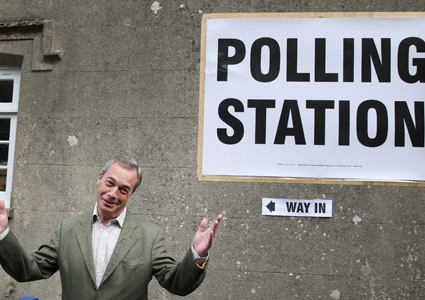
Botched ruling: The Electoral Commission's decision to allow "An Independence From Europe — UK Independence Now" to appear on ballot papers at the top of the list of candidates probably cost Nigel Farage's UKIP two MPs (credit: Getty Images)
Anyone who cares about the hardware of democracy should be concerned that in the European Parliamentary election on May 22, 2014, almost a quarter of a million people voted for an unknown political party called "An Independence from Europe", which did not even exist until March 26, 2014. This new name, with the slogan "UK Independence Now" alongside it, appeared on ballot papers in every region, earning this fledgling political party tens of thousands of votes all over the country — and this happened with the full approval of the Electoral Commission.
It was the brainchild of Mike Nattrass, the former West Midlands UKIP MEP, who had a falling out with the party when he was not selected to run for re-election in 2014. Nattrass registered his new party in May 2012 under the name "4 a Referendum" more than 12 months before he was deselected, so he might have had an inkling of what was coming.
In late 2013, "4 a Referendum Party" morphed into "A Referendum Party" and then an application was made on February 24, 2014, to change the name to "An Independence Party". The following day, the Electoral Commission rejected this name on the grounds that it was "too close to UK Independence Party". The "party description fails on confusion with a registered party" read a note that appears on the paperwork, signed by a Commission official (name redacted). A further application was made on March 21, 2014, to register: "An Independence from Europe". This time the Commission allowed it, giving its approval in less than a week, on March 26. Apparently, the insertion of the words "from Europe" satisfied its previous concerns about "confusion".
What is clear to everyone but the Electoral Commission is that this new party name and slogan were deliberately placed on the ballot paper to confuse voters. It was a blatant example of "passing off" one party for another. The fact that the Commission realised there was potential for confusion if it allowed the name "An Independence Party" makes it all the more troubling that it allowed the subsequent application simply because the words "from Europe" had been added.
Parties are listed on the ballot paper in alphabetical order. Cunningly, Nattrass had registered a name that would appear at the top of the ballot paper and added the slogan "UK Independence Now", knowing that the real UKIP would appear at the bottom. In many polling stations, and most notably on postal ballots, the ballot paper was folded, putting UKIP behind a fold and Nattrass's new name on top of what was a lengthy sheet. It was a direct appeal to the core of UKIP's support and there is no doubt that it confused voters on a large scale.
An Independence from Europe, because it fielded candidates in all regions, also qualified for party political broadcasts, which featured candidates who were routinely shown on screen above the words "UK Independence MEP candidate". Only the word "party" was missing and even some hardened UKIP supporters were fooled into thinking that they were looking at a UKIP broadcast, especially when they saw a familiar face — Nattrass himself — taking part. Many other candidates standing for the new party were disenfranchised former UKIP members who might also have been familiar to some voters.
Naturally, strong representations were made to the Electoral Commission by UKIP's leadership and many of its supporters, but they got short shrift because the Commission had bizarrely decided that the new party's name was not confusing to the voters. Writing in a standard response to the many complaints it received, an apparatchik with the title "Assistant Advisor Guidance" wrote:
In the fanciful world of the Electoral Commission, voters at the European election would easily distinguish between "An Independence from Europe — UK Independence Now", and the "UK Independence Party" and that there would be no confusion at all.
Yet the election result proved that hundreds of thousands of voters were in fact misled. An Independence from Europe scooped 235,000 votes despite being completely unheard of prior to the election. Scandalously, its vote was sufficiently high in London and the South West region to deny UKIP an extra seat in both cases, providing the country with two Green Party MEPs that it manifestly did not want.
Naturally, strong representations were made to the Electoral Commission by UKIP's leadership and many of its supporters, but they got short shrift because the Commission had bizarrely decided that the new party's name was not confusing to the voters. Writing in a standard response to the many complaints it received, an apparatchik with the title "Assistant Advisor Guidance" wrote:
One test is whether in the opinion of the Commission a party name, description or emblem is the same as one that is already on the register; or it is likely to result in voters confusing it with one that is already on the register.
Neither the party name "An Independence from Europe" nor the description "UK Independence Now" was already on the register. Therefore we made the decision that the party name was not likely to cause voters to confuse it with another registered party.
We also considered the test of whether the name and description could result in voters confusing them with names or descriptions that are already registered. We decided that although there are some overlapping words, the party name and description are sufficiently different from those registered by the UK Independence Party (UKIP) to mean that in our opinion voters were not likely to confuse them with the UKIP name and descriptions.
In the fanciful world of the Electoral Commission, voters at the European election would easily distinguish between "An Independence from Europe — UK Independence Now", and the "UK Independence Party" and that there would be no confusion at all.
Yet the election result proved that hundreds of thousands of voters were in fact misled. An Independence from Europe scooped 235,000 votes despite being completely unheard of prior to the election. Scandalously, its vote was sufficiently high in London and the South West region to deny UKIP an extra seat in both cases, providing the country with two Green Party MEPs that it manifestly did not want.
UKIP's constituency association chairman, David Watt, was an observer at the count in Brentwood, Essex, and confirmed, in a letter to the local returning officer, that around 30 ballot papers had initial votes for "An Independence from Europe" which had been changed to votes for UKIP, presumably when the voters realised their mistake. These ballots were deemed to be spoiled. Mr Watt added: "There were no instances where the erasure was replaced by a cross in favour of any other party." Even more disturbing was his revelation that there were 369 unaltered votes for An Independence from Europe at the same count. He concluded: "Based on the spoiled vote evidence, we can reasonably assume that the intention of almost all of these voters was to vote for UKIP." There is no doubt that this was a crime against democracy and something that adds to the lengthening list of disasters for which the Electoral Commission has been responsible.
In 2009, the Commission approved a £2.4 million donation to the Liberal Democrats which was later proved to have come from stolen funds. In July this year, following a complaint from a Conservative MP, the Parliamentary Ombudsman ruled that the Commission was guilty of "maladministration".
The Ombudsman said the Commission "fell significantly short of what was required" about donations in cash and also flights. "It failed to ask for relevant information without good reason and so failed adequately to discharge its monitoring function," the Ombudsman continued. Obviously feeling itself to be above and beyond criticism, the Commission has refused to accede to the Ombudsman's quite reasonable request that it should apologise for its incompetence.
In 2010, it was heavily criticised for the handling of the General Election, including allegations of fraudulent postal voting, a shortage of ballot papers in Liverpool Wavertree (one polling station only had enough ballot papers for 80 per cent of the electorate), and failure to foresee problems at polling stations, which found themselves overrun as the 10pm deadline for votes approached.
For several years, there have been persistent allegations of bribery, intimidation and postal voting fraud connected with Tower Hamlets in east London, all of which have been brought to the attention of the Electoral Commission. The result is a current court case in which residents are seeking to overturn the election of their latest mayor, amid another swathe of allegations of electoral improprieties, including intimidation at polling stations, not to mention the fact that it took officials in Tower Hamlets four days to count the votes. The Commission has been long on written recommendations for improvement but short on action. One prominent local politician described the May elections in Tower Hamlets as having been "the stage for third-world village politics".
In 2009, the Commission approved a £2.4 million donation to the Liberal Democrats which was later proved to have come from stolen funds. In July this year, following a complaint from a Conservative MP, the Parliamentary Ombudsman ruled that the Commission was guilty of "maladministration".
The Ombudsman said the Commission "fell significantly short of what was required" about donations in cash and also flights. "It failed to ask for relevant information without good reason and so failed adequately to discharge its monitoring function," the Ombudsman continued. Obviously feeling itself to be above and beyond criticism, the Commission has refused to accede to the Ombudsman's quite reasonable request that it should apologise for its incompetence.
In 2010, it was heavily criticised for the handling of the General Election, including allegations of fraudulent postal voting, a shortage of ballot papers in Liverpool Wavertree (one polling station only had enough ballot papers for 80 per cent of the electorate), and failure to foresee problems at polling stations, which found themselves overrun as the 10pm deadline for votes approached.
For several years, there have been persistent allegations of bribery, intimidation and postal voting fraud connected with Tower Hamlets in east London, all of which have been brought to the attention of the Electoral Commission. The result is a current court case in which residents are seeking to overturn the election of their latest mayor, amid another swathe of allegations of electoral improprieties, including intimidation at polling stations, not to mention the fact that it took officials in Tower Hamlets four days to count the votes. The Commission has been long on written recommendations for improvement but short on action. One prominent local politician described the May elections in Tower Hamlets as having been "the stage for third-world village politics".
In May, the Commission was forced to apologise to the family of Drummer Lee Rigby for the deep offence caused to his family by its decision to allow the extremist party Britain First to register the slogan "Remember Lee Rigby" which appeared on European election ballot papers in Wales. The Commission's independent audit committee, chaired by Elizabeth Butler, ruled that in allowing the registration of the slogan it had "failed to exercise its responsibility properly in this area" and to give due consideration to "the broader context" in its decision-making. This ruling triggered the resignation of the Commission's director of party and election finance, who clearly did not feel he was above criticism.
Manifestly, the Commission failed in its duty to consider the "broader context" in its decision to allow "An Independence from Europe, UK Independence Now" to appear on the ballot paper and on our television screens. What will it allow in the General Election — someone to register "An Independent Conservative Party"? It would be sufficiently different from existing party names, using the Commission's current methodology.
The Commission's current chairperson, Jenny Watson, has been in office since 2009 and many of its worst errors have taken place while she has been in charge. Watson is on a salary of more than £100,000 a year but is required to work only three days a week.
It is clear that the Electoral Commission, created in 2001 by the Labour Government, is not fit for purpose in its present form. It should be abolished and replaced by an organisation with much less potential for political bias and more clearly defined responsibilities and powers. In 2010, in a possible attempt to tackle accusations of bias, four additional part-time Electoral Commissioners were appointed, one from each of the big three political parties plus one from the Scottish National Party. Tellingly, despite its continuing electoral successes, no one representing UKIP was appointed. Had that happened, perhaps the passing-off disaster that occurred at the 2014 European election could have been avoided.
What is certain is that there must never again be a national election in this country where, in all likelihood, almost a quarter of a million people were misled into voting for a nonentity of a political party that they did not support. The 2014 European election results were quite seriously distorted. There needs to be a major overhaul of ballot paper procedures and postal voting and a clampdown on electoral fraud. Is this likely to happen with the current Electoral Commission?
Manifestly, the Commission failed in its duty to consider the "broader context" in its decision to allow "An Independence from Europe, UK Independence Now" to appear on the ballot paper and on our television screens. What will it allow in the General Election — someone to register "An Independent Conservative Party"? It would be sufficiently different from existing party names, using the Commission's current methodology.
The Commission's current chairperson, Jenny Watson, has been in office since 2009 and many of its worst errors have taken place while she has been in charge. Watson is on a salary of more than £100,000 a year but is required to work only three days a week.
It is clear that the Electoral Commission, created in 2001 by the Labour Government, is not fit for purpose in its present form. It should be abolished and replaced by an organisation with much less potential for political bias and more clearly defined responsibilities and powers. In 2010, in a possible attempt to tackle accusations of bias, four additional part-time Electoral Commissioners were appointed, one from each of the big three political parties plus one from the Scottish National Party. Tellingly, despite its continuing electoral successes, no one representing UKIP was appointed. Had that happened, perhaps the passing-off disaster that occurred at the 2014 European election could have been avoided.
What is certain is that there must never again be a national election in this country where, in all likelihood, almost a quarter of a million people were misled into voting for a nonentity of a political party that they did not support. The 2014 European election results were quite seriously distorted. There needs to be a major overhaul of ballot paper procedures and postal voting and a clampdown on electoral fraud. Is this likely to happen with the current Electoral Commission?