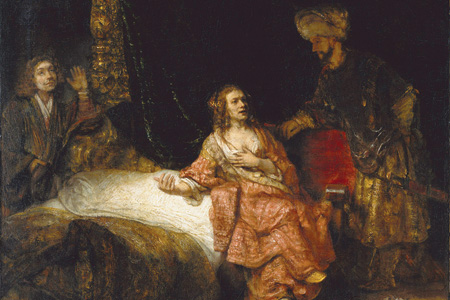
"Joseph and Potiphar's Wife" (1655): In this late painting, all the figures are fully clothed, including Potiphar's wife who is accusing Joseph (left) of attempted rape (image: Scala, Florence/Bildagentur Fur Kunst, Kulture Und Geschichte, Berlin)
Taking care not to trip on the ice-glazed pavements, Rembrandt van Rijn made his way through middle Amsterdam. As he turned into Sint Antoniesbreestraat, one of the city's most charming streets, he slipped his hand into the fold of his coat. The wind off the sea beyond chased his veins deeper into his body, but he was more concerned about finding the key that lay hidden in the swathes of wool that brushed his thigh. It had taken him years and a small fortune to obtain it, and he was not prepared to lose it now.
It was January 1639, and Rembrandt had pledged a monumental 13,000 guilders for a house on the Breestraat, as the wide street was known. As he fumbled in his pocket for the key, he could try to reassure himself that his extravagant purchase was worthwhile. The building was perfectly positioned in the artists' district to attract the business he required to pay the sum off in regular instalments. He knew that a house like this, red-brick, imposing, crowned with a glorious inset pediment, would mark him out as a man of means and good taste. As an artist of 32, with an armful of important commissions already to his name, he could never have imagined that he would be handing the house over to his creditors before two decades were out.
An exhibition that opened at the National Gallery last month and runs until January 18 shows how Rembrandt flourished as an artist in his late years, despite struggling beneath a growing tide of penury. Forced in middle age to declare himself bankrupt in the face of mounting house bills and the financial demands of a former lover, Rembrandt continued to produce paintings and drawings. His haemorrhage of savings appeared to do little to stem his creative output.
But this story of art triumphing over life was not confined to his final years. Rembrandt's first brush with poverty, which was in his case a relative term, happened decades earlier when he was still a young man. Certain habits he acquired during his early days on the Breestraat would prove to be prophetic of his later life. When — wrinkled, bankrupt and crestfallen — he faced the challenge of conquering the earthly realities of a more frugal life, it must have helped that he had already sought them out as a young artist in the city.
Rembrandt was born into a large milling family in Leiden, south-west of Amsterdam, in 1606, four years after the foundation of the Dutch East India Company. The Dutch Republic was waging war to gain independence from Spain, but booming trade had transformed it into a rich country. Immigrants, many of them having escaped the regions still under Spanish rule, filled Amsterdam and Leiden with skilled labour. Rembrandt arrived in Amsterdam in 1624 as a young student of the artist Pieter Lastman, whose studio was located on the Breestraat. The road ran through the Vlooienburg ("flooded") neighbourhood, a new addition to the desperately overcrowded city, constructed on former flood plains. It was cosmopolitan and bohemian, popular with artists, collectors and dealers.
In 1631, Rembrandt became a resident on the same street, in the house of an art dealer. He married the dealer's cousin, Saskia van Uylenburgh, the daughter of a burgomeister, resident in the same house, and they relocated temporarily to a business district of Amsterdam. Eight years later, they were back on the Breestraat, living in the house next door to the building in which they had met. Their life here was the picture of extravagance. Visitors climbed the stairs to their porch and walked across the smart black and white tiles of the entrance hall. There was a grand art room in which Rembrandt received his patrons, and comfortable living quarters with vast fireplaces which his assistants had to pass each day to reach the floor above.
Here lay a small studio, a larger studio, and a storage room. The shelves were cluttered with ornaments: busts of Roman emperors, collections of armour, fabrics, assorted knives. Rembrandt had developed a habit of gathering bits and pieces from all over the city, not just its markets and auctions, but its bridges and dusty corners, too.
Here, among his miscellanea, Rembrandt's early biographers puzzled at the artist's interest in objects with little material value. One wrote mockingly of him buying clothes that were "outdated and shabby". Another critic scoffed that Rembrandt deemed his old weaponry and scarves "antiquities", as if they rivalled the classical or classicising sculptures which flooded the art market. These peculiar objects seemed to jar unforgivably with Rembrandt's otherwise elegant surroundings.
But Rembrandt's rags, which he reimagined in his paintings, were part of a much deeper fascination with life outside his gilded walls. Long before he faced the prospect of bankruptcy, he engaged heartily with what it meant to live a rustic, simple life. In 1631, the year he first came to the Breestraat, he made a pair of etchings that shocked genteel society. In one, a man in baggy breeches, laden with travelling gear, was urinating carelessly on the ground. In the other, a country lass was squatting by a tree and lifting her skirts to do the same — and more.
Those loyal to Rembrandt could defend him from criticism by suggesting that these were merely amateur exercises inspired by the art of earlier printmakers, such as Jacques Callot. But the truth was that Rembrandt was eager to continue in the same earthy vein.
Although he fast established himself as a skilled portraitist, open to commissions from Amsterdam's private citizens and wealthy guilds, including the surgeons' guild, he could not turn his back on the other side of city life. Not once did he paint a burgomeister. Passing the wealthy merchants who, smug with revenue piped in from foreign trade ventures, clogged the canals with their elegant barges, Rembrandt sought the have-nots.
Here lay a small studio, a larger studio, and a storage room. The shelves were cluttered with ornaments: busts of Roman emperors, collections of armour, fabrics, assorted knives. Rembrandt had developed a habit of gathering bits and pieces from all over the city, not just its markets and auctions, but its bridges and dusty corners, too.
Here, among his miscellanea, Rembrandt's early biographers puzzled at the artist's interest in objects with little material value. One wrote mockingly of him buying clothes that were "outdated and shabby". Another critic scoffed that Rembrandt deemed his old weaponry and scarves "antiquities", as if they rivalled the classical or classicising sculptures which flooded the art market. These peculiar objects seemed to jar unforgivably with Rembrandt's otherwise elegant surroundings.
But Rembrandt's rags, which he reimagined in his paintings, were part of a much deeper fascination with life outside his gilded walls. Long before he faced the prospect of bankruptcy, he engaged heartily with what it meant to live a rustic, simple life. In 1631, the year he first came to the Breestraat, he made a pair of etchings that shocked genteel society. In one, a man in baggy breeches, laden with travelling gear, was urinating carelessly on the ground. In the other, a country lass was squatting by a tree and lifting her skirts to do the same — and more.
Those loyal to Rembrandt could defend him from criticism by suggesting that these were merely amateur exercises inspired by the art of earlier printmakers, such as Jacques Callot. But the truth was that Rembrandt was eager to continue in the same earthy vein.
Although he fast established himself as a skilled portraitist, open to commissions from Amsterdam's private citizens and wealthy guilds, including the surgeons' guild, he could not turn his back on the other side of city life. Not once did he paint a burgomeister. Passing the wealthy merchants who, smug with revenue piped in from foreign trade ventures, clogged the canals with their elegant barges, Rembrandt sought the have-nots.
He mused on those who depended on alms for survival. One almshouse was established in the south-west of the city to support Roman Catholic women. Another would be founded in the mid-century to cater for the young and elderly, regardless of their religious denomination. Rembrandt made some small studies of families receiving their supplies. He was still more interested in the citizens who slipped through the net entirely.
In the early and mid-1630s, in pointed contrast to the portraits of noblewomen he was commissioned to paint, including that of Amalia van Solms, wife of the Prince of Orange, he made sketches of young women begging on the streets clutching babies to their breasts.
What seems to have interested him most about these unfortunate people was the emotion they carried in their bodies and faces. The heavy reworkings of his sketches reveal that he strove hard to capture the posture of each subject. A deceptively simple study of a hunched shoulder revealed the dejection these women felt. Unlike Rembrandt's wealthy sitters, the poor could not hide behind ruffed collars and etiquette that stifled all expression.
It was the bare-all approach that Rembrandt favoured in the 80 or more self-portraits he made across the course of his life, too. He often presented himself in elaborate costume, as if to highlight the distinction between artificiality and the nature of his painted flesh, which struck contemporary eyes as rough and imperfect. As these paintings showed, he was well used to looking beneath the surface.
Amsterdam provided an interesting vantage point from which to look outside as well as within. Many of the houses here were more remarkable for their windows than their doors. Residents could peer inquisitively out. Windows often figure large in Rembrandt's art. While life might have dictated that he spend the late 1630s looking indoors, where his wife Saskia was giving birth to child after child, and sadly seeing each buried in infancy, Rembrandt established a habit of looking out onto the streets.
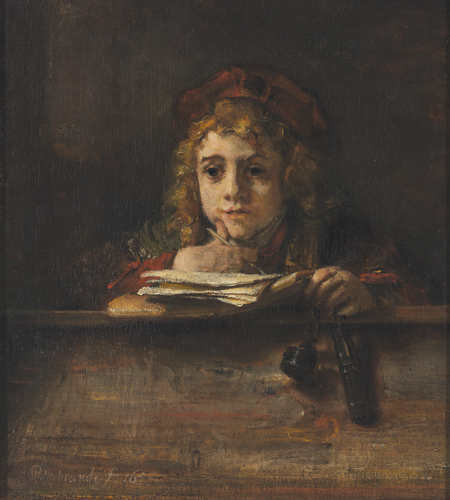
Portrait of the artist's son: "Titus at his Desk" (1655) (image: Museum Boijmans Van Beuningen, Rotterdam)
In the early and mid-1630s, in pointed contrast to the portraits of noblewomen he was commissioned to paint, including that of Amalia van Solms, wife of the Prince of Orange, he made sketches of young women begging on the streets clutching babies to their breasts.
What seems to have interested him most about these unfortunate people was the emotion they carried in their bodies and faces. The heavy reworkings of his sketches reveal that he strove hard to capture the posture of each subject. A deceptively simple study of a hunched shoulder revealed the dejection these women felt. Unlike Rembrandt's wealthy sitters, the poor could not hide behind ruffed collars and etiquette that stifled all expression.
It was the bare-all approach that Rembrandt favoured in the 80 or more self-portraits he made across the course of his life, too. He often presented himself in elaborate costume, as if to highlight the distinction between artificiality and the nature of his painted flesh, which struck contemporary eyes as rough and imperfect. As these paintings showed, he was well used to looking beneath the surface.
Amsterdam provided an interesting vantage point from which to look outside as well as within. Many of the houses here were more remarkable for their windows than their doors. Residents could peer inquisitively out. Windows often figure large in Rembrandt's art. While life might have dictated that he spend the late 1630s looking indoors, where his wife Saskia was giving birth to child after child, and sadly seeing each buried in infancy, Rembrandt established a habit of looking out onto the streets.
Portrait of the artist's son: "Titus at his Desk" (1655) (image: Museum Boijmans Van Beuningen, Rotterdam)
His artistic predecessors, including Brueghel the Elder, had painted the familiar scene of a woman making pancakes before Lent. But whereas they had portrayed her in a kitchen, Rembrandt's picture (now in the Rijksmuseum) shows her outdoors, a hag at a street stall, stirring batter for excitable children. He also drew a woman looking out of a shuttered window while another crouched on the street with her young child, who was at once fascinated and terrified by an inquisitive dog.
It was small consolation, but the fact that Rembrandt had found something warming in the camaraderie of street life would stand him in good stead for when his own riches began to dwindle. He knew that his house on the Breestraat was steadily sinking into the marshy ground. Unable to afford the bills for the necessary repairs, he was also forced to pay those of the neighbour with whom he shared a party wall.
Rembrandt was using Amsterdam's houses as windows onto the world outside well into the 1640s. His life indoors was fraught. In 1642, Saskia died from tuberculosis. Only one of their children, Titus, had survived. Father and son were still living on the Breestraat with a nurse for the child, Geertje Dircks, whom Rembrandt promptly made his lover. In time, refusing to marry her, he would leave her hungry for money and revenge, as he gradually diverted his affections towards a new housemaid, Hendrickje Stoffels.
Rembrandt's first biographers were less than enthusiastic about his avowed plebeian tastes. Responding to his studies of female nudes, a poet, Andries Pels, wondered at Rembrandt's habit of choosing as his models washerwomen or peat-treaders, marred with blemishes and creases from their clothes.
Not only did these pictures fail to satisfy his critics' lust for classical beauty or female virtue but they also revealed a troubling kinship with a world beneath the one he belonged to.
Occasionally, Rembrandt felt the pressure to conform to these ideals, including in the commissions he received in his later life. In the early 1650s, the Dutch Republic went to war with England. The market value of art plummeted, making it difficult for Rembrandt to sell his masterpieces and pay the sums demanded on his house.
Shortly before he was declared insolvent, he painted the Biblical scene of Joseph and Potiphar's Wife, probably for a wealthy merchant. In this dark and brooding painting, the wife gesticulates before her husband, making the nefarious claim that Joseph had attempted to rape her, while he raises his hands skyward, pledging his innocence. Despite being in the bedchamber, all three figures are dressed, the men particularly elegantly; only Joseph's coat lies discarded in the foreground, a witness to his attempt at escaping the woman's embrace.
It was small consolation, but the fact that Rembrandt had found something warming in the camaraderie of street life would stand him in good stead for when his own riches began to dwindle. He knew that his house on the Breestraat was steadily sinking into the marshy ground. Unable to afford the bills for the necessary repairs, he was also forced to pay those of the neighbour with whom he shared a party wall.
Rembrandt was using Amsterdam's houses as windows onto the world outside well into the 1640s. His life indoors was fraught. In 1642, Saskia died from tuberculosis. Only one of their children, Titus, had survived. Father and son were still living on the Breestraat with a nurse for the child, Geertje Dircks, whom Rembrandt promptly made his lover. In time, refusing to marry her, he would leave her hungry for money and revenge, as he gradually diverted his affections towards a new housemaid, Hendrickje Stoffels.
Rembrandt's first biographers were less than enthusiastic about his avowed plebeian tastes. Responding to his studies of female nudes, a poet, Andries Pels, wondered at Rembrandt's habit of choosing as his models washerwomen or peat-treaders, marred with blemishes and creases from their clothes.
Not only did these pictures fail to satisfy his critics' lust for classical beauty or female virtue but they also revealed a troubling kinship with a world beneath the one he belonged to.
Occasionally, Rembrandt felt the pressure to conform to these ideals, including in the commissions he received in his later life. In the early 1650s, the Dutch Republic went to war with England. The market value of art plummeted, making it difficult for Rembrandt to sell his masterpieces and pay the sums demanded on his house.
Shortly before he was declared insolvent, he painted the Biblical scene of Joseph and Potiphar's Wife, probably for a wealthy merchant. In this dark and brooding painting, the wife gesticulates before her husband, making the nefarious claim that Joseph had attempted to rape her, while he raises his hands skyward, pledging his innocence. Despite being in the bedchamber, all three figures are dressed, the men particularly elegantly; only Joseph's coat lies discarded in the foreground, a witness to his attempt at escaping the woman's embrace.
The painting was in marked contrast to a print Rembrandt produced on the same theme as an optimistic young artist in 1634. Here, in the earlier version, Potiphar's wife lay on a bed, nude from the waist down. She writhed and contorted her body as she clung to Joseph, who struggled to make his escape from her bedchamber. Her legs were parted lustily, leaving little to the imagination. The work foreshadowed several further prints, including one in which a couple made love in bed, and another in which a monk copulated with a woman in a crop field.
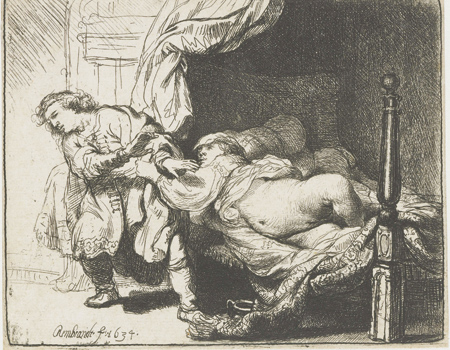
"Joseph and Potiphar's Wife" (1634): In this earlier print, Potiphar's lusty wife tries to drag Joseph into her bed (image: Rijksmuseum)
By comparison with these works, some of the wrinkled female nudes Rembrandt produced in his late years were restrained. Offensive though their flesh and status were to his critics, they lacked the earthiness of many of his earlier prints and drawings.
Rembrandt had not been the first artist to embrace the seedier side of life. But in seeking it so stubbornly in Amsterdam's most prosperous age, he went some way towards presenting himself as someone who could handle life's struggles.
Drained by paying maintenance to Geertje Dircks, whom he had locked away for five years in a house of correction, forced to give up his house on the Breestraat, which he never managed to pay off, struggling to sell his art in a difficult market, Rembrandt's predicament in the mid-17th century was unenviable.
Another man might have given up, or tried to save face by fleeing Amsterdam altogether, but Rembrandt did not. Supplementing his career as a painter with work in an art business for his son Titus and lover Hendrickje, both of whom would predecease him, Rembrandt lived out his final years in rented accommodation in Amsterdam's working-class district. It lacked the elegance of the Breestraat, but as Rembrandt had discovered years ago, life went on, however refined the windows one lived behind.
"Joseph and Potiphar's Wife" (1634): In this earlier print, Potiphar's lusty wife tries to drag Joseph into her bed (image: Rijksmuseum)
By comparison with these works, some of the wrinkled female nudes Rembrandt produced in his late years were restrained. Offensive though their flesh and status were to his critics, they lacked the earthiness of many of his earlier prints and drawings.
Rembrandt had not been the first artist to embrace the seedier side of life. But in seeking it so stubbornly in Amsterdam's most prosperous age, he went some way towards presenting himself as someone who could handle life's struggles.
Drained by paying maintenance to Geertje Dircks, whom he had locked away for five years in a house of correction, forced to give up his house on the Breestraat, which he never managed to pay off, struggling to sell his art in a difficult market, Rembrandt's predicament in the mid-17th century was unenviable.
Another man might have given up, or tried to save face by fleeing Amsterdam altogether, but Rembrandt did not. Supplementing his career as a painter with work in an art business for his son Titus and lover Hendrickje, both of whom would predecease him, Rembrandt lived out his final years in rented accommodation in Amsterdam's working-class district. It lacked the elegance of the Breestraat, but as Rembrandt had discovered years ago, life went on, however refined the windows one lived behind.