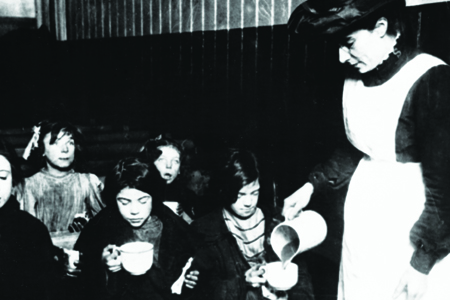
Before the welfare state: A Salvation Army worker gives out breakfast to slum children (image: Museum of London/Heritage Images/Getty Images)
Let me begin with a quote, which will be familiar to many of you: "The making of a good society depends not on the State but on the citizens, acting individually or in free association with one another, acting on motives of various kinds — some selfish, others unselfish, some narrow and material, others inspired by love of man and love of God. The happiness or unhappiness of the society in which we live depends upon ourselves as citizens, not only the instruments of political power which we call the State." That is William Beveridge, from his book Voluntary Action, published in that pivotal year 1948.
The 20th century witnessed an historic, often bitter, contest between individualist and collectivist traditions in the pursuit of social progress. By the 1950s, it resulted in the state reigning supreme in health and welfare provision, with charities reduced to the periphery. Things have moved in recent decades, with something of a charitable revival. By this century, Britain had reached a curious stage in the evolution of social policy, in which the state wanted the voluntary societies to do more and the voluntary societies wanted the state to do more. Now, the exhausted parties seem to be heading for the ropes, in what we have come to call, sometimes admiringly, sometimes not, partnership.
In the ambiguous welfare world of today, it has become necessary to use the word independent before the name of a non-governmental charity, for it is no longer obvious that a charitable institution is not a government agency. Charity law, after all, does not prohibit government authorities from setting up charities. Britain remains a nation of joiners and volunteers, who continually revive our local communities from below. But at the higher echelons of social provision, which attracts the bulk of media attention, there is some confusion over what constitutes a charity. In an era of partnerships and public service contracts, the state and many voluntary bodies have become so intertwined that it is rather fanciful to think of them as representing two distinct sectors. Greyness pervades the discussion.
I would like to begin with some remarks on the history of charity, which should help us to put our current position in context. The boundaries between state assistance and charitable assistance were much clearer in the past. In the 19th century, a general guideline was that charity dealt with deserving cases and the state with the undeserving. This division of responsibilities often broke down in practice but at least it gave some clarity to the issue. There was a measure of state funding of individual institutions in the 19th century. But in general, the attitude of Victorian charitable campaigners to the state was rather like the revulsion felt by the curly-haired boy in Nicholas Nickleby, as his mouth opened before Mrs Squeers's brimstone and treacle spoon.
The Victorians held government in esteem, but expected little from it on social issues. They widely assumed that in serving good causes voluntary associations served the wider cause of religious and civil liberty. Charities gave a voice and influence to those who were excluded, or felt excluded from the political nation: minorities, dissenters, women and the working classes — perhaps above all to the working classes, whose charitable energies and effective organisation still await recognition. To most charitable campaigners, the state was an artificial contrivance, useful in punishing sinners but incapable of redemptive action. They were apt to think that government institutions were heartless and bureaucratic. Prisons and workhouses, for example, had an unhappy reputation for insensitivity among charitable activists, particularly the women, who were becoming more and more influential in the 19th century.
The Victorian years saw the feminisation of philanthropy, in respect to both volunteering and subscribers. At the beginning of the 19th century, women comprised about 10 per cent of charitable subscribers; by the end of the century the figure was over 60 per cent. Removed from political influence and professional employment, large numbers of women turned naturally to charity as a form of self-expression, which led to a general softening of Victorian society. But their charitable activities were often hedged in by restrictions. Elizabeth Fry's experience in prison reform is but one example of "masculine officialism". In 1869, the prominent philanthropist Josephine Butler argued that large legislative welfare systems were "masculine" in character, while the parochial system of charitable ministration, with its corollary of recreating domestic life in institutions, was essentially "feminine". I will return to this theme.
Victorian philanthropists could boast of remarkable achievements. In 1885, the charitable receipts for London alone exceeded the budgets of several European states. But in the late 19th century, attitudes to poverty began to change, partly driven by the rise of social surveys. In an industrial economy under strain, people began to take the view that poverty was not simply a product of individual breakdown, as charity's advocates had long assumed, but of faults in the economy and the structure of society. Those who took the view that the state should intervene more decisively believed that their more "scientific" appreciation of the causes of poverty would lead to its elimination.
The story in the 20th century is a familiar one. Successive administrations were increasingly drawn into the social arena, at first piecemeal with the Liberal social reforms early in the century, and then, propelled by the Depression and the command economy of the Second World War, into more wholesale welfare changes. In time, a less personal approach to welfare, the belief in the efficacy of legislation and state intervention, became as compelling to its advocates as Christian service had been to the Victorians.
The Victorian years saw the feminisation of philanthropy, in respect to both volunteering and subscribers. At the beginning of the 19th century, women comprised about 10 per cent of charitable subscribers; by the end of the century the figure was over 60 per cent. Removed from political influence and professional employment, large numbers of women turned naturally to charity as a form of self-expression, which led to a general softening of Victorian society. But their charitable activities were often hedged in by restrictions. Elizabeth Fry's experience in prison reform is but one example of "masculine officialism". In 1869, the prominent philanthropist Josephine Butler argued that large legislative welfare systems were "masculine" in character, while the parochial system of charitable ministration, with its corollary of recreating domestic life in institutions, was essentially "feminine". I will return to this theme.
Victorian philanthropists could boast of remarkable achievements. In 1885, the charitable receipts for London alone exceeded the budgets of several European states. But in the late 19th century, attitudes to poverty began to change, partly driven by the rise of social surveys. In an industrial economy under strain, people began to take the view that poverty was not simply a product of individual breakdown, as charity's advocates had long assumed, but of faults in the economy and the structure of society. Those who took the view that the state should intervene more decisively believed that their more "scientific" appreciation of the causes of poverty would lead to its elimination.
The story in the 20th century is a familiar one. Successive administrations were increasingly drawn into the social arena, at first piecemeal with the Liberal social reforms early in the century, and then, propelled by the Depression and the command economy of the Second World War, into more wholesale welfare changes. In time, a less personal approach to welfare, the belief in the efficacy of legislation and state intervention, became as compelling to its advocates as Christian service had been to the Victorians.
The relationship between government and the people changed so dramatically in the post-war years that late-Victorian Britain was widely seen as an ancien régime. The creation of the welfare state signalled that there was a decisive winner in the debate over social policy. The extraordinary circumstances of "total war" had necessitated planning of a universal nature and on a scale never seen before. The planning imperative meant that government paid scant heed to the democratic impulses and good offices of charitable associations with their ethic of personal service and selective provision. After all the strains and suffering of the 1930s and 1940s, fairness was a powerful argument on the side of widening government provision in the health and social services.
In what may be seen as the welfare equivalent of urban renewal, post-war reconstruction ravaged much of the historic fabric of the charitable social services. Something fundamental happened to British culture, once so Christian and voluntary. The traditional liberal ideal of balancing rights and duties had been supplanted, as the social critic David Selbourne observed, "by a politics of dutiless right". "The impression was given," as the former Labour Secretary of State for Health and Social Security Richard Crossman conceded, "that socialism was an affair for the Cabinet, acting through the existing Civil Service."
It was perhaps not surprising that politicians did not encourage popular participation in their reforms. Social laws offered a blueprint for the reconstruction of society that did not require the participation of volunteers or summonses to self-help. If the interests of the state and society were identical, intermediary institutions were superfluous. Ironically, the inheritance that politicians and civil servant mandarins welcomed — and built upon — was a systematic paternalism that far exceeded that of the voluntarists they often disavowed.
As the burden of care shifted radically to government, charitable service became characterised as an "amenity". There were occasional puffs offered to philanthropy by political leaders, but Crossman observed that to many on the Left philanthropy was "an odious expression of social oligarchy and churchy bourgeois attitudes" and "do-gooding a word as dirty as philanthropy". Barbara Castle, as Labour Minister of Health, believed that a proper social democracy should show "a toughness about the battle for equality rather than do-goodery". The use of "do-gooder" as a term of abuse encapsulated the transformation of values that had taken place.
In the post-war decades, British citizens showed little uneasiness with the greater ministerial control over their lives, for they widely identified with the achievements of the welfare state. It was not a strong current in political discussion to argue that effective social reform might come from below, from local institutions that derived their energy and legitimacy from openness to the immediate needs of individuals and communities. Across the political spectrum, politicians sought to replace the sense of community, which people had built up in the past out of family life and self-governing local institutions, with a sense of national community, built out of central bureaucratic structures and party politics. In passing social legislation, Parliament acted in the name of equality and social justice. The beauty of such abstractions perhaps blinded the public to the dangers of overburdening the state.
In what may be seen as the welfare equivalent of urban renewal, post-war reconstruction ravaged much of the historic fabric of the charitable social services. Something fundamental happened to British culture, once so Christian and voluntary. The traditional liberal ideal of balancing rights and duties had been supplanted, as the social critic David Selbourne observed, "by a politics of dutiless right". "The impression was given," as the former Labour Secretary of State for Health and Social Security Richard Crossman conceded, "that socialism was an affair for the Cabinet, acting through the existing Civil Service."
It was perhaps not surprising that politicians did not encourage popular participation in their reforms. Social laws offered a blueprint for the reconstruction of society that did not require the participation of volunteers or summonses to self-help. If the interests of the state and society were identical, intermediary institutions were superfluous. Ironically, the inheritance that politicians and civil servant mandarins welcomed — and built upon — was a systematic paternalism that far exceeded that of the voluntarists they often disavowed.
As the burden of care shifted radically to government, charitable service became characterised as an "amenity". There were occasional puffs offered to philanthropy by political leaders, but Crossman observed that to many on the Left philanthropy was "an odious expression of social oligarchy and churchy bourgeois attitudes" and "do-gooding a word as dirty as philanthropy". Barbara Castle, as Labour Minister of Health, believed that a proper social democracy should show "a toughness about the battle for equality rather than do-goodery". The use of "do-gooder" as a term of abuse encapsulated the transformation of values that had taken place.
In the post-war decades, British citizens showed little uneasiness with the greater ministerial control over their lives, for they widely identified with the achievements of the welfare state. It was not a strong current in political discussion to argue that effective social reform might come from below, from local institutions that derived their energy and legitimacy from openness to the immediate needs of individuals and communities. Across the political spectrum, politicians sought to replace the sense of community, which people had built up in the past out of family life and self-governing local institutions, with a sense of national community, built out of central bureaucratic structures and party politics. In passing social legislation, Parliament acted in the name of equality and social justice. The beauty of such abstractions perhaps blinded the public to the dangers of overburdening the state.
The strategic planning in welfare provision that characterised the post-war decades ended in doubts, reassessment, and recrimination. After the oil crisis in the mid-1970s, the spending limits of the state social services propelled a revival of interest in charitable provision. The New Right, with its reversion to the language of the minimal state, echoed sentiments that had been little commended since the heyday of Victorian liberalism. But such sentiments were being voiced in a world that had lost its Christian underpinnings and in which more and more women went out to work, leaving them less time for volunteering. Mrs Thatcher, an admirer of Victorian values, often spoke in glowing terms of voluntarism, but her Victorian values were highly selective. She had a need for political control that expressed itself in greater centralisation, not less, and carried forward the very collectivist agenda she disavowed.
Mrs Thatcher failed to recall that the Victorians saw little virtue in blurring the boundaries between the state and voluntary institutions. On this issue, one of the measures of her administration was particularly significant, though now little remembered. Section 5 of the Health Services Act of 1980 permitted hospitals to organise their own appeals. Giving what amounted to charitable status to statutory bodies stunned the charitable establishment. Those myriad societies which had struggled to find a place alongside the NHS as money-raisers for hospitals were now in direct competition with the largest, most heavily financed enterprise in the whole field of social welfare, whose fund-raising drives were to be financed by the Treasury. The then Chairman of the National Council for Voluntary Organisations, Sara Morrison, declared that the Health Services Act represented "the most damaging blow suffered by the voluntary sector for many years".
The decline of world socialism after the collapse of the Soviet empire in 1989 had more positive repercussions for voluntary traditions than Mrs Thatcher and the New Right. It was a powerful reminder of the political benefits of voluntary activity. The decline of British socialism challenged the Whiggish assumption that social provision was a linear progression towards a model welfare state. The challenges to collectivism effectively changed the language of politics, reshaping the context in which charity was understood. In the 1990s, charity came to be elided with notions of civil society or community service. If social engineering was the fashion in post-war Britain, welfare pluralism, with its emphasis on democratic local initiative, was increasingly the language. The Labour Party under Tony Blair, reeling from Thatcherism at home and the collapse of socialism abroad, felt obliged to cast aside the dogmas of the past and embrace charitable institutions. Politicians of all hues now conceded that the state had failed to elevate the principle of social duty, and adopted the mantra of balancing rights with personal responsibility. This did not, however, diminish their desire to co-opt and control voluntary societies.
Mrs Thatcher failed to recall that the Victorians saw little virtue in blurring the boundaries between the state and voluntary institutions. On this issue, one of the measures of her administration was particularly significant, though now little remembered. Section 5 of the Health Services Act of 1980 permitted hospitals to organise their own appeals. Giving what amounted to charitable status to statutory bodies stunned the charitable establishment. Those myriad societies which had struggled to find a place alongside the NHS as money-raisers for hospitals were now in direct competition with the largest, most heavily financed enterprise in the whole field of social welfare, whose fund-raising drives were to be financed by the Treasury. The then Chairman of the National Council for Voluntary Organisations, Sara Morrison, declared that the Health Services Act represented "the most damaging blow suffered by the voluntary sector for many years".
The decline of world socialism after the collapse of the Soviet empire in 1989 had more positive repercussions for voluntary traditions than Mrs Thatcher and the New Right. It was a powerful reminder of the political benefits of voluntary activity. The decline of British socialism challenged the Whiggish assumption that social provision was a linear progression towards a model welfare state. The challenges to collectivism effectively changed the language of politics, reshaping the context in which charity was understood. In the 1990s, charity came to be elided with notions of civil society or community service. If social engineering was the fashion in post-war Britain, welfare pluralism, with its emphasis on democratic local initiative, was increasingly the language. The Labour Party under Tony Blair, reeling from Thatcherism at home and the collapse of socialism abroad, felt obliged to cast aside the dogmas of the past and embrace charitable institutions. Politicians of all hues now conceded that the state had failed to elevate the principle of social duty, and adopted the mantra of balancing rights with personal responsibility. This did not, however, diminish their desire to co-opt and control voluntary societies.
For all the talk about welfare pluralism and a fresh role for voluntary institutions in the 1990s, there was an assumption that the state was still in charge, but it should offer charities a more prominent role in social provision. Definitions matter, and now the government rather than the charities provided them. For centuries, the standard definition of charity was "Christian love", or "love of one's fellow man", or simply "kindness". But as Britain moved from being a voluntary society to a collectivist one, from a Christian society to a secular one, such meanings looked decidedly old-fashioned. Consequently, the definition of charity has come up for bureaucratic review, to make it more compatible with the national, secular and corporate priorities of government.
An important update on offer came with the Charities Act of 2006, which defined charity as "public benefit". The usage reflects a government agenda which seeks to offer a concordat with its junior partners in the voluntary sector. But as charity comes under ministerial control, it is effectively depersonalised. One of the complaints I sometimes hear from charitable campaigners today, particularly women, is that government funding and the corporate nature of many institutions are driving out traditions of personal ministration. In the press, the criticism is typically that today's voluntary workers lack the human touch and spend less and less time on their visits to beneficiaries. One is reminded of Josephine Butler's remark that legislative programmes are masculine and charity feminine. What we are witnessing today, as charity becomes more corporate and bureaucratic, is its masculinisation.
The Charities Act 2006 reads as though written by a robot. It lacks any sense of the past, and you will look in vain for the words kindness, love, or, for that matter, Christianity. It is a measure of religious decline in Britain that the definition of "religion" in the Act includes belief in more than one God and belief in no god at all. Now that, one might say, is being ecumenical with the truth. The resort to phrases like "public benefit" is an example of the administrative mind forging a conceptual language to justify the state's ascendancy in welfare provision. This conforms to a presumption that citizens become moral agents through compulsory taxation to pay for universal benefits. But this notion that we become compassionate through compulsion and proxy is a flattering self-deception, especially as universal benefits often accrue to those who do not need them. Perhaps we can look forward to the day when the Inland Revenue sets up its own charitable trust, to receive donations from citizens who wish to top up their taxes with gifts to the Treasury.
Voluntary action extends well beyond what the political language can provide. Officialdom is impatient with anything casual or humble, what Wordsworth called "that best portion of a good man's life — his little, nameless, unremembered acts of kindness and love". Of course, charities need to be businesslike and efficient in order to spend their donors' money wisely, but they should not be judged by performance indicators alone. Victorian legislators had wisely avoided defining charity too narrowly, for they assumed that it was preferable for charities to define the citizenry. But in highly centralized democracies like Britain, politicians, whatever their party allegiance, seem unable to resist co-opting rival centres of authority.
An important update on offer came with the Charities Act of 2006, which defined charity as "public benefit". The usage reflects a government agenda which seeks to offer a concordat with its junior partners in the voluntary sector. But as charity comes under ministerial control, it is effectively depersonalised. One of the complaints I sometimes hear from charitable campaigners today, particularly women, is that government funding and the corporate nature of many institutions are driving out traditions of personal ministration. In the press, the criticism is typically that today's voluntary workers lack the human touch and spend less and less time on their visits to beneficiaries. One is reminded of Josephine Butler's remark that legislative programmes are masculine and charity feminine. What we are witnessing today, as charity becomes more corporate and bureaucratic, is its masculinisation.
The Charities Act 2006 reads as though written by a robot. It lacks any sense of the past, and you will look in vain for the words kindness, love, or, for that matter, Christianity. It is a measure of religious decline in Britain that the definition of "religion" in the Act includes belief in more than one God and belief in no god at all. Now that, one might say, is being ecumenical with the truth. The resort to phrases like "public benefit" is an example of the administrative mind forging a conceptual language to justify the state's ascendancy in welfare provision. This conforms to a presumption that citizens become moral agents through compulsory taxation to pay for universal benefits. But this notion that we become compassionate through compulsion and proxy is a flattering self-deception, especially as universal benefits often accrue to those who do not need them. Perhaps we can look forward to the day when the Inland Revenue sets up its own charitable trust, to receive donations from citizens who wish to top up their taxes with gifts to the Treasury.
Voluntary action extends well beyond what the political language can provide. Officialdom is impatient with anything casual or humble, what Wordsworth called "that best portion of a good man's life — his little, nameless, unremembered acts of kindness and love". Of course, charities need to be businesslike and efficient in order to spend their donors' money wisely, but they should not be judged by performance indicators alone. Victorian legislators had wisely avoided defining charity too narrowly, for they assumed that it was preferable for charities to define the citizenry. But in highly centralized democracies like Britain, politicians, whatever their party allegiance, seem unable to resist co-opting rival centres of authority.
Just as the bureaucratic mind cannot cope with the creative chaos of competing organisations pulling in different directions, post-war British politicians have not been able to imagine any form of democracy operating outside the parameters of ministerial control. The Victorian belief that democracy is inherent in independent voluntary institutions is largely beyond their understanding. In 2001, Gordon Brown remarked: "Politicians once thought the man in Whitehall knew best. Now we understand that the mother from the playgroup might know better." Rest assured, he didn't mean it. This is the same Gordon Brown, who, in an article in The Times in 1988, decried charity as "a sad and seedy competition for public pity". As Chancellor and later Prime Minister, he assumed that one way to invigorate his political agenda was by further co-opting and financing charities. Government funding escalated.
As the state insinuated itself in the folds of charity, the government, not the voluntary citizen, has become the presiding judge of what constitutes charity or public benefit. While definitions continue to revolve around the issue of independence, governments of all stripes tend to see charitable institutions, at least in the health and social services, as agencies under their supervision. Traditionally, charities saw themselves as having their own objectives. Government stresses professional competence and efficiency. Traditionally, charities stressed personal service and moral purpose. Government expects welfare to be systematic and comprehensive. Traditionally, charities valued selectivity and improvisation.
Government provision depends on compulsory taxation; it is not religious or altruistic but quantitative and materialist in conception. It is largely about furthering equality. Charitable provision, on the other hand, cannot be extorted by force. Its proponents have flourished in a liberal polity, often underpinned by religious belief that is primarily individualistic, even though it may also be egalitarian. To a Treasury official, representing the collective, a hospital waiting list is an abstraction. To a charitable campaigner, representing the individual, it is an offence. Distinctions between charity and government action are thus deeply rooted, not least in thinking about their respective roles and boundaries. The state will almost certainly retain its pre-eminence in the health and social services in Britain, but the perennial question remains: where should the balance lie between the "right" to welfare and the "virtue" of charity?
In recent decades, the balance has been further complicated by the so-called "contract culture". In 1990, the Home Office, in the interests of efficiency, directed that in dealing with voluntary organizations government departments should establish clear policy objectives, and grants that did not relate to such objectives should be phased out. With the implementation of that policy the government sought to enlist the voluntary sector for its own purposes. As charities are brought into the orbit of government they are encouraged to take on board a view of welfare that is favoured by the state.
As the state insinuated itself in the folds of charity, the government, not the voluntary citizen, has become the presiding judge of what constitutes charity or public benefit. While definitions continue to revolve around the issue of independence, governments of all stripes tend to see charitable institutions, at least in the health and social services, as agencies under their supervision. Traditionally, charities saw themselves as having their own objectives. Government stresses professional competence and efficiency. Traditionally, charities stressed personal service and moral purpose. Government expects welfare to be systematic and comprehensive. Traditionally, charities valued selectivity and improvisation.
Government provision depends on compulsory taxation; it is not religious or altruistic but quantitative and materialist in conception. It is largely about furthering equality. Charitable provision, on the other hand, cannot be extorted by force. Its proponents have flourished in a liberal polity, often underpinned by religious belief that is primarily individualistic, even though it may also be egalitarian. To a Treasury official, representing the collective, a hospital waiting list is an abstraction. To a charitable campaigner, representing the individual, it is an offence. Distinctions between charity and government action are thus deeply rooted, not least in thinking about their respective roles and boundaries. The state will almost certainly retain its pre-eminence in the health and social services in Britain, but the perennial question remains: where should the balance lie between the "right" to welfare and the "virtue" of charity?
In recent decades, the balance has been further complicated by the so-called "contract culture". In 1990, the Home Office, in the interests of efficiency, directed that in dealing with voluntary organizations government departments should establish clear policy objectives, and grants that did not relate to such objectives should be phased out. With the implementation of that policy the government sought to enlist the voluntary sector for its own purposes. As charities are brought into the orbit of government they are encouraged to take on board a view of welfare that is favoured by the state.
The use of charities to do the government's bidding has been criticised as a devolved form of government administration that turns the intermediary institutions of civil society into agencies of the state through contracts and financial control. This does not alarm defenders of government partnerships, who argue that cooperation with the state arose from the historic failings of charitable societies. They are inclined to see critics of the contract culture as reactionaries, living in a Victorian dreamland. Clearly, the world has moved on over the last century, but we are in no position to look down on the Victorians. Look around, we owe much of our cultural, medical, and religious infrastructure to their benevolence. The original Church House was built to commemorate the Golden Jubilee of Queen Victoria.
Since the 1980s, a few social critics and a smattering of politicians have argued that government funding and the voluntary ethos are incompatible. In the eyes of such commentators, we are witnessing a further stage in the perfection of the state monolith under the guise of partnership, a process that one charitable director calls a "cultural takeover by stealth". The appetite for state contracts and grants has grown to the point where the question is now being asked how institutions paid for out of compulsory taxation, which would not exist without state subsidies, can be called voluntary. As most of us will agree, charitable independence is a slippery concept, which has received several tortuous analyses in recent years. The next time it is under examination I would suggest the employment of a language philosopher rather than a team of lawyers.
In contemporary Britain, charitable officials often come from a background in government service and wish to distance themselves from the hierarchies and pieties of the charitable past. For them, partnerships are what enlivens the voluntary sector and makes their labours possible. The agreement titled "Getting it right together", which was signed in 1998, provided a framework for cooperation between central government and voluntary organisations. It recognised the diversity of volunteering and sought greater recognition for volunteers. But the agreement skirted the issue of independence, preferring to emphasise that volunteering was open to everyone.
The government's recognition and promotion of volunteering has much to recommend it. And while few doubt that the work done by state charities is valuable, the nagging issue of their independence will not go away. There is bound to be a cost to autonomy, personal ministration and civic democracy when charities become enmeshed in government regulation and what overseers call "service delivery". Complex contracting arrangements, have created, as the National Council for Voluntary Organisations (NCVO) observes, bureaucratic "pitfalls". Who is the volunteer working for in this compact? Those charities that work closely with the local or central government are more likely to shape their priorities to suit available grants, to create their own bureaucracies, to distance charitable campaigners from beneficiaries, and to play down religion. As they become larger, they take on the character of government departments.
Since the 1980s, a few social critics and a smattering of politicians have argued that government funding and the voluntary ethos are incompatible. In the eyes of such commentators, we are witnessing a further stage in the perfection of the state monolith under the guise of partnership, a process that one charitable director calls a "cultural takeover by stealth". The appetite for state contracts and grants has grown to the point where the question is now being asked how institutions paid for out of compulsory taxation, which would not exist without state subsidies, can be called voluntary. As most of us will agree, charitable independence is a slippery concept, which has received several tortuous analyses in recent years. The next time it is under examination I would suggest the employment of a language philosopher rather than a team of lawyers.
In contemporary Britain, charitable officials often come from a background in government service and wish to distance themselves from the hierarchies and pieties of the charitable past. For them, partnerships are what enlivens the voluntary sector and makes their labours possible. The agreement titled "Getting it right together", which was signed in 1998, provided a framework for cooperation between central government and voluntary organisations. It recognised the diversity of volunteering and sought greater recognition for volunteers. But the agreement skirted the issue of independence, preferring to emphasise that volunteering was open to everyone.
The government's recognition and promotion of volunteering has much to recommend it. And while few doubt that the work done by state charities is valuable, the nagging issue of their independence will not go away. There is bound to be a cost to autonomy, personal ministration and civic democracy when charities become enmeshed in government regulation and what overseers call "service delivery". Complex contracting arrangements, have created, as the National Council for Voluntary Organisations (NCVO) observes, bureaucratic "pitfalls". Who is the volunteer working for in this compact? Those charities that work closely with the local or central government are more likely to shape their priorities to suit available grants, to create their own bureaucracies, to distance charitable campaigners from beneficiaries, and to play down religion. As they become larger, they take on the character of government departments.
Furthermore, as charitable agencies become increasingly accountable to government, they are prone to forfeit their role as critics of government policy. The growth of partnerships has dulled the candour of charitable officials. Some years ago, the Association of Charitable Foundations observed that "in a world where funding comes from service contracts, there is a danger that passion is neutralised, in the interest of financial survival. People do what they are paid to do rather than what they care deeply about doing." A hospital voluntarist put it more succinctly years ago: "No one is rude to his rich uncle."
One of the issues before us is whether charitable campaigners can find a role that is consistent with their traditions of institutional autonomy and personal service? In the late 1970s, about 10 per cent of overall charitable revenue came from government sources. According to a study of the British voluntary sector by Jeremy Kendall, the figure stood at 45 per cent by the beginning of this century, while donations from individuals had declined. In 2010, figures compiled by the NCVO put the overall proportion of state funding at 38 per cent. Presumably this was for a somewhat narrower definition of the voluntary sector than Kendall's. Whatever the percentage, we are dealing with large sums of money, just under £14 billion transferred from the taxpayer in the year 2009/2010.
At present, about 41,000 charities, about a quarter of all registered charities, have a direct financial relationship with the state. Of these, it has been estimated that 27,000 receive more than 75 per cent of their income from government sources. Extracting information on the percentage of government income of individual societies can be difficult. In many annual reports there is a lack of transparency on this issue. Charities are under no legal duty to advise in their accounts how much, if any, of their income in the year is derived from government sources. Still, from available financial records, it is clear that even once fiercely independent institutions receive substantial amounts of their income from government.
For decades, charities have been, as I put it years ago, "swimming into the mouth of Leviathan". Their increased dependence on the state has blurred the boundaries of charitable and government provision, which is further complicated by the many governmental authorities that have set up charities. The balance of power in the voluntary sector has tipped in favour of large, publicly-funded institutions. The 130,000 or so charities that do not receive state support, typically small institutions, rarely have a voice in the media and are largely outside the debate, though they will be influenced by its results. What is the government planning to do for them, apart from offering them contracts and grants?
As charities are brought into the orbit of government, they take on a view of welfare inherited from the state, whose contracts often set their agenda. Once on the payroll of the taxpayer, they have less incentive to raise funds privately. Indeed, many charitable officials think of themselves not as charitable campaigners but as employees of government. Several have admitted as much in my company. The leader of one prominent society told me privately that he thought charity "demeaning". Yet his institution enjoys the tax benefits that charitable status provides.
One of the issues before us is whether charitable campaigners can find a role that is consistent with their traditions of institutional autonomy and personal service? In the late 1970s, about 10 per cent of overall charitable revenue came from government sources. According to a study of the British voluntary sector by Jeremy Kendall, the figure stood at 45 per cent by the beginning of this century, while donations from individuals had declined. In 2010, figures compiled by the NCVO put the overall proportion of state funding at 38 per cent. Presumably this was for a somewhat narrower definition of the voluntary sector than Kendall's. Whatever the percentage, we are dealing with large sums of money, just under £14 billion transferred from the taxpayer in the year 2009/2010.
At present, about 41,000 charities, about a quarter of all registered charities, have a direct financial relationship with the state. Of these, it has been estimated that 27,000 receive more than 75 per cent of their income from government sources. Extracting information on the percentage of government income of individual societies can be difficult. In many annual reports there is a lack of transparency on this issue. Charities are under no legal duty to advise in their accounts how much, if any, of their income in the year is derived from government sources. Still, from available financial records, it is clear that even once fiercely independent institutions receive substantial amounts of their income from government.
For decades, charities have been, as I put it years ago, "swimming into the mouth of Leviathan". Their increased dependence on the state has blurred the boundaries of charitable and government provision, which is further complicated by the many governmental authorities that have set up charities. The balance of power in the voluntary sector has tipped in favour of large, publicly-funded institutions. The 130,000 or so charities that do not receive state support, typically small institutions, rarely have a voice in the media and are largely outside the debate, though they will be influenced by its results. What is the government planning to do for them, apart from offering them contracts and grants?
As charities are brought into the orbit of government, they take on a view of welfare inherited from the state, whose contracts often set their agenda. Once on the payroll of the taxpayer, they have less incentive to raise funds privately. Indeed, many charitable officials think of themselves not as charitable campaigners but as employees of government. Several have admitted as much in my company. The leader of one prominent society told me privately that he thought charity "demeaning". Yet his institution enjoys the tax benefits that charitable status provides.
The issue of the generous salaries given to senior administrators in many publicly-funded agencies has aroused a good deal of comment in the press of late. The criticism flows from a misunderstanding. It arises from assuming that CEOs of the publicly-funded institutions are in fact working for voluntary institutions, which is questionable. Their generous pay is perfectly understandable when seen in the context of the pay scales of government bodies, such as NHS Trusts. The directors of independent charities are relatively poorly paid because they often have to raise their own salaries through fund-raising measures.
In the Thatcher years, talented Labour Party supporters, isolated politically, moved into charitable societies. With egalitarian ideals and a background in political lobbying and government service, they do not want to return to a time when voluntary institutions were responsible for essential services. Nor, unlike charitable campaigners of old, do they have the desire to make themselves unnecessary. Talk about the Big Society or rolling back the state makes them nervous. They are content to act as welfare providers dependent on state grants and service contracts, which pays their salaries and keeps them in touch with national policy.
Still, we may be reaching a tipping point, when more and more individuals will assume that charities are essentially governmentfunded and consequently end their contributions. The universities, which are seen to be state institutions, have had this problem for decades. A former CEO of the Countryside Alliance, which raises most of its income from subscriptions, accuses the government of obfuscation: "The laziness of the Treasury in not establishing a proper framework for quasi-government bodies as separate from charities is an insult to the millions of people in this country who give of their time, expertise and money to truly independent voluntary organisations." It is this lack of clarity that has led some critics to call for a new category of non-profit organisation, those that receive substantial funds from statutory sources.
As I suggested earlier, neither charity nor the government has lived up to public expectations of social provision. The charge once levelled at Victorian charity, that it could not cope with the volume of social need, is now levelled at the government. But whatever changes are being considered that affect the relationship between the state and charity, it is worth putting them in the context of first principles. Sadly, we have become accustomed to politically expedient quick fixes — the lottery is a prime example — which have left us in our present state of confusion. I am reminded of what Walter Bagehot, the great Victorian Liberal, said about the characteristic defects of the English: "Their want of intellectual and guiding principle, their even more complete want of the culture which would provide that principle, their absorption in the present difficulty, and their hand-to-mouth readiness to seek reform without thinking of the consequences."
In the Thatcher years, talented Labour Party supporters, isolated politically, moved into charitable societies. With egalitarian ideals and a background in political lobbying and government service, they do not want to return to a time when voluntary institutions were responsible for essential services. Nor, unlike charitable campaigners of old, do they have the desire to make themselves unnecessary. Talk about the Big Society or rolling back the state makes them nervous. They are content to act as welfare providers dependent on state grants and service contracts, which pays their salaries and keeps them in touch with national policy.
Still, we may be reaching a tipping point, when more and more individuals will assume that charities are essentially governmentfunded and consequently end their contributions. The universities, which are seen to be state institutions, have had this problem for decades. A former CEO of the Countryside Alliance, which raises most of its income from subscriptions, accuses the government of obfuscation: "The laziness of the Treasury in not establishing a proper framework for quasi-government bodies as separate from charities is an insult to the millions of people in this country who give of their time, expertise and money to truly independent voluntary organisations." It is this lack of clarity that has led some critics to call for a new category of non-profit organisation, those that receive substantial funds from statutory sources.
As I suggested earlier, neither charity nor the government has lived up to public expectations of social provision. The charge once levelled at Victorian charity, that it could not cope with the volume of social need, is now levelled at the government. But whatever changes are being considered that affect the relationship between the state and charity, it is worth putting them in the context of first principles. Sadly, we have become accustomed to politically expedient quick fixes — the lottery is a prime example — which have left us in our present state of confusion. I am reminded of what Walter Bagehot, the great Victorian Liberal, said about the characteristic defects of the English: "Their want of intellectual and guiding principle, their even more complete want of the culture which would provide that principle, their absorption in the present difficulty, and their hand-to-mouth readiness to seek reform without thinking of the consequences."
Since much of the former hostility between Left and Right over social provision has been defused in recent decades, partnerships between the state and charitable bodies seem likely to grow. But if the contract culture continues to expand it may have unhappy consequences, not least for many of the independent institutions that struggle to compete for individual donations. Perhaps some research on the issue of unfair competition is in order. But there are still bigger issues at stake. Voluntary action provides a democratic safeguard, against what Stanley Baldwin called "the standardising pressure of the state's mechanism". Tension between the state and independent charitable institutions, with their different agendas and contrasting democratic forms, is both desirable and invigorating. A social philosophy that undermines the freedom of association and the duties of citizenship is one in which democracy atrophies.
The poor will always have us with them. Consequently, charity is as important to the givers as to the receivers. Historically, it was not simply about the delivery of services to the needy, but also about civic participation, self-help and moral training. Recent government statements suggest they admire such principles. But if our politicians really believed in them they would clarify the boundaries between the state and charity, would lessen the unnecessary regulations on those institutions that do not receive state assistance, and would increase the tax incentives to giving. There has been little sign of support for such changes from our elected officials, for it would reduce government revenue and control.
I will end with Alexis de Tocqueville, the great 19th-century philosopher of associational democracy, who observed that in a culture in which free associations prospered individuals had to prove themselves resolute and responsible in their dealings with others. This was in sharp contrast to an authoritarian culture, however benign, which encouraged docility and indecisiveness in its citizens. And he concluded: "Among democratic nations it is only by association that the resistance of the people to the government can ever display itself: hence the latter always looks with ill favour on those associations which are not in its own power; and it is well worthy of remark that among democratic nations the people themselves often entertain against these very associations a secret feeling of fear and jealousy, which prevents the citizens from defending the institutions of which they stand so much in need."
The poor will always have us with them. Consequently, charity is as important to the givers as to the receivers. Historically, it was not simply about the delivery of services to the needy, but also about civic participation, self-help and moral training. Recent government statements suggest they admire such principles. But if our politicians really believed in them they would clarify the boundaries between the state and charity, would lessen the unnecessary regulations on those institutions that do not receive state assistance, and would increase the tax incentives to giving. There has been little sign of support for such changes from our elected officials, for it would reduce government revenue and control.
I will end with Alexis de Tocqueville, the great 19th-century philosopher of associational democracy, who observed that in a culture in which free associations prospered individuals had to prove themselves resolute and responsible in their dealings with others. This was in sharp contrast to an authoritarian culture, however benign, which encouraged docility and indecisiveness in its citizens. And he concluded: "Among democratic nations it is only by association that the resistance of the people to the government can ever display itself: hence the latter always looks with ill favour on those associations which are not in its own power; and it is well worthy of remark that among democratic nations the people themselves often entertain against these very associations a secret feeling of fear and jealousy, which prevents the citizens from defending the institutions of which they stand so much in need."