On March 28, 1990, a few months after the fall of the Berlin Wall, the then Pope gave thanks to God "for the fact that the precariousness of lies has been manifest". What did St John Paul, as he now is, mean by this resonant phrase?
Lies presuppose truth. These concepts also presume that human beings are moral agents, capable of distinguishing between them. The ability to distinguish between lies and truth, in other words, presupposes freedom. And the presumption of human freedom rests on a presumption that we are individuals; that our needs and aspirations are more than merely material ones; that we have duties not only to the state, but to one another; that we have rights by virtue of our humanity; that we are free to render unto Caesar the things which are Caesar's and unto God the things that are God's.
But in the empire created by Stalin and sustained by force of Soviet arms until 1989, none of these things could be presumed. It was Caesar's representative in Judaea, Pontius Pilate, who asked: "What is truth?" However we choose to interpret that question, Pilate's Communist counterparts in the Cold War certainly did not believe that truth mattered. Like jesting Pilate, they would not stay for an answer. What interested the Pilates of the Warsaw Pact was not truth, but power. Their domination was, however, based less on brute force than on the power to abolish the distinction between truth and lies. The dictatorship of the proletariat was in fact what Pope-Emeritus Benedict meant by the dictatorship of relativism. Of the three categories of relativism moral, cultural and epistemological — it is the last that is most subversive of humanity. Once truth and lies are indistinguishable, it is child's play to excuse the inexcusable. Following the example set by St John Paul, Margaret Thatcher and Ronald Reagan, however, people were able to confront the "evil empire" with the truth about itself, with all the terrible, shameful lies, past and present, that everybody behind the Iron Curtain suspected, but which they could never openly acknowledge because their way of life depended on deception and coercion.
An appetite for truth, then, was the essential prerequisite in what we still called Eastern Europe for what was to happen in 1989. Václav Havel called it "living in truth"; his works, like those of almost every important writer of that time and of that place, are meditations on the near impossibility of leading such a life in a culture saturated with lies. Dissidents learned to be human lie-detectors; they needed to be, because spies and informers were everywhere. But their dedication to the truth required certain character traits, of which the most striking was stubbornness.
An appetite for truth, then, was the essential prerequisite in what we still called Eastern Europe for what was to happen in 1989. Václav Havel called it "living in truth"; his works, like those of almost every important writer of that time and of that place, are meditations on the near impossibility of leading such a life in a culture saturated with lies. Dissidents learned to be human lie-detectors; they needed to be, because spies and informers were everywhere. But their dedication to the truth required certain character traits, of which the most striking was stubbornness.
The most stubborn woman I ever met was the late Yelena Bonner, widow of Andrei Sakharov; having survived every Russian autocrat from Stalin to Putin, she treated them all with a kind of debonair disdain. Natan Sharansky was another stumbling block for the Kremlin. He told me he had endured years of solitary confinement, knowing that Andropov might execute him at any time on trumped up espionage charges, thanks to two things: the game of chess, which he played in his head, and the tiny copy of the Psalms, which he knew by heart and still keeps with him everywhere. What was the truth that revealed the precariousness of lies? It was the faith that moves mountains, whether it be the Jewish faith of Sharansky in Russia, or the Lutheran faith of Pastor László Tőkés in Romania, or the Catholic faith of Father Jerzy Popiełuszko in Poland. I remember the mood in Warsaw shortly after Father Popiełuszko's murder. It was one of simmering indignation, a thirst for justice and a quiet resolution that this brave young priest should not have been martyred in vain.
I remember, too, the mood in Prague in November 1989: not revenge for the violence of the police, nor even for 40 years of despotism, but pride in the history of pre-war Czechoslovak democracy — the first in Central Europe — and a firm attachment to the rule of law. The city where the Thirty Years' War began, where genocide, ethnic cleansing and show trials had taken place within living memory would now show the world how the people could make a peaceful revolution, a revolution without a Terror — a Velvet Revolution. In Prague, as in Warsaw and Budapest, the precariousness of lies manifested itself in the unexpected collapse of the most elaborate systems of control ever devised by men: the secret police, the propaganda machine, the party itself. The fear that had sustained the system had abated, though not disappeared; some members of the old order survived in power, whether by changing party names (the Hungarian Socialists, for instance) or by claiming to be a "transitional" guarantor of stability (General Jaruzelski remained Polish president despite his role in martial law). In Romania the Ceaușescus were executed after a putsch by other party apparatchiks, who bought themselves a few more years of power for which Romanians are still paying a price.
Despite the corruption, division and decay that Communism left in its wake, however, the more important story was the success of the new democracies. Those nations that clung to the past, such as breakaway Slovakia, took longer to find freedom, but only in the Balkans was there a real reversion to barbarism. History is not always the story of liberty, and sometimes truth is inextricable from tragedy.
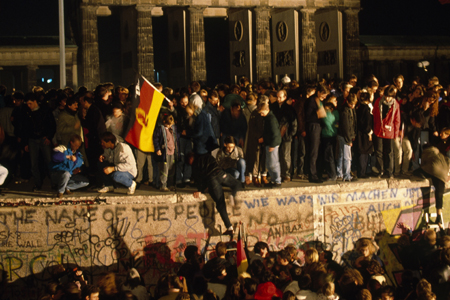
And so to Berlin. I found myself in the epicentre of the earthquake on November 9, 1989, almost by accident. But being in the right place at the right time is never just serendipity: looking back on it I realise that my whole life had been leading up to this moment. The triumph of truth over lies in the events of that night became manifest in the fact that the fate of the Berlin Wall was decided by the failure of the party to communicate with the people. Günter Schabowski, the Politburo member for East Berlin, invited the foreign media to what was then an unprecedented display of glasnost: a press conference broadcast live on television. What happened in the last few minutes of that conference unfolded like a drama — but no human hand could have scripted it.
I remember, too, the mood in Prague in November 1989: not revenge for the violence of the police, nor even for 40 years of despotism, but pride in the history of pre-war Czechoslovak democracy — the first in Central Europe — and a firm attachment to the rule of law. The city where the Thirty Years' War began, where genocide, ethnic cleansing and show trials had taken place within living memory would now show the world how the people could make a peaceful revolution, a revolution without a Terror — a Velvet Revolution. In Prague, as in Warsaw and Budapest, the precariousness of lies manifested itself in the unexpected collapse of the most elaborate systems of control ever devised by men: the secret police, the propaganda machine, the party itself. The fear that had sustained the system had abated, though not disappeared; some members of the old order survived in power, whether by changing party names (the Hungarian Socialists, for instance) or by claiming to be a "transitional" guarantor of stability (General Jaruzelski remained Polish president despite his role in martial law). In Romania the Ceaușescus were executed after a putsch by other party apparatchiks, who bought themselves a few more years of power for which Romanians are still paying a price.
Despite the corruption, division and decay that Communism left in its wake, however, the more important story was the success of the new democracies. Those nations that clung to the past, such as breakaway Slovakia, took longer to find freedom, but only in the Balkans was there a real reversion to barbarism. History is not always the story of liberty, and sometimes truth is inextricable from tragedy.
And so to Berlin. I found myself in the epicentre of the earthquake on November 9, 1989, almost by accident. But being in the right place at the right time is never just serendipity: looking back on it I realise that my whole life had been leading up to this moment. The triumph of truth over lies in the events of that night became manifest in the fact that the fate of the Berlin Wall was decided by the failure of the party to communicate with the people. Günter Schabowski, the Politburo member for East Berlin, invited the foreign media to what was then an unprecedented display of glasnost: a press conference broadcast live on television. What happened in the last few minutes of that conference unfolded like a drama — but no human hand could have scripted it.
At 18:53, in answer to a question by Riccardo Ehrman, an Italian journalist, Schabowski produced a piece of paper and announced that a decision had been made to allow East German citizens to emigrate from the German Democratic Republic. The atmosphere in the room was instantly electrified and questions came thick and fast. Unused to dealing with Western journalists, Schabowski became increasingly nervous and incoherent. A German journalist, Peter Brinkmann, called out repeatedly: "When does that come into force?" Schabowski scratched his head and stumbled over his reply as he looked at his documents. "As far as I know," he muttered, "that is immediately, without delay."
As the significance of what we were being told dawned on the millions of East German viewers watching at home, I finally got my hands on the only microphone and for the first time mentioned the Berlin Wall. At this point, the climax of the story, I prefer to hand over the narration to the Harvard historian Mary Elise Sarotte. Her new book The Collapse: The Accidental Opening of the Berlin Wall (Basic Books, £18.99) is by far the most thoroughly researched account so far of the events of November 9, 1989. She was not present at the time, but has spoken to or corresponded with all the key players who were. As one who was there, I can vouch for her objectivity and accuracy. Professor Sarotte writes:
With that confusing statement hanging in the air, and with Johnson and everyone else still waiting for a response to the question of what would happen to the Wall, Schabowski abruptly said: "Thank you very much!" and ended the press conference. It was 7:00:54 p.m. He had intentionally closed the press conference without determining the fate of the Wall. That task would, as a result, be left to the participants in the peaceful revolution later that night.
As the significance of what we were being told dawned on the millions of East German viewers watching at home, I finally got my hands on the only microphone and for the first time mentioned the Berlin Wall. At this point, the climax of the story, I prefer to hand over the narration to the Harvard historian Mary Elise Sarotte. Her new book The Collapse: The Accidental Opening of the Berlin Wall (Basic Books, £18.99) is by far the most thoroughly researched account so far of the events of November 9, 1989. She was not present at the time, but has spoken to or corresponded with all the key players who were. As one who was there, I can vouch for her objectivity and accuracy. Professor Sarotte writes:
Finally, Daniel Johnson, a foreign correspondent for Britain's Daily Telegraph, stood up and asked loudly: "What will happen with the Berlin Wall now?" The room suddenly became quiet as everyone waited expectantly for the answer, but only a long, fraught silence followed. It seemed as though Schabowski had suddenly lost the power of speech.
Finally the East German Politburo member ended the excruciating pause with the following words: "It has been drawn to my attention that it is 7:00 p.m. This is the last question, yes, please understand!" Then Schabowski suddenly tried to link the status of the Wall to the painfully slow process of disarmament, saying that the questions about the border "would definitely be positively influenced if the FRG and Nato would commit themselves to and carry out disarmament, just as the GDR and other socialist states have already completed certain preliminary steps."
With that confusing statement hanging in the air, and with Johnson and everyone else still waiting for a response to the question of what would happen to the Wall, Schabowski abruptly said: "Thank you very much!" and ended the press conference. It was 7:00:54 p.m. He had intentionally closed the press conference without determining the fate of the Wall. That task would, as a result, be left to the participants in the peaceful revolution later that night.
Sarotte is correct: Schabowski had avoided a direct answer to my question. There was no good answer; he repeated the question to give himself time to think, though this only encouraged the viewers to ask themselves the same question. But the logic of the regime's decision to allow its citizens to freely travel and emigrate was clear. There was no point in maintaining a heavily manned and fortified Wall, complete with increasingly deadly automatic weapons systems, dividing not only the capital but the whole of Germany, if people could come and go as they pleased. A Berlin Wall which did not divide the city and the people would have no raison d'être. Yet without the Wall, the German Democratic Republic would lose those people. That is why it had been built — against international agreements — in 1961. The GDR, however, justified the Wall with a lie: that this "anti-fascist protection barrier" existed to prevent a Nazi invasion. The Berlin Wall, the most notorious symbol of the Cold War, was built upon a lie. Even the concrete blocks from which it was constructed were toxic, being full of asbestos. Its model was the Nazi wall that had surrounded the Warsaw Ghetto. The Berlin Wall was the totalitarian lie in concrete form.
The precariousness of that lie, and all the other lies on which the whole existence of this "democratic republic" was predicated, became manifest to the East German people in that pregnant pause when Schabowski was faced with my question. He could not tell them the truth, even though the truth was staring him in the face. And in that moment, the culmination of months of protest, the people lost their fear and the regime lost what remained of its legitimacy. When they went to the checkpoints and demanded to be allowed through, the border guards — who were still under orders to shoot to kill — lost their nerve. Within hours of the press conference, the Wall was open. Young people who had watched the press conference recognised me and embraced me in the street. We celebrated with their home-made wine. Truth had prevailed over lies that proved to be more precarious than anybody had supposed.
How do I feel about it all now, 25 years later? Fortunate to have a footnote in history, especially when the history is written by scholars as distinguished as Professor Sarotte. Happy to have had a walk-on part as one of countless extras in the one modern German drama with a happy, bloodless ending. Above all, I feel proud to have done what journalists are there to do: to make it clear to the world what is happening, to be the voice of the powerless in the presence of the powerful, to ask them the right questions. Sometimes there is no answer, for silence may be the most unintentionally revealing answer of all.
Since the Wall opened that night, the world has opened up too. It is hard for people who can email, text or phone anybody and tell everybody what they think on social media to imagine the world of 1989, when reporting the opening of the Wall meant dialling London for half an hour to get a landline out of East Berlin, dictating my report over the phone to a copytaker and hoping that I had accurately taken down what Schabowski had said, because there were no search engines to check it. Today you can fly almost anywhere, certainly within your own country; but when the Wall came down, even Chancellor Helmut Kohl, who was in Warsaw at the time, could only fly to Berlin to greet the cheering crowds through the air corridor agreed four decades before by the wartime Allies, which meant a lengthy detour via Hamburg.
The precariousness of that lie, and all the other lies on which the whole existence of this "democratic republic" was predicated, became manifest to the East German people in that pregnant pause when Schabowski was faced with my question. He could not tell them the truth, even though the truth was staring him in the face. And in that moment, the culmination of months of protest, the people lost their fear and the regime lost what remained of its legitimacy. When they went to the checkpoints and demanded to be allowed through, the border guards — who were still under orders to shoot to kill — lost their nerve. Within hours of the press conference, the Wall was open. Young people who had watched the press conference recognised me and embraced me in the street. We celebrated with their home-made wine. Truth had prevailed over lies that proved to be more precarious than anybody had supposed.
How do I feel about it all now, 25 years later? Fortunate to have a footnote in history, especially when the history is written by scholars as distinguished as Professor Sarotte. Happy to have had a walk-on part as one of countless extras in the one modern German drama with a happy, bloodless ending. Above all, I feel proud to have done what journalists are there to do: to make it clear to the world what is happening, to be the voice of the powerless in the presence of the powerful, to ask them the right questions. Sometimes there is no answer, for silence may be the most unintentionally revealing answer of all.
Since the Wall opened that night, the world has opened up too. It is hard for people who can email, text or phone anybody and tell everybody what they think on social media to imagine the world of 1989, when reporting the opening of the Wall meant dialling London for half an hour to get a landline out of East Berlin, dictating my report over the phone to a copytaker and hoping that I had accurately taken down what Schabowski had said, because there were no search engines to check it. Today you can fly almost anywhere, certainly within your own country; but when the Wall came down, even Chancellor Helmut Kohl, who was in Warsaw at the time, could only fly to Berlin to greet the cheering crowds through the air corridor agreed four decades before by the wartime Allies, which meant a lengthy detour via Hamburg.
Anyone who believes that we in the West live in a "surveillance society" today should see The Lives of Others, Florian Henckel von Donnersmarck's film about the Stasi, the East German secret police, or read the screenplay, which has just been published by Pushkin Press (£8.99). The Stasi's penetration of East German society was total: one in seven was an informer and they employed ten times as many agents per capita as the Gestapo had done. Even in Bonn, the West German capital, the Stasi were legion. As a schoolboy living with a German family in 1974, I was shocked to discover that Willy Brandt, the Chancellor, had been forced to resign after his aide Günter Guillaume was unmasked as a Stasi agent. By the time I was working in Bonn as a foreign correspondent in the late 1980s, the Stasi were even more ubiquitous there. The spymaster of the Stasi's foreign intelligence service, Markus ("Mischa") Wolf, later wrote a lively but self-aggrandising memoir, Man Without a Face, with Anne McElvoy. But it is only a slight exaggeration to say that Wolf knew everything that mattered about everybody who mattered in Bonn. The legacy of this is the continuing espionage hysteria in Germany, especially since the revelations of Edward Snowden, who is seen there as a hero rather than a traitor. Berlin's security relationship with Washington is now worse than at any time since 1945.
But the open society that the wartime generation died for and the Cold War generation lived for is now taken for granted. Most people no longer feel any obligation to make sacrifices — of lives, privacy, even money — to defend freedom, democracy and the rule of law. Instead, we retreat into a virtual world where we can treat the forces that in reality threaten our open society as though they too could be deleted at the click of a mouse.
Our leaders aim to defend the West, not by defeating our enemies but by keeping them at arm's length. This new strategy of containment has bought us time, but we shall pay dearly for our unwillingness to give primacy to foreign policy and defence, as we did in the Cold War. Compared to the first two interventions in Iraq, the latest one by the Obama administration seems too little and too late. As I write, Islamic State forces are close enough to Baghdad to shell its international airport. The Pentagon insists that IS does not pose an "imminent threat" to the Iraqi capital, but we must reckon with the possibility of a siege. If IS were to take Baghdad, the reverberations would be felt for decades throughout the world. Not since the fall of Saigon would American — and Western — prestige have suffered such a blow. We just can't let it happen.
Since the fall of the Berlin Wall, the world has become a better place: life, liberty and the pursuit of happiness are now within the grasp of countless millions who could only dream of them before. But any defence of the Western civilisation that has conferred these blessings requires constant vigilance, including reflection on why the ideology that erected the Wall eventually collapsed. Even with the enemy at the gates, the denigrators of the West will not desist. Pankaj Mishra in the Guardian sneers that "Anglo-American elites who are handsomely compensated to live forever in the early 20th century . . . will never cease to find more brutes to exterminate." On the contrary: unless we learn the right lessons of the Cold War, it is the brutes who will exterminate us.
But the open society that the wartime generation died for and the Cold War generation lived for is now taken for granted. Most people no longer feel any obligation to make sacrifices — of lives, privacy, even money — to defend freedom, democracy and the rule of law. Instead, we retreat into a virtual world where we can treat the forces that in reality threaten our open society as though they too could be deleted at the click of a mouse.
Our leaders aim to defend the West, not by defeating our enemies but by keeping them at arm's length. This new strategy of containment has bought us time, but we shall pay dearly for our unwillingness to give primacy to foreign policy and defence, as we did in the Cold War. Compared to the first two interventions in Iraq, the latest one by the Obama administration seems too little and too late. As I write, Islamic State forces are close enough to Baghdad to shell its international airport. The Pentagon insists that IS does not pose an "imminent threat" to the Iraqi capital, but we must reckon with the possibility of a siege. If IS were to take Baghdad, the reverberations would be felt for decades throughout the world. Not since the fall of Saigon would American — and Western — prestige have suffered such a blow. We just can't let it happen.
Since the fall of the Berlin Wall, the world has become a better place: life, liberty and the pursuit of happiness are now within the grasp of countless millions who could only dream of them before. But any defence of the Western civilisation that has conferred these blessings requires constant vigilance, including reflection on why the ideology that erected the Wall eventually collapsed. Even with the enemy at the gates, the denigrators of the West will not desist. Pankaj Mishra in the Guardian sneers that "Anglo-American elites who are handsomely compensated to live forever in the early 20th century . . . will never cease to find more brutes to exterminate." On the contrary: unless we learn the right lessons of the Cold War, it is the brutes who will exterminate us.