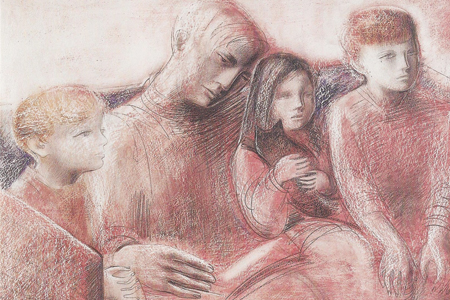
"The poet reading to his children" (1948) by Barbara Hepworth: from left, Piers, Herbert, Sophie (with Rimbaud the cat) and Thomas Read (image copyright: Sophie Bowness/Hepworth Estate)
When my father, Herbert Read, died in 1968, my mother had inscribed on his gravestone "Knight, Poet, Anarchist" — words that reflected how she thought he would like to be remembered rather than the reality of his reputation at the time. That came from his writings on art. He was "the apostle of modernism" who had defended cubism, surrealism and abstraction against the scorn of his fellow-countrymen. But he was also a decorated soldier, a civil servant, a curator, an editor, a publisher, a novelist, a literary critic, and an activist in the cause of nuclear disarmament. He had devoted his life to many causes and had once proposed a more appropriate epitaph: here lies Herbert Read, killed by committees.
The church at Kirkdale in North Yorkshire where he was buried is only a mile or two from the farm where was born in 1893. His father was a farmer: in an exquisite memoir of his childhood, The Innocent Eye, my father recalled his "sensitive face, his soft brown eyes, and his close curly black hair". But these memories were few because in February, 1903, his father fell ill out hunting and died of pneumonia a few days later. He was 34 years old. His widow, Eliza, was a year younger with three sons aged nine, seven and five; and the personal tragedy was exacerbated by the inevitable impoverishment that followed the death of a tenant farmer with no son of an age to take on the farm. The farm hands and domestic servants were dismissed, the stock sold at auction and Eliza Read with her three young sons moved to a rented cottage in the nearby town of Kirbymoorside.
Since my father would have to live off his wits, it was clear to his mother and uncles that he should have a good education. There was no money to pay school fees but a place was found at a charitable institution, the Crossley and Porter School for Orphans, housed in a grimy replica of a French Renaissance chateau on the moors overlooking Halifax. Read would remain in this austere institution for the next five years, leaving the premises only on a Sunday to go to church, and for a holiday in Ryedale in the summer and at Christmas.
My father left Crossley and Porters at the age of 15 and was taken on as a junior clerk by the Skyrac and Morley Savings Bank in Leeds. He lived with his mother who had moved to the city. Each evening, after work, he went to night school and in 1912 enrolled as a student at the University. He joined the Leeds Arts Club and the University's Officer's Training Corps whose summer training camp provided a free holiday in the open air. To the distress of his mother, he lost his faith, declared himself an atheist and secretly fostered an ambition to be, not a lawyer as his family supposed, but a writer, a journalist or even a poet.
In August, 1914, war was declared and, under the terms of his engagement in the OTC, Read joined the Yorkshire Regiment, the Green Howards and after six months of training, he was commissioned as a Second Lieutenant. His experiences in the war inevitably had a profound effect on the development of his personality and, fortuitously, provided him with a wider education than he had received at Leeds. He had developed exceptional powers of concentration reading in the rowdy play-room at Crossley's School and the list of authors he devoured as he sat in barracks or in the trenches is prodigious. He also wrote letters, not to his mother who had died of cancer in December, 1914, but to a girl he had met at the Students' Union, Evelyn Roff.
Those letters, stripped of all personal references, are now published in a collection of his writings on the war, All That Was Left of Them, by the Orage Press (£20). The book, compiled and edited by my brother Benedict, has an excellent introduction by my nephew, James Read, who has carefully investigated his grandfather's career as a soldier. It includes all of HR's writings on the war and his war poetry. In the letters and prose writings we follow his progress from a shy subaltern with a Yorkshire accent among snobbish Etonians, castigated by his colonel for bringing a radical journal, New Age, into the mess, to the confident commander of his battalion facing annihilation during the great retreat. In "The Raid" he describes in fictional form his foray from the trenches at the head of a platoon, faces blackened with burnt cork, to seize a German soldier and so identify the opposing forces — a feat which won him the Military Cross; and "In Retreat" the longer and more protracted engagement. "We were rushed up to the line in the early hours of the morning," he wrote to Evelyn:
For this he was awarded the DSO, "a medal", wrote Hugh Cecil writing of Read in The Flower of Battle, "not often given to junior officers in that war, unless they had just missed a V.C. He was also promoted to Captain." The intensity of HR's experiences in the Great War brought out paradoxical aspects of his personality. He described it as "an adventure" but emerged a pacifist; he prized the extraordinary camaraderie developed under fire, yet clearly relished being in command. The Yorkshire accent, disdained by the smug Etonians, brought him closer to his men, and social distinctions proved irrelevant to the qualities of character that emerged under fire.
What was the source of his courage? In "The Raid" Read analyses the cowardice of an officer P. whose terror "might bitch the show and bring disgrace to us all. He had a mother and a sweetheart . . . He never got free from his home thoughts; he was still bound in some sort of dependence to these ties. His mind was not free to lead its own existence . . . I think that is why he was a coward." Did Read's own courage come from his own lack of family ties, or innate detachment, or the influence of Nietzsche, whose work he was immersed in at the time?
And from then and for six days and nights we were fighting as I never dreamt I would fight — without sleep — often without food and all the time besieged by hordes of the Boche. The Colonel was wounded during the second day and I had to take command of the battalion. We were surrounded in our original position and had to fight our way through. We took up position after position, always to be surrounded. On the whole the men were splendid and there were many fine cases of heroism. But our casualties were very heavy and we who have come through may thank our lucky stars eternally.
For this he was awarded the DSO, "a medal", wrote Hugh Cecil writing of Read in The Flower of Battle, "not often given to junior officers in that war, unless they had just missed a V.C. He was also promoted to Captain." The intensity of HR's experiences in the Great War brought out paradoxical aspects of his personality. He described it as "an adventure" but emerged a pacifist; he prized the extraordinary camaraderie developed under fire, yet clearly relished being in command. The Yorkshire accent, disdained by the smug Etonians, brought him closer to his men, and social distinctions proved irrelevant to the qualities of character that emerged under fire.
What was the source of his courage? In "The Raid" Read analyses the cowardice of an officer P. whose terror "might bitch the show and bring disgrace to us all. He had a mother and a sweetheart . . . He never got free from his home thoughts; he was still bound in some sort of dependence to these ties. His mind was not free to lead its own existence . . . I think that is why he was a coward." Did Read's own courage come from his own lack of family ties, or innate detachment, or the influence of Nietzsche, whose work he was immersed in at the time?
After the war, HR was given a high-flying post in the Treasury but, feeling stifled by the civil service, secured a transfer to the ceramics department in the V&A. His ambition was still to be a poet, and it would seem that literary London found something agreeably anomalous about this decorated young officer with a Yorkshire accent eager to enlist in the avant-garde. Through Frank Rutter, the director of the Leeds Art Gallery, he met Richard Aldington and Ezra Pound. He was taken up by Osbert and Edith Sitwell and, dining at Osbert's house at 2 Carlyle Square, was introduced to Lytton Strachey, Virginia Woolf, Siegfried Sassoon and Aldous Huxley. Edith Sitwell found him "shy and charming"; he was a regular guest at her Saturday afternoon tea parties and would sometimes stay on and make an omelette for supper. On the night before his investiture with the DSO at Buckingham Palace, he was invited to dinner at the Carton Restaurant to meet "by special request" another poet whose work he had read and admired, T.S. Eliot. The two men became life-long friends.
On August 7, 1919, HR had married Evelyn Roff. His mother was dead; he had no family; she was the only girl he knew. She shared some but not all of his enthusiasms but was suspicious of his Bohemian friends. Later my father confessed that he had somewhat brow-beaten her into accepting his proposal, and the marriage was not a success. By the time Evelyn gave birth to a son, John, in 1923 she already felt neglected by a husband who, returning from a day's work at the V&A, would shut himself up in his study to pursue his literary career.
On the recommendation of the Director of the V&A, Sir Eric Maclagan, Read was made art critic of the newly-formed BBC review, The Listener, and he began writing in defence of avant-garde artists and sculptors such as Ben Nicholson, Barbara Hepworth and Henry Moore. The articles became a book, The Meaning of Art; and further works on contemporary art followed — Art Now, Art and Society, Art and Industry, Education Through Art. In 1931, he was appointed Professor of Fine Art at the University of Edinburgh. He moved to a substantial house in the city with his wife and son, but soon after his arrival he met a young musicologist from the university, Margaret Ludwig. They fell in love and a year later Read resigned his Chair, left his wife and son, and fled to London with the woman who would in due course become his second wife and the mother of four more children.
In Art Now, Read had praised Gauguin for having the courage to give up his job in a bank, leave his wife and family and devote himself to painting. In another work, In Defence of Shelley, he commended the poet for his desertion of his wife: "He earned immediate opprobrium and more than a century of calumny; but he lifted himself out of a premature old age of exhaustion, into a brighter element of intellectual vitality, and into a new lease of poetic inspiration." No doubt Read hoped that his own scandalous elopement would do the same. In the garden of their first home, a studio in Hampstead close to those of Nicholson, Hepworth and Moore, he built a wooden hut and wrote a novel, The Green Child, a work of poetic beauty admired by many but conventional in style and form — more W.H. Hudson and Joseph Conrad than James Joyce or Henry Miller.
On August 7, 1919, HR had married Evelyn Roff. His mother was dead; he had no family; she was the only girl he knew. She shared some but not all of his enthusiasms but was suspicious of his Bohemian friends. Later my father confessed that he had somewhat brow-beaten her into accepting his proposal, and the marriage was not a success. By the time Evelyn gave birth to a son, John, in 1923 she already felt neglected by a husband who, returning from a day's work at the V&A, would shut himself up in his study to pursue his literary career.
On the recommendation of the Director of the V&A, Sir Eric Maclagan, Read was made art critic of the newly-formed BBC review, The Listener, and he began writing in defence of avant-garde artists and sculptors such as Ben Nicholson, Barbara Hepworth and Henry Moore. The articles became a book, The Meaning of Art; and further works on contemporary art followed — Art Now, Art and Society, Art and Industry, Education Through Art. In 1931, he was appointed Professor of Fine Art at the University of Edinburgh. He moved to a substantial house in the city with his wife and son, but soon after his arrival he met a young musicologist from the university, Margaret Ludwig. They fell in love and a year later Read resigned his Chair, left his wife and son, and fled to London with the woman who would in due course become his second wife and the mother of four more children.
In Art Now, Read had praised Gauguin for having the courage to give up his job in a bank, leave his wife and family and devote himself to painting. In another work, In Defence of Shelley, he commended the poet for his desertion of his wife: "He earned immediate opprobrium and more than a century of calumny; but he lifted himself out of a premature old age of exhaustion, into a brighter element of intellectual vitality, and into a new lease of poetic inspiration." No doubt Read hoped that his own scandalous elopement would do the same. In the garden of their first home, a studio in Hampstead close to those of Nicholson, Hepworth and Moore, he built a wooden hut and wrote a novel, The Green Child, a work of poetic beauty admired by many but conventional in style and form — more W.H. Hudson and Joseph Conrad than James Joyce or Henry Miller.
Read wrote no further novels. With no regular salary and two households to support, he had to take any work he could find. At the suggestion of Roger Fry, he was made editor of The Burlington Magazine, became a reader for Heinemann and finally a director of the publishers Routledge & Kegan Paul. He remained at Routledge for the next 30 years, responsible for publishing writers such as Georges Simenon, Denton Welch, Simone Weil, Samuel Beckett and C.G. Jung.
Despite the office job, he continued to write on art and entered into fierce controversies about both art and literature — defending Romanticism against the Classicism of his friend Eliot, and organising a Surrealist exhibition in the Burlington Galleries in 1936 — "the desperate act of men too profoundly convinced of the rottenness of our civilisation to save a shred of respectability". For this J. B. Priestley called him "a nitwit" but as tokens of appreciation the nitwit was given works by Yves Tanguy, Paul Delvaux, Max Ernst, René Magritte, Graham Sutherland, Joan Miró, Pablo Picasso, Jean Cocteau and Alexander Calder which now joined the paintings and sculptures by Ben Nicholson, Barbara Hepworth, Naum Gabo and Henry Moore in my father's ad hoc collection of art. With the approach of World War II, my parents left London to live in a thatched Arts and Craft house near Beaconsfield that my father had built when married to Evelyn and let after moving to Edinburgh. However, like Olivero, the hero of The Green Child, he pined for the rural paradise he remembered for his youth — that "age of unearthly bliss to which all the strands of my subsequent happiness are tied". He wrote a poem, "Exile's Lament".
After ten years, in 1949, this exile came to an end. He sold the Arts and Crafts house and bought a large Queen Anne rectory at Stonegrave, a village a mile or two from the farm where he had been born and spent the first ten years of his life.
I was aged eight when we moved to Yorkshire and had a stimulating if not always happy childhood in the draughty old house with its threadbare carpets, archaic plumbing, mish-mash of modernist and baroque furniture, and exceptional collection of modern art. There were ponies, a donkey, a French poodle, poultry, rabbits, guinea-pigs, a grouchy Yorkshire gardener, a Bavarian cook, a pallid maid-servant, regular visits from artists, writers and musicians, and during the holidays the attics packed with our friends from school.
As a quid pro quo for her agreeing to the move to Yorkshire, my father had agreed with my mother that their four children should be educated at Catholic boarding schools — in the case of his three sons, at nearby Ampleforth College. Even in the holidays, he left our upbringing and the running of the household to her, shutting himself away in a large study in the north wing of the house, emerging only for meals, a sharp constitutional walk after breakfast and a longer one in the afternoon. He was gentle and kind — his face always lit up when I came into the room — but silent and remote. I resented the monks in loco parentis and never became institutionalised at Ampleforth, leaving at the age of 16.
Despite the office job, he continued to write on art and entered into fierce controversies about both art and literature — defending Romanticism against the Classicism of his friend Eliot, and organising a Surrealist exhibition in the Burlington Galleries in 1936 — "the desperate act of men too profoundly convinced of the rottenness of our civilisation to save a shred of respectability". For this J. B. Priestley called him "a nitwit" but as tokens of appreciation the nitwit was given works by Yves Tanguy, Paul Delvaux, Max Ernst, René Magritte, Graham Sutherland, Joan Miró, Pablo Picasso, Jean Cocteau and Alexander Calder which now joined the paintings and sculptures by Ben Nicholson, Barbara Hepworth, Naum Gabo and Henry Moore in my father's ad hoc collection of art. With the approach of World War II, my parents left London to live in a thatched Arts and Craft house near Beaconsfield that my father had built when married to Evelyn and let after moving to Edinburgh. However, like Olivero, the hero of The Green Child, he pined for the rural paradise he remembered for his youth — that "age of unearthly bliss to which all the strands of my subsequent happiness are tied". He wrote a poem, "Exile's Lament".
Here where I labour hour by hour
The folk are mean and the land is sour.
God grant I may return to die
Between the Riccall and the Rye.
After ten years, in 1949, this exile came to an end. He sold the Arts and Crafts house and bought a large Queen Anne rectory at Stonegrave, a village a mile or two from the farm where he had been born and spent the first ten years of his life.
I was aged eight when we moved to Yorkshire and had a stimulating if not always happy childhood in the draughty old house with its threadbare carpets, archaic plumbing, mish-mash of modernist and baroque furniture, and exceptional collection of modern art. There were ponies, a donkey, a French poodle, poultry, rabbits, guinea-pigs, a grouchy Yorkshire gardener, a Bavarian cook, a pallid maid-servant, regular visits from artists, writers and musicians, and during the holidays the attics packed with our friends from school.
As a quid pro quo for her agreeing to the move to Yorkshire, my father had agreed with my mother that their four children should be educated at Catholic boarding schools — in the case of his three sons, at nearby Ampleforth College. Even in the holidays, he left our upbringing and the running of the household to her, shutting himself away in a large study in the north wing of the house, emerging only for meals, a sharp constitutional walk after breakfast and a longer one in the afternoon. He was gentle and kind — his face always lit up when I came into the room — but silent and remote. I resented the monks in loco parentis and never became institutionalised at Ampleforth, leaving at the age of 16.
My father was often absent. Every other week he went to London to work at Routledge, attend meetings of the Arts Council, the British Council, the Tate Gallery and the ICA, which he had founded in 1947 with Roland Penrose. He was often abroad, lecturing in the US and South America, judging international art competitions, going each year first to confer with C.G. Jung at his home in Küsnacht (he was the general editor of his collected works) and then crossing the Alps to be lionised in the suitably named Palazzo Venier dei Leoni in Venice by Peggy Guggenheim. In deciding to withdraw to Yorkshire, Read had given little thought to the human landscape. His remaining relatives were thin on the ground; a couple of cousins would occasionally pay visits but because of the size of our house and our private education, we were befriended by neighbours whose passion was for field sports and thought all modern art was tosh. If they respected my father, it was not for his reputation as an intellectual but for the decorations he had received during World War I. They would address him as Captain Read until he was knighted in 1953 when he became Sir Herbert.
His acceptance of a knighthood was a source of disillusion to many of his anarchist friends. He liked to blame the decision on my mother but I suspect he was quietly delighted by this official recognition of what he had achieved. However, despite the knighthood and his world-wide reputation, my father became somewhat melancholy in his later years. His accomplishments had been prodigious: he was the author of more than 60 books and a thousand essays, lectures, prefaces and reviews on anarchism, syndicalism, poetry, psychoanalysis, education, design and, of course, modern art.
However, he had not become the creative writer as he had once hoped be. He had never written a second novel and his reputation as a poet had been overshadowed by that of his friend Eliot. Always indifferent to the pecuniary value of works of art, he was somewhat dismayed to find that the struggling artists he had championed were now all multi-millionaires — the works of Moore and Hepworth a necessary accoutrement to public buildings throughout the world; and, with advent of Pop Art, he felt that the cause to which he had devoted his life had been hijacked by charlatans. He also remained pessimistic about the future of Western civilisation, and suffered from his lack of any religious belief. "All my life I have found more sustenance in the work of those who bear witness to the reality of a living God than in the work of those who deny God . . . In that state of suspense, ‘waiting on God', I still live and shall probably die." In 1966 he was diagnosed with cancer and, after two years of suffering, died in his bed at Stonegrave — not precisely between the Ricall and the Rye, but close enough.
His acceptance of a knighthood was a source of disillusion to many of his anarchist friends. He liked to blame the decision on my mother but I suspect he was quietly delighted by this official recognition of what he had achieved. However, despite the knighthood and his world-wide reputation, my father became somewhat melancholy in his later years. His accomplishments had been prodigious: he was the author of more than 60 books and a thousand essays, lectures, prefaces and reviews on anarchism, syndicalism, poetry, psychoanalysis, education, design and, of course, modern art.
However, he had not become the creative writer as he had once hoped be. He had never written a second novel and his reputation as a poet had been overshadowed by that of his friend Eliot. Always indifferent to the pecuniary value of works of art, he was somewhat dismayed to find that the struggling artists he had championed were now all multi-millionaires — the works of Moore and Hepworth a necessary accoutrement to public buildings throughout the world; and, with advent of Pop Art, he felt that the cause to which he had devoted his life had been hijacked by charlatans. He also remained pessimistic about the future of Western civilisation, and suffered from his lack of any religious belief. "All my life I have found more sustenance in the work of those who bear witness to the reality of a living God than in the work of those who deny God . . . In that state of suspense, ‘waiting on God', I still live and shall probably die." In 1966 he was diagnosed with cancer and, after two years of suffering, died in his bed at Stonegrave — not precisely between the Ricall and the Rye, but close enough.