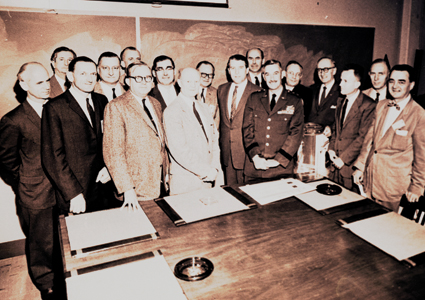
Wernher von Braun (tenth from left) and his rocket development team, pictured in 1959 at the Army Ballistic Missile Agency, which became part of NASA the following year. Most had been recruited by the US in "Operation Paperclip", including Arthur Rudolph (eighth from left) (image: NASA)
The moving, high-profile ceremonies held in Poland and many other countries to mark the 70th anniversary of the liberation of Auschwitz on January 27, 1945, would make it appear that the battle for memory of the Holocaust has been well and truly won.
Since I was among those freed by the Russians from the Budapest ghetto, also in January 1945, I was included in an extraordinary reception for Holocaust survivors held at Central Hall, Westminster, before the main public programme of remembrance. In view of their advancing ages, the set-up was rather like a Women's Institute tea party. The survivors and their families were seated at small tables where they could relax and chat over tea and sandwiches. Some of my closest and most admired friends who had been through the horrors of Auschwitz such as Trude Levi, Rudy Kennedy and Roman Halter were not there. Together with an increasing number of those who experienced the death camps, slave labour factories, and ghettoes, they have died in the past few years. Some extraordinary people were present and still very much alive to tell the world and, in particular, the next generation. Some of their stories were featured in a set of wonderful television documentaries broadcast during the week of the commemoration.
At the Westminster gathering, a series of VIP guests went gradually from table to table. Their presence demonstrated an exceptional degree of support, commitment and kindness. Among them were the Prince of Wales and the Duchess of Cornwall, the leaders of the main political parties, the Archbishop of Canterbury and the Chief Rabbi, the Director General of the BBC together with David Dimbleby, whose father Richard had made a famous broadcast describing the conditions at Bergen-Belsen when the camp was liberated by British troops. During the public commemoration which followed the party, the Prime Minister announced a commitment by the government, with cross-party agreement, to provide £50 million towards a large new Holocaust memorial and educational endowment in London.
Subsequent reports in the national press put something of a damper on the anniversary events by stressing that they had taken place against a background of Islamism, together with a new anti-Semitism associated with criticism of Israel. The extent of this danger is open to debate. There is a shortage of reliable evidence. In any case, the current panic about reportedly burgeoning anti-Semitism should not provide a diversion from an arguably greater danger: namely, that there still remain crucial gaps in our knowledge and understanding of the history of the Holocaust.
Though the basic facts about the Nazi murder of some six million Jews and millions of non-Jews are widely known (albeit still not widely enough), and though outright Holocaust denial is generally limited to the far Right and to much of the Arab world, there remains a major problem of Holocaust "greywashing" or "soft-core" denial. Universities in particular tend to ignore or, if not to ignore, to misinterpret the Holocaust in favour of a narrative of subsequent European union. The problem dates back to the 1940s and the Cold War. Nazi Germany's political triumph in 1945 was almost as spectacular as its military defeat. The consequences of that triumph continue to affect and to damage Europe today.
By the time he ended his life in his beleaguered Berlin bunker, Adolf Hitler had largely achieved his central ideological aim of destroying European Jewry. For the remnant of Jews who emerged from hiding or from the concentration camps, it would be impossible to re-establish their rich communal life in Central and Eastern Europe. Most of the survivors would seek to remake their shattered lives outside Europe.
Hitler had also succeeded in his main strategic objective: to ensure that the Allies would see the Soviet Union rather than Germany as the principal enemy. With every step of its long retreat in 1943-45, the Third Reich came closer to achieving its underlying political aim of exposing Communist Russia as the main threat to the civilised world. The conservative plotters against Adolf Hitler in the Kreisau Circle were as anti-Russian as the Nazis. Their anger against the German Führer was at least partly based on his failure to forge an effective anti-Soviet alliance.
As the Second World War continued, the Western powers and the Soviet Union were already preparing for a post-war struggle. United by an official policy of demanding an unconditional Nazi surrender, pro-Westerners and pro-Communists promoted rival factions within resistance movements in occupied Europe. In Italy, the prospect of Soviet subversion led Allen Dulles, America's secret service chief based in Switzerland, to negotiate in March 1945 with SS General Karl Wolff, Heinrich Himmler's associate. Dulles organised "Operation Sunrise", to ensure that Wolff would not be obliged to surrender to the Communists in northern Italy. When the Soviets found out, they demanded in vain to be included in the talks.
Following Nazi Germany's surrender in May 1945, the country's transformation from enemy to associate was remarkably rapid. Of course, there were token war crimes trials. These were hardly the main story. The United States soon started recruiting Nazi scientists such as Wernher von Braun in "Operation Paperclip".
Even more significant were secret actions by US, British and French intelligence agencies to bring Nazi political operatives on board. They could—it was hoped—provide essential information about Soviet political subversion and continue on behalf of the US, Britain and France anti-Soviet operations similar to the ones they had performed during the Second World War. In some cases Stalin discovered what was going on and demanded the handover of the former Nazis who had become servants of Western intelligence agencies. In such cases, the former Nazis were often moved to places of refuge in the USA, Canada and elsewhere.
Chilling evidence of the emergence of Communists as the principal enemy comes from revelations about the Bad Nenndorf interrogation centre near Hanover. Here, complaints about the regime run by Lieutenant-Colonel Robin "Tin Eye" Stephens led to courts-martial in 1948. As the MI5 website reports, "Several prisoners suffered such severe physical harm that they had to be taken to a local civilian hospital. Two of the prisoners died within twenty-four hours of arriving at the hospital, and another was so badly malnourished that it took him six months to recover."
The interrogation centre was set up in June 1945 to obtain information from "some of Hitler's most notorious henchmen" and businessmen such as Alfred Toepfer who had flourished under the Nazis. Within a year, the objective had changed. "[A]s the Nazi threat in Germany declined, by mid-1946," reports MI5, the interrogation centre "began to reorientate its efforts towards the Soviet Union."
Hitler had also succeeded in his main strategic objective: to ensure that the Allies would see the Soviet Union rather than Germany as the principal enemy. With every step of its long retreat in 1943-45, the Third Reich came closer to achieving its underlying political aim of exposing Communist Russia as the main threat to the civilised world. The conservative plotters against Adolf Hitler in the Kreisau Circle were as anti-Russian as the Nazis. Their anger against the German Führer was at least partly based on his failure to forge an effective anti-Soviet alliance.
As the Second World War continued, the Western powers and the Soviet Union were already preparing for a post-war struggle. United by an official policy of demanding an unconditional Nazi surrender, pro-Westerners and pro-Communists promoted rival factions within resistance movements in occupied Europe. In Italy, the prospect of Soviet subversion led Allen Dulles, America's secret service chief based in Switzerland, to negotiate in March 1945 with SS General Karl Wolff, Heinrich Himmler's associate. Dulles organised "Operation Sunrise", to ensure that Wolff would not be obliged to surrender to the Communists in northern Italy. When the Soviets found out, they demanded in vain to be included in the talks.
Following Nazi Germany's surrender in May 1945, the country's transformation from enemy to associate was remarkably rapid. Of course, there were token war crimes trials. These were hardly the main story. The United States soon started recruiting Nazi scientists such as Wernher von Braun in "Operation Paperclip".
Even more significant were secret actions by US, British and French intelligence agencies to bring Nazi political operatives on board. They could—it was hoped—provide essential information about Soviet political subversion and continue on behalf of the US, Britain and France anti-Soviet operations similar to the ones they had performed during the Second World War. In some cases Stalin discovered what was going on and demanded the handover of the former Nazis who had become servants of Western intelligence agencies. In such cases, the former Nazis were often moved to places of refuge in the USA, Canada and elsewhere.
Chilling evidence of the emergence of Communists as the principal enemy comes from revelations about the Bad Nenndorf interrogation centre near Hanover. Here, complaints about the regime run by Lieutenant-Colonel Robin "Tin Eye" Stephens led to courts-martial in 1948. As the MI5 website reports, "Several prisoners suffered such severe physical harm that they had to be taken to a local civilian hospital. Two of the prisoners died within twenty-four hours of arriving at the hospital, and another was so badly malnourished that it took him six months to recover."
The interrogation centre was set up in June 1945 to obtain information from "some of Hitler's most notorious henchmen" and businessmen such as Alfred Toepfer who had flourished under the Nazis. Within a year, the objective had changed. "[A]s the Nazi threat in Germany declined, by mid-1946," reports MI5, the interrogation centre "began to reorientate its efforts towards the Soviet Union."
Interrogations at Bad Nenndorf consequently became a crucial source of information. They provided information on a range of subjects, such as Soviet scientific research and technology, most importantly atomic research, and the Soviet intelligence services. They also provided, as one report noted in 1947, "as complete an Order of Battle for the Red Army" as was possible to obtain at the time. Several suspected Soviet agents were interrogated at Bad Nenndorf, providing "unassailable evidence of Russian espionage within the British Zone in Germany", as Stephens put it.
The Cold War made it extremely difficult to bring Nazi war criminals to justice or to demand compensation from companies which had profited from slave labour. In the rush to recruit West Germany as a fully fledged anti-Communist ally, the United States acceded to demands from Chancellor Konrad Adenauer for the early release of arch-criminals such as Edmund Veesenmayer. Sentenced to 20 years for his activities as Nazi supremo in Budapest at the time when half a million Jews were deported to Auschwitz or sent on death marches, he was released after only two years. With relatively few exceptions, academics who had served the Nazis, including Nazi historians, were reinstated. In May 1951, the Adenauer government passed a law reinstating civil servants (except for Gestapo officials) who had been dismissed after the fall of Hitler for their services to the Nazi regime.
Eric Lichtblau's recent book The Nazis Next Door: How America Became A Safe Haven For Hitler's Men (Houghton Mifflin, £18.46) throws important light on how the Cold War prevented a just reckoning for the Holocaust.
This is not a new theme. It was the subject of the Spencer Tracy film Judgment at Nuremberg (1961), Tom Bower's classic 1981 study Blind Eye to Murder, Alti Rodal's highly censored 1986 report carried out for the Deschenes Commission into readier admission of former Nazis than of Jews into post-war Canada, Christopher Simpson's vital investigative work Blowback (1988), and several works by John Loftus. Following the selective declassification of records under the terms of legislation enacted under the presidency of Bill Clinton, the US National Archives published in 2010 a discussion of "a sample of newly released records" by Richard Breitman and Norman Goda titled Hitler's Shadow: Nazi War Criminals, U.S. Intelligence, and the Cold War.
Nevertheless, the topic has received far too little attention. The Nazis Next Door adds to the literature in two important ways. It provides valuable information of the belated, much hampered efforts of a small unit within the US Department of Justice, the Office of Special Investigations (OSI), to bring to account even a small number of elderly Nazi perpetrators, or alleged perpetrators, living in the US.
Moreover, Lichtblau uses his narrative skills as a Pulitzer prize-winning reporter for the New York Times to give a compelling account of the realities of the work of the Nazi-hunters within the US Department of Justice. They frequently faced a needle-in-a-haystack search to track down former Nazis admitted to the US many years before. They had to overcome Central Intelligence Agency resistance to releasing records. In the words of Harry Rositzke, who headed the CIA's spy section in Munich in the early 1950s, "It was a visceral business of using any bastard as long as he was anti-Communist." It was hardly surprising that the CIA, reluctant at the best of times to release information, was particularly resistant to admit its use of Nazi war criminals during the Cold War.
Once they had located their targets, the Nazi-hunters in the OSI still had to find evidence sufficient to mount a robust legal case. After the passage of many years, identification of suspects by their former victims could be unreliable. False accusations could undermine the entire exercise of bringing Holocaust perpetrators to justice.
The Cold War made it extremely difficult to bring Nazi war criminals to justice or to demand compensation from companies which had profited from slave labour. In the rush to recruit West Germany as a fully fledged anti-Communist ally, the United States acceded to demands from Chancellor Konrad Adenauer for the early release of arch-criminals such as Edmund Veesenmayer. Sentenced to 20 years for his activities as Nazi supremo in Budapest at the time when half a million Jews were deported to Auschwitz or sent on death marches, he was released after only two years. With relatively few exceptions, academics who had served the Nazis, including Nazi historians, were reinstated. In May 1951, the Adenauer government passed a law reinstating civil servants (except for Gestapo officials) who had been dismissed after the fall of Hitler for their services to the Nazi regime.
Eric Lichtblau's recent book The Nazis Next Door: How America Became A Safe Haven For Hitler's Men (Houghton Mifflin, £18.46) throws important light on how the Cold War prevented a just reckoning for the Holocaust.
This is not a new theme. It was the subject of the Spencer Tracy film Judgment at Nuremberg (1961), Tom Bower's classic 1981 study Blind Eye to Murder, Alti Rodal's highly censored 1986 report carried out for the Deschenes Commission into readier admission of former Nazis than of Jews into post-war Canada, Christopher Simpson's vital investigative work Blowback (1988), and several works by John Loftus. Following the selective declassification of records under the terms of legislation enacted under the presidency of Bill Clinton, the US National Archives published in 2010 a discussion of "a sample of newly released records" by Richard Breitman and Norman Goda titled Hitler's Shadow: Nazi War Criminals, U.S. Intelligence, and the Cold War.
Nevertheless, the topic has received far too little attention. The Nazis Next Door adds to the literature in two important ways. It provides valuable information of the belated, much hampered efforts of a small unit within the US Department of Justice, the Office of Special Investigations (OSI), to bring to account even a small number of elderly Nazi perpetrators, or alleged perpetrators, living in the US.
Moreover, Lichtblau uses his narrative skills as a Pulitzer prize-winning reporter for the New York Times to give a compelling account of the realities of the work of the Nazi-hunters within the US Department of Justice. They frequently faced a needle-in-a-haystack search to track down former Nazis admitted to the US many years before. They had to overcome Central Intelligence Agency resistance to releasing records. In the words of Harry Rositzke, who headed the CIA's spy section in Munich in the early 1950s, "It was a visceral business of using any bastard as long as he was anti-Communist." It was hardly surprising that the CIA, reluctant at the best of times to release information, was particularly resistant to admit its use of Nazi war criminals during the Cold War.
Once they had located their targets, the Nazi-hunters in the OSI still had to find evidence sufficient to mount a robust legal case. After the passage of many years, identification of suspects by their former victims could be unreliable. False accusations could undermine the entire exercise of bringing Holocaust perpetrators to justice.
This was shown by the sorry saga of the OSI's attempt to prove that a car factory worker originally from Ukraine, John Demianiuk, was "Ivan the Terrible", a particularly brutal guard at the Treblinka extermination camp. Based on testimony from a number of survivors, Demianiuk was deported in 1986 and sent to stand trial in Israel; the case collapsed. It was not until 2011 that Demianiuk was finally convicted in Germany as a guard, not at Treblinka but at Sobibor. By then he was over 90 years old; he died the following year.
The desire to obtain victories in court sometimes created perverse incentives. The OSI could find itself concentrating on bringing charges against relatively minor figures because there was documentary evidence. As if these barriers were not enough, it could find itself facing pressure to abandon its inquiries from politically influential ethnic lobbies or prominent figures such as Pat Buchanan.
Created in 1979, the OSI operated within the US Department of Justice until 2010 when it was merged into a Human Rights and Special Prosecutions Section. The Nazis Next Door gives a vivid picture of the frustrations and victories of successive heads of the OSI, especially Neal Sher and Eli Rosenbaum.
Lichtblau took leave from the New York Times in 2013 to take a fellowship at the US Holocaust Memorial Museum in Washington to review the documentary evidence and to conduct extensive interviews.
Rosenbaum is probably the most important and most successful of all Nazi-hunters but is far less known than Simon Wiesenthal and others who have enjoyed the limelight. After stellar academic performances at the University of Pennsylvania and Harvard, he has spent nearly all of his 35-year working life in the OSI and its successor body.
Rather than give a comprehensive list of inquiries, prosecutions and other actions, Lichtblau provides the inside story of a number of key cases, most of them sensational at the time but subsequently almost forgotten.
An exceptionally well-known example, whose background the book describes, is the exposure of former UN Secretary General Kurt Waldheim and his resulting ban on entry to the US.
Two other riveting accounts typify the book. One concerns the investigation which led in 1983 to a plea bargain with Arthur Rudolph, Wernher von Braun's former deputy in the production of the V2 missile. In lieu of prosecution for his role in the administration of slave labour in the underground missile factory at Dora-Mittelbau, Rudolph agreed to give up his US citizenship and return to Germany.
As a third-year law student at Harvard, Rosenbaum had chanced to see a photograph in a local bookshop. Supplied by von Braun for an admiring book about US rocketry, it showed Russian prisoners of war "contributing to the manufacture" of Nazi rockets. A passage in the book, The Rocket Team, recounted how Rudolph, as operations chief at Dora, had been obliged to leave a New Year's Eve party to sort out an unexpected engineering glitch. On the basis of this account, Rosenbaum was able to obtain an admission from Rudolph of his participation in the use of slave labour at Dora-Mittelbau.
The second account relates the long search for evidence sufficient to strip Alexandras Lileikis of his US citizenship in 1996. A former security police chief in Vilnius during the Holocaust, Lileikis returned to face trial in his native Lithuania. He died four years later after his trial was adjourned on health grounds.
The desire to obtain victories in court sometimes created perverse incentives. The OSI could find itself concentrating on bringing charges against relatively minor figures because there was documentary evidence. As if these barriers were not enough, it could find itself facing pressure to abandon its inquiries from politically influential ethnic lobbies or prominent figures such as Pat Buchanan.
Created in 1979, the OSI operated within the US Department of Justice until 2010 when it was merged into a Human Rights and Special Prosecutions Section. The Nazis Next Door gives a vivid picture of the frustrations and victories of successive heads of the OSI, especially Neal Sher and Eli Rosenbaum.
Lichtblau took leave from the New York Times in 2013 to take a fellowship at the US Holocaust Memorial Museum in Washington to review the documentary evidence and to conduct extensive interviews.
Rosenbaum is probably the most important and most successful of all Nazi-hunters but is far less known than Simon Wiesenthal and others who have enjoyed the limelight. After stellar academic performances at the University of Pennsylvania and Harvard, he has spent nearly all of his 35-year working life in the OSI and its successor body.
Rather than give a comprehensive list of inquiries, prosecutions and other actions, Lichtblau provides the inside story of a number of key cases, most of them sensational at the time but subsequently almost forgotten.
An exceptionally well-known example, whose background the book describes, is the exposure of former UN Secretary General Kurt Waldheim and his resulting ban on entry to the US.
Two other riveting accounts typify the book. One concerns the investigation which led in 1983 to a plea bargain with Arthur Rudolph, Wernher von Braun's former deputy in the production of the V2 missile. In lieu of prosecution for his role in the administration of slave labour in the underground missile factory at Dora-Mittelbau, Rudolph agreed to give up his US citizenship and return to Germany.
As a third-year law student at Harvard, Rosenbaum had chanced to see a photograph in a local bookshop. Supplied by von Braun for an admiring book about US rocketry, it showed Russian prisoners of war "contributing to the manufacture" of Nazi rockets. A passage in the book, The Rocket Team, recounted how Rudolph, as operations chief at Dora, had been obliged to leave a New Year's Eve party to sort out an unexpected engineering glitch. On the basis of this account, Rosenbaum was able to obtain an admission from Rudolph of his participation in the use of slave labour at Dora-Mittelbau.
The second account relates the long search for evidence sufficient to strip Alexandras Lileikis of his US citizenship in 1996. A former security police chief in Vilnius during the Holocaust, Lileikis returned to face trial in his native Lithuania. He died four years later after his trial was adjourned on health grounds.
After the war, Lileikis had worked in East Germany for the CIA in providing information on Communists, for which he was rewarded by entry into the US and the award of American citizenship. Proof of his former position was insufficient for legal purposes. The OSI needed documentary evidence of his involvement in sending Jews to their death in the forest killing ground at Ponary outside Vilnius. Eventually, during one of 16 visits to examine archives in Lithuania, a multilingual OSI researcher, Mike McQueen, tracked down a whole set of Lileikis's signatures on deportation orders. These overcame Lileikis's denials and Fifth Amendment pleas, but they were insufficient to satisfy the court in Lithuania.
The Nazis Next Door ends with a telling epilogue befitting the 70th anniversary memorial of the liberation of Auschwitz, which is likely to be the last significant commemoration when more than a handful of survivors are still alive. In 2014, the US authorities arrested one of the last Nazis still living in the US: Johannes Breyer, aged 89, was charged with taking part in the gassing of 216,000 Jews at Auschwitz. On the very day he was ordered back to Germany, he died.
So what is the future of Holocaust commemoration when perpetrators, witnesses and surviving victims are no more? The answer in various countries is to establish museums, to make a last effort to video-record survivors' testimonies, to establish an annual day of remembrance, and to fund educational schemes such as the regular visits to Auschwitz arranged in the UK by the Holocaust Educational Trust.
These all are worthy and necessary. However, they are not sufficient to overcome the misunderstanding of the Holocaust which is the legacy of the Cold War. Moreover, public schemes and monuments have pitfalls. They all too easily become glossy, simplistic presentations and provide career opportunities for some highly- paid professionals. The director of one Holocaust memorial in the US had a yearly salary package in 2012 of nearly $600,000.
There are several unresolved issues to be addressed.
First, while survivors of Nazi atrocities remain alive, the world community and world Jewry in particular has a responsibility to ensure that they are not left in serious material need or without proper healthcare. In countries ranging from Israel to Lithuania, elderly victims have been neglected.
Second, records of intelligence agencies from the decade after the end of the Second World War need to be made available regarding the use in the Cold War of former Nazis. In the US, the Nazi War Crimes Disclosure Act was signed by President Clinton on October 8, 1998. The inter-agency working group established to supervise the declassification process included James Crichelow, the former CIA officer directly responsible for the policy of recruiting former Nazis to the Gehlen Organisation, the fledgling West German foreign intelligence agency. It is not surprising that the declassification was incomplete. Nevertheless, it produced useful results summarised in various publications.
There is an urgent need for similar declassification by the UK. The case is strengthened by reliable indications that British reluctance to reveal postwar dealings with former Nazis has prevented release of information by other countries. Intelligence agencies are particularly hesitant to publish details of agents employed by sister agencies, even in the distant past.
The Nazis Next Door ends with a telling epilogue befitting the 70th anniversary memorial of the liberation of Auschwitz, which is likely to be the last significant commemoration when more than a handful of survivors are still alive. In 2014, the US authorities arrested one of the last Nazis still living in the US: Johannes Breyer, aged 89, was charged with taking part in the gassing of 216,000 Jews at Auschwitz. On the very day he was ordered back to Germany, he died.
So what is the future of Holocaust commemoration when perpetrators, witnesses and surviving victims are no more? The answer in various countries is to establish museums, to make a last effort to video-record survivors' testimonies, to establish an annual day of remembrance, and to fund educational schemes such as the regular visits to Auschwitz arranged in the UK by the Holocaust Educational Trust.
These all are worthy and necessary. However, they are not sufficient to overcome the misunderstanding of the Holocaust which is the legacy of the Cold War. Moreover, public schemes and monuments have pitfalls. They all too easily become glossy, simplistic presentations and provide career opportunities for some highly- paid professionals. The director of one Holocaust memorial in the US had a yearly salary package in 2012 of nearly $600,000.
There are several unresolved issues to be addressed.
First, while survivors of Nazi atrocities remain alive, the world community and world Jewry in particular has a responsibility to ensure that they are not left in serious material need or without proper healthcare. In countries ranging from Israel to Lithuania, elderly victims have been neglected.
Second, records of intelligence agencies from the decade after the end of the Second World War need to be made available regarding the use in the Cold War of former Nazis. In the US, the Nazi War Crimes Disclosure Act was signed by President Clinton on October 8, 1998. The inter-agency working group established to supervise the declassification process included James Crichelow, the former CIA officer directly responsible for the policy of recruiting former Nazis to the Gehlen Organisation, the fledgling West German foreign intelligence agency. It is not surprising that the declassification was incomplete. Nevertheless, it produced useful results summarised in various publications.
There is an urgent need for similar declassification by the UK. The case is strengthened by reliable indications that British reluctance to reveal postwar dealings with former Nazis has prevented release of information by other countries. Intelligence agencies are particularly hesitant to publish details of agents employed by sister agencies, even in the distant past.
Third, while survivors are still alive and able to provide information of historical value, there should be more emphasis on in-depth conversations with selected persons rather than the fairly standardised video interviews which have been all too common. The experiences of some victims were too traumatic to be revealed in short conversations with relative strangers. Two survivors whom I came to know well felt able to tell me things only after several years. I discovered recently that one of them had provided information to a museum on condition that it was not to be revealed within the lifetime of his children.
Fourth, as a perverse result of the Cold War and of the desire to appease post-war West Germany, there has never been a legal reckoning for the Holocaust. This surely must be resolved. The miserable, out-of-court settlements reached in the late 1990s by lawyers representing survivors in class action suits in the US were on the basis that the German corporations who had participated in and profited from slave labour under the Nazis would admit no legal responsibility. When I accompanied former slave labourers at Auschwitz to see the then German ambassador in London in the 1990s, the ambassador stressed that "strictly speaking" there had been nothing illegal in their employment. If Europe is to be rebuilt on the basis of respect for the rule of law, this position is intolerable.
Fifth, there have been concerted and growing efforts within the European Union to promote the doctrine of "Double Genocide", namely that the Holocaust should not be considered in isolation but on a par with Soviet misdeeds. The effect of this doctrine in such countries as Hungary and Lithuania has been to place greater emphasis on Soviet than on Nazi crimes. In the Vilnius museum built in the former Nazi and then Soviet police headquarters, only a single room has been belatedly added to record the murders of Lithuanian Jews in the Holocaust—murders in which Lithuanians had been active participants. There is a growing tendency in Central and Eastern Europe to downgrade the Holocaust by comparison with Communist terror.
Sixth, the Cold War emphasis on anti-Soviet analysis has continued to affect the way in which the history of Europe in the 20th century is taught in many universities. Whereas the Holocaust is firmly on the teaching agenda in schools in the UK and elsewhere, the same often does not apply in higher education. St Antony's College, Oxford, was a Cold War creation. It later received considerable funding for its European studies centre from the Volkswagen Foundation with the advice of Hermann Abs, the director of Deutsche Bank mainly responsible for foreign investments at the time the bank financed the construction of the Buna works at Auschwitz. Abs (who died in 1994), as well as leading German historians, would have had us believe he was ignorant of this.
Seventh, this leads to the conclusion that there needs to be considerably better funding of Holocaust history from neutral and Jewish sources rather than from German ones.
Until these issues are resolved, our understanding and memory of the Holocaust will remain in doubt.
Fourth, as a perverse result of the Cold War and of the desire to appease post-war West Germany, there has never been a legal reckoning for the Holocaust. This surely must be resolved. The miserable, out-of-court settlements reached in the late 1990s by lawyers representing survivors in class action suits in the US were on the basis that the German corporations who had participated in and profited from slave labour under the Nazis would admit no legal responsibility. When I accompanied former slave labourers at Auschwitz to see the then German ambassador in London in the 1990s, the ambassador stressed that "strictly speaking" there had been nothing illegal in their employment. If Europe is to be rebuilt on the basis of respect for the rule of law, this position is intolerable.
Fifth, there have been concerted and growing efforts within the European Union to promote the doctrine of "Double Genocide", namely that the Holocaust should not be considered in isolation but on a par with Soviet misdeeds. The effect of this doctrine in such countries as Hungary and Lithuania has been to place greater emphasis on Soviet than on Nazi crimes. In the Vilnius museum built in the former Nazi and then Soviet police headquarters, only a single room has been belatedly added to record the murders of Lithuanian Jews in the Holocaust—murders in which Lithuanians had been active participants. There is a growing tendency in Central and Eastern Europe to downgrade the Holocaust by comparison with Communist terror.
Sixth, the Cold War emphasis on anti-Soviet analysis has continued to affect the way in which the history of Europe in the 20th century is taught in many universities. Whereas the Holocaust is firmly on the teaching agenda in schools in the UK and elsewhere, the same often does not apply in higher education. St Antony's College, Oxford, was a Cold War creation. It later received considerable funding for its European studies centre from the Volkswagen Foundation with the advice of Hermann Abs, the director of Deutsche Bank mainly responsible for foreign investments at the time the bank financed the construction of the Buna works at Auschwitz. Abs (who died in 1994), as well as leading German historians, would have had us believe he was ignorant of this.
Seventh, this leads to the conclusion that there needs to be considerably better funding of Holocaust history from neutral and Jewish sources rather than from German ones.
Until these issues are resolved, our understanding and memory of the Holocaust will remain in doubt.