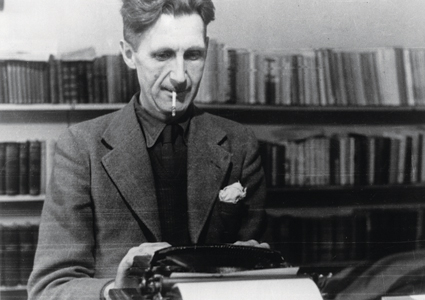
George Orwell: His essay "Politics and the English Language" remains influential, even if many prominent writers have ignored his advice (Mondadori Portfolio via Getty Images)
In his famous essay, "Politics and the English Language", George Orwell wrote: "In our time it is broadly true that political writing is bad writing. Where it is not true, it will generally be found that the writer is some kind of rebel, expressing his private opinions and not a ‘party line'. Orthodoxy, of whatever colour, seems to demand a lifeless, imitative style." Written nearly 70 years ago, Orwell's essay skewered six commonplace barbarities in contemporary political discourse so clearly and ruthlessly that it made it harder for succeeding political writers to perpetrate them.
However, each generation starts life afresh. Today political writing is evolving in a direction Orwell never predicted. A new method of expression has come into existence. Examples can be found in speeches, official documents and even the literature produced by academic institutions and charities. It has already spread into mainstream journalism, changing not just political writing, but also sports journalism, foreign reporting and column writing. The new method of expression has become the dominant form in blogs and social media.
It rejects conventional rules of grammar, and is no longer concerned with accuracy and truth. The writers criticised in Orwell's famous essay all assumed they were describing the outside world objectively. Indeed the worst political writing of the last century, from both Left and Right, stemmed from the writers' assumption that their politics was grounded in scientific truth.
The modern school has turned this assumption on its head. Instead of objectivity, it concentrates its attention on subjective experience. Instead of reason, it values emotion. Where once writers maintained distance from their subject matter, the new sensibility demands intimacy.
Each of the five passages below demonstrates some of the conventions that are now common in much of British discourse. I have only chosen passages from respected sources. They illustrate an outlook which has only become part of mainstream culture over the past few years, in which the writer's feelings about the subject are infinitely more important than the subject. It is almost inconceivable that any established writer would have written in this way about serious issues in Orwell's time.
I wanted to share with you my own experience of Mensch. You see a couple of months ago I ended up having coffee with her at Portcullis House . . . During our meeting, Mensch was at her most passionate and sincere when she talked about feminism . . . I'm sure I'll be accused of naïveté, but sitting there talking to her, I felt she was talking with the sort of depth that only comes from personal experience.Ellie Mae O'Hagan, New StatesmanBut the authenticity of this as Nick's personal, very personal view should be in no doubt. His family's history, Miriam's family, his kids are all part of the reason he fights to deliver things like free school meals, lower taxes, more jobs. So when he talks about why he is internationalist it's personal, when he talks about why he is a liberal it's personal, and when he talks about freedom and democracy it's personal.Baroness Grender, The Guardian
Of the Tory conference just gone, for example, I must confess that I saw very little indeed. Very, very little. None, actually. Nor of the Labour conference either. Not a minute of it . . . I didn't vote in the general election . . . But that was because I was on honeymoon in Greece. Yes I could have posted my vote, but that would have meant going to reception, buying a stamp, all that palaver, when I was supposed to be in my hotel room making babies. So I did my thing and you did yours. I got Kitty. You got the coalition.Giles Coren, The Times
I'm anti-torture, me. There's a brave statement. But I am. I think it's the wrong thing to do . . . Does this mean I'd rather the occasional hijacking, bombing or miscellaneous terrorist outrage occurred? Just so a few beardy psychopaths don't occasionally have a miserable time in shipping containers? I've twisted and equivocated on this one for years, and I'm afraid I just don't see any way out of it. Yes. It does.Hugo Rifkind, The Times
We are truly sorry for what has happened and that you have been let down.
It is our actions now and over the coming months and years that will make the difference.
You are the lifeblood of our business, and we will not allow ourselves to be distracted from what really matters—delivering for you, day in and day out.Marcus Agius, then chairman of Barclays, apologising to customers in the wake of the Libor scandal
In the Barclays letter, and all of the above passages the writer addresses an individual reader in a familiar tone, simulating a personal connection which does not exist. Authorial invisibility has been abandoned. Indeed, the writer is so firmly in the foreground that little else can be seen. In an article of some 900 words ostensibly about Louise Mensch, O'Hagan uses first-person pronouns more than 50 times. She speculates loosely about what Mensch might think but the article is really about O'Hagan. Likewise the Giles Coren article is not about the party conferences, which are used as a device to discuss his vastly more important private life.
In fairness, the Grender piece is on the surface about Nick Clegg, but it is clear that his policies matter because he (and she) believe in them personally, not because they have any objective value to anyone else. The Barclays letter shows that the new sensibility has penetrated the business world: even bloodless corporations now pretend they have feelings. Notice that although remedial action is promised it is not specified, like a child promising to be good forever. What the letter really says is: "We've been caught. Let us get away with it. What matters is our profit, and that depends on your compliance."
This narcissistic writing embodies two equally dangerous assumptions. The first is that emotion is more important than thought. "Passion" is the pre-eminent virtue, and no context is too banal. "Shop with passion! Shop with a purpose!" urges Amnesty International, in an email flogging T-shirts with human rights slogans. The second is that no subject is more important than the writer. Coren patronises any of his readers who might be interested in politics (notice that this approach rests on a false choice between public engagement and parenting). Nothing is trivial and nothing innately significant, except the feelings of the writer. In this confessional discourse abstract concerns and private sentiment get muddled up, while tone of voice and subject-matter are often mismatched, as in the case of the Rifkind passage on torture above.
English is a supple language; this is one of its great strengths. Words have always changed their shape and meaning, served different parts of speech, come and gone over time. But now, something is happening to words themselves. It's not merely that this or that word is used incorrectly. Words no longer have to mean anything at all.
Consider again the passage above about Nick Clegg from Olly Grender, the Liberal Democrat spin-doctor. Those on the receiving end are not supposed to think but to make a positive emotional connection with Clegg (and Grender). The cognitive communication serious politics once demanded has been replaced by the "affective communication" of marketing. To grasp the scale and speed of the change, let's compare the leadership speeches at past Tory and Labour party conferences to those of today.
Thirty years ago Britain was convulsed by the tragedy of the miners strike. Here is a section from Neil Kinnock's critique of Margaret Thatcher, as delivered at Blackpool in 1984:
Here is part of Margaret Thatcher's response to the Labour leader a week later:
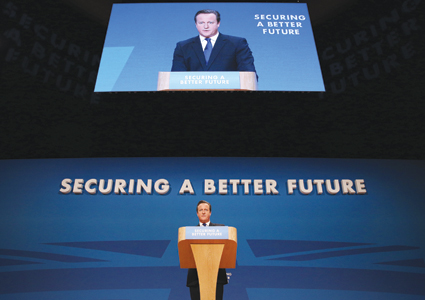
David Cameron: His speeches illustrate the modern prioritisation of style over substance in the language of politics (Peter MacDiarmid/Getty Images)
The miners' strike was an historic struggle. The two passages above show that the oratory of the two greatest leaders of the day rose to the occasion. Neither Kinnock nor Thatcher talked down to their audience. Their language was clear, easy to understand, and grounded in history. Cadence and rhetorical devices are employed to underscore the gravity of the subject and the momentous principles at stake, not to enhance their own likeability or simulate a personal connection with the voter.
Here is David Cameron at the Conservative Party Conference in 2013: "Is it enough to just fix what went wrong? I say no. Not for me. . . Now, I know it'll be tough. But I know we've got what it takes." He treats his government as a collection of individuals on a first-name basis: "They said we couldn't get terrorists out of this country. Well—Theresa knew otherwise." "George" made a brilliant speech and "Boris" made a great speech and Dave himself was Action Man: "I vetoed that treaty. I got Britain out of the EU bail-out scheme. And yes, I cut that budget."
He loves Samantha, and "was incredibly proud of her" when she got her first business cards. The role of Prime Minister is a "job", just like other people have: "I get to visit some amazing factories in my job." "Amazing" and "incredible" are the Prime Minister's two adjectives of choice, though he sometimes uses the terms "huge" or "massive". Houses are now "homes". In David Cameron's universe people are "desperate" to get and have things, people like Emily and James, a couple he claims to have met a few days before. They are aspirational, Emily and James, as is required of today's citizens. So it's a good thing the Prime Minister knows "there's another thing people need—the most important thing of all. More money in their pockets." The shrinking of language and the shrivelling of purpose go hand in hand.
The style of serious, straightforward political discussion employed by Kinnock and Thatcher survived until the early 1990s. The final conference speech of the lost Labour leader John Smith in the autumn of 1993 was perhaps the last time it was heard. With the victory of Tony Blair everything changed at once. Tony Blair mangled traditional discourse. In his short masterpiece, Coping with Post-Democracy, Professor Colin Crouch has described how politicians suddenly ceased to speak like ordinary people and started to present "glib and finely honed statements which have a character all their own".
Blair made one further leap: he assumed that his personal feelings about his actions are in themselves proof of their rightness. This remains as the foundation of his defence on Iraq. He has long abandoned any attempt (admittedly this gets harder and harder) to justify his actions by their results, particularly their impact on British interests. Blair governed by psychodrama; he made decisions because they made him feel like a strong, ethical leader. David Cameron famously views himself as the "heir to Blair". In the speech analysed above, and on other occasions, he has copied Tony Blair's use of language. Both men communicate through very brief messages requiring negligible concentration, often constructing their arguments to appeal to the emotions rather than to the intellect.
This narcissistic writing embodies two equally dangerous assumptions. The first is that emotion is more important than thought. "Passion" is the pre-eminent virtue, and no context is too banal. "Shop with passion! Shop with a purpose!" urges Amnesty International, in an email flogging T-shirts with human rights slogans. The second is that no subject is more important than the writer. Coren patronises any of his readers who might be interested in politics (notice that this approach rests on a false choice between public engagement and parenting). Nothing is trivial and nothing innately significant, except the feelings of the writer. In this confessional discourse abstract concerns and private sentiment get muddled up, while tone of voice and subject-matter are often mismatched, as in the case of the Rifkind passage on torture above.
English is a supple language; this is one of its great strengths. Words have always changed their shape and meaning, served different parts of speech, come and gone over time. But now, something is happening to words themselves. It's not merely that this or that word is used incorrectly. Words no longer have to mean anything at all.
Consider again the passage above about Nick Clegg from Olly Grender, the Liberal Democrat spin-doctor. Those on the receiving end are not supposed to think but to make a positive emotional connection with Clegg (and Grender). The cognitive communication serious politics once demanded has been replaced by the "affective communication" of marketing. To grasp the scale and speed of the change, let's compare the leadership speeches at past Tory and Labour party conferences to those of today.
Thirty years ago Britain was convulsed by the tragedy of the miners strike. Here is a section from Neil Kinnock's critique of Margaret Thatcher, as delivered at Blackpool in 1984:
In all economic policy, in all social policy, in their very appearance and their conduct of government, this government creates the climate of confrontation, the conditions of conflict: it speaks only the language of conquest. And, in the midst of all that chaos, in the midst of all that assault on the essentials of civilised life in this country and of values in this country, they call for the condemnation of violence. I do not respond to that because it is a taunt, a call to forswear intimidation from a government that bases its whole policy on intimidation.
Here is part of Margaret Thatcher's response to the Labour leader a week later:
It seems there are some who are out to destroy a properly elected Government. They are out to bring down the framework of law. That is what we have seen in this strike. And what is the law they seek to defy? It is the common law created by fearless judges and passed down across the centuries. It is legislation scrutinised and enacted by the Parliament of a free people.
David Cameron: His speeches illustrate the modern prioritisation of style over substance in the language of politics (Peter MacDiarmid/Getty Images)
The miners' strike was an historic struggle. The two passages above show that the oratory of the two greatest leaders of the day rose to the occasion. Neither Kinnock nor Thatcher talked down to their audience. Their language was clear, easy to understand, and grounded in history. Cadence and rhetorical devices are employed to underscore the gravity of the subject and the momentous principles at stake, not to enhance their own likeability or simulate a personal connection with the voter.
Here is David Cameron at the Conservative Party Conference in 2013: "Is it enough to just fix what went wrong? I say no. Not for me. . . Now, I know it'll be tough. But I know we've got what it takes." He treats his government as a collection of individuals on a first-name basis: "They said we couldn't get terrorists out of this country. Well—Theresa knew otherwise." "George" made a brilliant speech and "Boris" made a great speech and Dave himself was Action Man: "I vetoed that treaty. I got Britain out of the EU bail-out scheme. And yes, I cut that budget."
He loves Samantha, and "was incredibly proud of her" when she got her first business cards. The role of Prime Minister is a "job", just like other people have: "I get to visit some amazing factories in my job." "Amazing" and "incredible" are the Prime Minister's two adjectives of choice, though he sometimes uses the terms "huge" or "massive". Houses are now "homes". In David Cameron's universe people are "desperate" to get and have things, people like Emily and James, a couple he claims to have met a few days before. They are aspirational, Emily and James, as is required of today's citizens. So it's a good thing the Prime Minister knows "there's another thing people need—the most important thing of all. More money in their pockets." The shrinking of language and the shrivelling of purpose go hand in hand.
The style of serious, straightforward political discussion employed by Kinnock and Thatcher survived until the early 1990s. The final conference speech of the lost Labour leader John Smith in the autumn of 1993 was perhaps the last time it was heard. With the victory of Tony Blair everything changed at once. Tony Blair mangled traditional discourse. In his short masterpiece, Coping with Post-Democracy, Professor Colin Crouch has described how politicians suddenly ceased to speak like ordinary people and started to present "glib and finely honed statements which have a character all their own".
Blair made one further leap: he assumed that his personal feelings about his actions are in themselves proof of their rightness. This remains as the foundation of his defence on Iraq. He has long abandoned any attempt (admittedly this gets harder and harder) to justify his actions by their results, particularly their impact on British interests. Blair governed by psychodrama; he made decisions because they made him feel like a strong, ethical leader. David Cameron famously views himself as the "heir to Blair". In the speech analysed above, and on other occasions, he has copied Tony Blair's use of language. Both men communicate through very brief messages requiring negligible concentration, often constructing their arguments to appeal to the emotions rather than to the intellect.
As far as reporting is concerned, the new discourse can be traced to the so-called "New Journalism" of the 1960s and 1970s, in which writers such as Truman Capote, Norman Mailer and Tom Wolfe deliberately blurred the boundaries between narrative and fiction. It was especially stimulated by the "gonzo journalism" of Hunter S. Thompson's Fear and Loathing in Las Vegas (1972), which was written entirely in the first person and highlighted interior experience to the exclusion of everything else. In theory an account of a political convention in Las Vegas, it focused on the adventures of a drug-crazed reporter sent to cover it. Norman Mailer's Miami and the Siege of Chicago is an earlier and even more brilliant example. This writer-foregrounding reportage works because these writers were incomparably better stylists than their followers. Furthermore Fear and Loathing had a moral premise of sorts: the conference and American society were themselves so crazy that they made sense only to a hallucinating observer.
Their techniques were copied, though without conviction, in Britain. In the 1980s Julie Burchill would attend party conferences where, colleagues recall, she would establish herself with large quantities of drugs and alcohol in her hotel room to watch the coverage on television, thus foregrounding the experience of the reporter and converting politics into background. Will Self followed suit, taking heroin in the Prime Minister's plane while following John Major in the 1997 general election.
Will Self ("So I was smacked out on the Prime Minister's jet—big deal.") was writing for the Observer, Burchill ("You don't learn about the state of the party from sitting in the conference hall.") for the Mail on Sunday. For the most part, however, this British version of gonzo remained a minority pursuit. It has only entered mainstream reporting over the last few years. Caitlin Moran, a gifted Times journalist, has developed a technique which collapses conventional grammar while placing herself at the heart of the narrative. She has a growing number of imitators, and is probably the most influential British journalist of her generation.
However the changes in British reporting cannot be explained simply in terms of journalistic fashion. In his famous essay George Orwell observed that "the decline of a language must ultimately have political and economic causes: it is not due simply to the bad influence of this or that individual writer."
The solipsism which now lies at the heart of so much contemporary prose is a consequence of the very profound social and economic shift that has changed Britain over the last 25 years. In the aftermath of World War Two identities were collective: regiment; trade union; community; church; country; family; political party. The most admired qualities were duty, courage, self-sacrifice—all of which required individuals to submerge their personalities in the interests of a broader struggle.
For generations, patriotism had been drilled into schoolchildren. Orwell recognised that it nurtured a capacity for selflessness and courage. In "My Country Right or Left", he writes of "the spiritual need for patriotism and the military virtues, for which, however little the boiled rabbits of the Left may like them, no substitute has yet been found".
From the second half of the 20th century, patriotism was confused with jingoistic nationalism and racist imperialism and was entirely abandoned, by state schools at least. Contemporary state education does an outstanding job of teaching tolerance, and respect for other cultures and other people; there is a good deal of old-fashioned British decency in all this. But the "spiritual need for patriotism and the military virtues" has never gone so unmet.
Their techniques were copied, though without conviction, in Britain. In the 1980s Julie Burchill would attend party conferences where, colleagues recall, she would establish herself with large quantities of drugs and alcohol in her hotel room to watch the coverage on television, thus foregrounding the experience of the reporter and converting politics into background. Will Self followed suit, taking heroin in the Prime Minister's plane while following John Major in the 1997 general election.
Will Self ("So I was smacked out on the Prime Minister's jet—big deal.") was writing for the Observer, Burchill ("You don't learn about the state of the party from sitting in the conference hall.") for the Mail on Sunday. For the most part, however, this British version of gonzo remained a minority pursuit. It has only entered mainstream reporting over the last few years. Caitlin Moran, a gifted Times journalist, has developed a technique which collapses conventional grammar while placing herself at the heart of the narrative. She has a growing number of imitators, and is probably the most influential British journalist of her generation.
However the changes in British reporting cannot be explained simply in terms of journalistic fashion. In his famous essay George Orwell observed that "the decline of a language must ultimately have political and economic causes: it is not due simply to the bad influence of this or that individual writer."
The solipsism which now lies at the heart of so much contemporary prose is a consequence of the very profound social and economic shift that has changed Britain over the last 25 years. In the aftermath of World War Two identities were collective: regiment; trade union; community; church; country; family; political party. The most admired qualities were duty, courage, self-sacrifice—all of which required individuals to submerge their personalities in the interests of a broader struggle.
For generations, patriotism had been drilled into schoolchildren. Orwell recognised that it nurtured a capacity for selflessness and courage. In "My Country Right or Left", he writes of "the spiritual need for patriotism and the military virtues, for which, however little the boiled rabbits of the Left may like them, no substitute has yet been found".
From the second half of the 20th century, patriotism was confused with jingoistic nationalism and racist imperialism and was entirely abandoned, by state schools at least. Contemporary state education does an outstanding job of teaching tolerance, and respect for other cultures and other people; there is a good deal of old-fashioned British decency in all this. But the "spiritual need for patriotism and the military virtues" has never gone so unmet.
Moreover the understanding that children are innately serious has been lost. The emphasis is on fun and self-expression. Each child's individuality is nurtured, their feelings meticulously considered. Much is made of teamwork , an important skill in the contemporary workplace. But teamwork is project-based; it is too shallow for loyalty and too flexible and temporary for a sense of collective identity. In secondary schools there is a new emphasis on aspiration: education is "sold" to students as a means to achieve wealth and status. Children are regularly asked to assess their lessons in a peculiar variation of customer feedback. They have become consumers rather than citizens.
As a result patriotism has become difficult to grasp. It requires one to shoulder the blame for wrongs done as well as pride in great achievements, the humiliations as well as the triumphs. It requires commitment, at the heart of which is sacrifice. Contemporary attempts to revive patriotism urge people to select Britishness as one aspect of a composite personal identity, and to view Britain as a huge corporation. Here is a recent attempt by the Prime Minister to market Britain in this way: "We come as a brand—and a powerful brand . . . Team GB. The winning team in world history." The vision revealed in this speech (a particularly grim example of the collapse of public discourse) was expressed in February 2014 at the start of the referendum on Scottish independence. Its debased conception of British identity is in some respects worse than the simple absence of patriotism.
This soulless, ersatz patriotism has arisen in the aftermath of the long withering of religion. Writing 200 years ago, Alexis de Tocqueville observed with characteristic foresight that "as the light of faith gradually dims, men's range of vision grows narrow . . . they seek the immediate gratification of their smallest wishes."
He went on: "In sceptical times, therefore, there is always the danger that men will surrender themselves endlessly to the casual whims of daily desire and that they will abandon entirely anything which requires long-term effort, thus failing to establish anything noble or calm or lasting."
Absence of belief in absolute truth paves the way for subjectivity and relativism, while depriving people of the sense that their innermost self is known and witnessed. This has further contributed to the self-scrutiny, self-reference and self-documentation of contemporary narcissism. (Auden remarked that in the English novels of his time, only Grahame Greene's characters had souls.)
The parish church provided witness to the unfolding of individual lives and a place within which one is known in a public rather than an intimate way. As an intermediate space between the protection of the family and the chaos of strangers, church offers respect and recognition without intrusion. The urge to expose one's personal life and feelings to strangers arises in part from the loss of spaces such as these.
The new narcissism is taught as an examination technique. Here are some tips from a GCSE revision guide for the English Writing examination:
As a result patriotism has become difficult to grasp. It requires one to shoulder the blame for wrongs done as well as pride in great achievements, the humiliations as well as the triumphs. It requires commitment, at the heart of which is sacrifice. Contemporary attempts to revive patriotism urge people to select Britishness as one aspect of a composite personal identity, and to view Britain as a huge corporation. Here is a recent attempt by the Prime Minister to market Britain in this way: "We come as a brand—and a powerful brand . . . Team GB. The winning team in world history." The vision revealed in this speech (a particularly grim example of the collapse of public discourse) was expressed in February 2014 at the start of the referendum on Scottish independence. Its debased conception of British identity is in some respects worse than the simple absence of patriotism.
This soulless, ersatz patriotism has arisen in the aftermath of the long withering of religion. Writing 200 years ago, Alexis de Tocqueville observed with characteristic foresight that "as the light of faith gradually dims, men's range of vision grows narrow . . . they seek the immediate gratification of their smallest wishes."
He went on: "In sceptical times, therefore, there is always the danger that men will surrender themselves endlessly to the casual whims of daily desire and that they will abandon entirely anything which requires long-term effort, thus failing to establish anything noble or calm or lasting."
Absence of belief in absolute truth paves the way for subjectivity and relativism, while depriving people of the sense that their innermost self is known and witnessed. This has further contributed to the self-scrutiny, self-reference and self-documentation of contemporary narcissism. (Auden remarked that in the English novels of his time, only Grahame Greene's characters had souls.)
The parish church provided witness to the unfolding of individual lives and a place within which one is known in a public rather than an intimate way. As an intermediate space between the protection of the family and the chaos of strangers, church offers respect and recognition without intrusion. The urge to expose one's personal life and feelings to strangers arises in part from the loss of spaces such as these.
The new narcissism is taught as an examination technique. Here are some tips from a GCSE revision guide for the English Writing examination:
- Use Emotive Language to get through to your reader . . . You could tell them some shocking or disturbing facts.
- Use Facts and Statistics . . . You can make these up if you like, but make sure they sound realistic. They'll make your argument more convincing.
- Add Generalisations . . . They're a good way to sound forceful and convincing.
- Include Personal Anecdotes to add interest.
- Present Opinions as Facts . . . to make your writing persuasive.
Students are also urged "to use as many interesting verbs, adjectives and adverbs as you can" and "to show off some vocabulary". Examples of truly dreadful prose are provided for students to emulate in pursuit of top marks. The emphasis on emotion, personal anecdote, and the profligate use of adjectives, adverbs, similes and metaphors is bad enough. Far worse is the teaching that truth and accuracy are optional. Let's now return to political writing. Journalists in the post-war epoch were not celebrities. They were classified according to function. Thus Hugh Massingham, founder of the modern political column, was known to readers of the Observer only as "Our Political Correspondent". First bylines became usual, picture bylines followed, and finally celebrity columnists emerged.
These changes accompanied powerful movements in society: the collapse of political parties as mass movements; the emergence of celebrity politicians; the decline of church-going; the growth of advertising (which, along with screenwriting for film and television, gave modern writers and politicians alike a masterclass in conveying emotions in a short space, with little language); the expectation of continual improvement and personal gratification in people's lifestyles; the return of private wealth and inequality on a scale not even seen in Edwardian times.
To be fair, Orwell's famous essay had an effect. Thanks to him, even today's journalists use fewer clichés and are less likely to use abstract words or long-winded formulations to obscure meaning. No comparable essay written in the last hundred years has been more influential, or done more good.
However, Orwell's task was comparatively easy. He was challenging the kind of prose that was produced by authoritarian political systems and their ideologues, or by powerful bureaucracies. The new barbarism in our common language, disseminated through marketing, nurtured by social media and increasingly taught in schools, is part of the spirit of the age itself.
As Orwell noted, writing does more than reflect the society that we live in. It helps to create it because it forms the kind of people that we become. The narcissism of so much public discourse makes rational debate almost impossible. All discussion becomes a parade of feelings, crowding out any analysis of effects. Political writing is collapsing into autobiography. This is turning us into smaller, trivial, selfish people. It is doing great damage to the public domain. Political writers should offer a window, not a mirror, to the world.
These changes accompanied powerful movements in society: the collapse of political parties as mass movements; the emergence of celebrity politicians; the decline of church-going; the growth of advertising (which, along with screenwriting for film and television, gave modern writers and politicians alike a masterclass in conveying emotions in a short space, with little language); the expectation of continual improvement and personal gratification in people's lifestyles; the return of private wealth and inequality on a scale not even seen in Edwardian times.
To be fair, Orwell's famous essay had an effect. Thanks to him, even today's journalists use fewer clichés and are less likely to use abstract words or long-winded formulations to obscure meaning. No comparable essay written in the last hundred years has been more influential, or done more good.
However, Orwell's task was comparatively easy. He was challenging the kind of prose that was produced by authoritarian political systems and their ideologues, or by powerful bureaucracies. The new barbarism in our common language, disseminated through marketing, nurtured by social media and increasingly taught in schools, is part of the spirit of the age itself.
As Orwell noted, writing does more than reflect the society that we live in. It helps to create it because it forms the kind of people that we become. The narcissism of so much public discourse makes rational debate almost impossible. All discussion becomes a parade of feelings, crowding out any analysis of effects. Political writing is collapsing into autobiography. This is turning us into smaller, trivial, selfish people. It is doing great damage to the public domain. Political writers should offer a window, not a mirror, to the world.