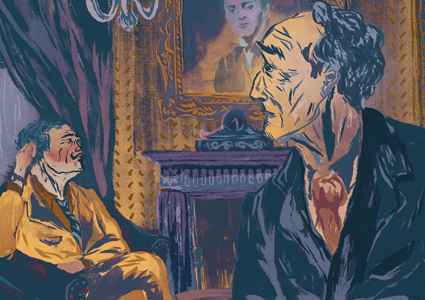
"England, I have discovered, is a country where no cuckoo should be counted until it is hatched." (illustration by Juliana Wang)
After the death of Jacob Bronowksi, Samuel Marcus Cohen succeeded, nem. con., to the title of Britain's favourite foreigner. So was he France's and Germany's and, he promised me, Italy's and Spain's, although his command of the last two languages was "far from approfondi". His short stories were always more than—as he described mine—"mere": they were philosophical and moral contes. The Sticking Point, his meta-novel about Baruch/Benedict Spinoza won prizes so prestigious that I had never heard of them. The word from Stockholm was that it needed only the clinching third volume of his Noah trilogy for Samuel Marcus to become a Nobel contender.
In the 1980s, after returning from abroad, I happened to meet S.M.C. at the launch party for a multinational philosophical chrestomathy to which he had contributed sections on Walter Benjamin ("albeit flawed, as perhaps I am, he remains my miglior fabbro"), Georg Lukács, and Antonio Gramsci. He welcomed me back to the metropolis with coercive cordiality. "Now that you are again at the still centre, so to say, you will need a London club at which to entertain your peers. You are probably thinking of the Garrick."
"Hadn't given it a thought," I said.
"Allow me to lead your feet into pastures greener, albeit less lush perhaps. I was—à l'époque—persuaded by certainly the third or even, in some eyes, the second greatest contemporary English draughtsman, to join the Stanhope. It may not boast the Garrick's tutti frutti peloton de tête nor yet a tie of the same stripe as the most lurid of Sicilian cassate, but it does sport an agreeably polyvalent ambience. And its centrality is convenient for the distended bladder."
Docility and the distinction of my sponsor led me to have lunch with him at the Stanhope a few weeks later. Its premises on North Audley Street had the traditional facilities of a gentleman's club: the reading room, the galleried library, the high-ceilinged dining room with a long communal table, a billiard room, and the bar with framed drawings and cartoons by famous members, past and current. There was also a bridge room.
Samuel Marcus was greeted with deferential salutes, but never with a hand-shake, a French habit discouraged between members. If I was embarrassed by the directness with which S.M.C. exacted promises of secondary support for "a candidature pas comme les autres", I was gratified by the members' friendliness. He warned me against presumption. "The Stanhope has a rigorous Scrutiny Committee and although, as you will have seen by inspection, there is no embargo on members of our—shall I say?—persuasion, one black ball will suffice to blight your prospects and my reputation. England, I have discovered, is a country where no cuckoo should be counted until it has hatched."
I had had no great wish to join the Stanhope, but I knew that I should be humiliated by rejection and by the gleeful woe with which Samuel Marcus was sure to announce it. Hence I was relieved when he telephoned to say that my name had been posted "albeit not high on the list" of successful candidates. It was typical of a master of the sous-texte that his congratulatory tone implied that I had only just scraped in. I discovered, when I inspected it, that the list was alphabetical.
Not long afterwards, I was not surprised to hear that Samuel Marcus had been elected a member of the Athenaeum, honoris causa; but I was surprised by my sentiment of betrayal when he resigned from the Stanhope. Having imagined myself recruited to a rare fraternity, I realised that Sammy had never regarded North Audley Street as more than a way station. His departure left me marooned in a membership which I should never have sought for myself.
The unofficial president of the Stanhope bridge room was Fred Kleinman. Although he retained vestiges of the accent with which he had fled Germany in 1936, Fred had acquired the handsome manners and lofty style of an English gentleman: Huntsman suits, handmade Lobb shoes, Harvie and Hudson double-cuffed shirts. Who would guess that, at the outbreak of war, he had been interned on the Isle of Man along with other "enemy aliens"? Such was his charm and his sportsmanship that he was quickly recruited to the bridge table by the commandant of the camp. Once released, he became executive director of a soon successful publishing house. He could remain on good terms with even the most ingenious of Hungarians. Fred was not a good bridge-player, but a cheerful partner: he never remarked your mistakes and presumed you to be amused by his.
The same was not true of Herbert Schosch. A short man with an upturned equestrian moustache and a sallow complexion, he usually wore a mustard-coloured suit, a brownish shirt and a blue, striped tie that might have been regimental. His accent was less pronounced than Fred Kleinman's but more obstreperous. At the bridge-table, he aped the conduct of the character whom the great Skid Simon immortalised, in Why You Lose at Bridge, as "Mr Smug": an aggressively bad player who never doubted that he was better than anyone else. I had the misfortune of being Herbert's partner while he bid to four spades against opponents who had already announced powerful hands. When doubled, Herbert contrived—by playing the hand even more ineptly than he had bid it—to go eight down, vulnerable.
As the penalty was being computed, I permitted myself to say, "Just as well I didn't redouble."
Our opponents smiled, but Herbert did not. "You misled me," he said.
"I passed throughout the auction," I said.
"By the eshpeed of your passing." He had a habit, which he told us came from his years as an engineering consultant in the Indian sub-continent, of making his esses into eshes.
Bridge-players rarely improve. Study and aptitude may turn a beginner into a better and sometimes into a very good player, but mediocre players flaunt their complacency by making the same errors over and over again, often after protracted thought. Herbert was prompt to reproach his partners (and instruct his opponents) but brooked no criticism from, in particular, Bernard Pinto, who had played for England, albeit in tournaments for which top players were unavailable.
Bernard was the captain and the sole selector of the club team for whatever duplicate competitions the Stanhope dared to enter. After I had been a member for several years, he asked me if I would care to partner him in a match against Hurlingham. Having been an addict during the 1960s, I had promised myself never again to play "serious" bridge, but I agreed to be seduced by a pundit. Athough Bernard never uttered a word of praise, my performance must have passed muster: I became his first choice as partner.
The unofficial president of the Stanhope bridge room was Fred Kleinman. Although he retained vestiges of the accent with which he had fled Germany in 1936, Fred had acquired the handsome manners and lofty style of an English gentleman: Huntsman suits, handmade Lobb shoes, Harvie and Hudson double-cuffed shirts. Who would guess that, at the outbreak of war, he had been interned on the Isle of Man along with other "enemy aliens"? Such was his charm and his sportsmanship that he was quickly recruited to the bridge table by the commandant of the camp. Once released, he became executive director of a soon successful publishing house. He could remain on good terms with even the most ingenious of Hungarians. Fred was not a good bridge-player, but a cheerful partner: he never remarked your mistakes and presumed you to be amused by his.
The same was not true of Herbert Schosch. A short man with an upturned equestrian moustache and a sallow complexion, he usually wore a mustard-coloured suit, a brownish shirt and a blue, striped tie that might have been regimental. His accent was less pronounced than Fred Kleinman's but more obstreperous. At the bridge-table, he aped the conduct of the character whom the great Skid Simon immortalised, in Why You Lose at Bridge, as "Mr Smug": an aggressively bad player who never doubted that he was better than anyone else. I had the misfortune of being Herbert's partner while he bid to four spades against opponents who had already announced powerful hands. When doubled, Herbert contrived—by playing the hand even more ineptly than he had bid it—to go eight down, vulnerable.
As the penalty was being computed, I permitted myself to say, "Just as well I didn't redouble."
Our opponents smiled, but Herbert did not. "You misled me," he said.
"I passed throughout the auction," I said.
"By the eshpeed of your passing." He had a habit, which he told us came from his years as an engineering consultant in the Indian sub-continent, of making his esses into eshes.
Bridge-players rarely improve. Study and aptitude may turn a beginner into a better and sometimes into a very good player, but mediocre players flaunt their complacency by making the same errors over and over again, often after protracted thought. Herbert was prompt to reproach his partners (and instruct his opponents) but brooked no criticism from, in particular, Bernard Pinto, who had played for England, albeit in tournaments for which top players were unavailable.
Bernard was the captain and the sole selector of the club team for whatever duplicate competitions the Stanhope dared to enter. After I had been a member for several years, he asked me if I would care to partner him in a match against Hurlingham. Having been an addict during the 1960s, I had promised myself never again to play "serious" bridge, but I agreed to be seduced by a pundit. Athough Bernard never uttered a word of praise, my performance must have passed muster: I became his first choice as partner.
A mathematical prodigy at Imperial College, Bernard had taken early retirement from a large company for which he had done some kind of rewardingly abstruse work. He was of medium height, paunchy, with a pouty, pink face. During the years I knew him, his curly dark hair turned white and fuzzy; it then furnished him with the blanched aura of a superannuated angel. He spoke little, but the downward tug of his lips gave his routine greetings a sarcastic edge. His dislike of Herbert Schosch was at once silent and undisguised.
When Herbert came to the club with a bad cold and sneezed and coughed with no effort to avert his head, Bernard took out his handkerchief (in his maidenly way, he still used one) and tied it, like a cowboy bandit, so that it masked his mouth and nose. I shared his displeasure but was a little embarrassed by its ostentation. Herbert compounded the heaviness of the air by lighting one of his small, pungent cigars. When I coughed, he said, "Not caught my cold already, have you, Freddie boy?"
My smooth partnership with Bernard Pinto did not bring the Stanhope sustained progress in the slow world of competitive "teams of four". Our other pair, whoever they might be, seldom had any knowledge of the expert game and small wish to acquire it. Bernard and I might drag them through a round or two, but our team's fortunes regularly foundered before the semi-finals. My partner seemed almost to relish the recurrent incompetence of our team-mates in what the jargon of the game calls "the other room". If he was pleased to play with me, he never indicated that he had read any of my books or seen any of my films.
Herbert Schosch, on the other hand, told me that his wife (his third) was a great admirer of my television work. Herbert's reduced stature and rumpled, liverish appearance made him seem an unlikely ladies' man, but Perry Frewin, who visited the bridge room only when he was not skiing at Gstaad or playing fifty pounds a hundred with Zia and Andrew and Omar, told me that Herbert's wife, Frankie (who but the English could reduce "Francesca" to so butch a diminutive?), was a former prima ballerina and renowned for being, to quote Perry, "no mean nut-cracker".
Perry was an Ulster Roman Catholic, by origin if not by persistent conviction. Like Fred Kleinman, his clothes were custom-made, but in his case the price tag seemed not to have been removed. He was both smart and not quite a gentleman. He had been in property and then in retail shops and then in whatever he was then in, and as quickly out of. If I saw him in the bar, he would summon me to a glass of the Bollinger which he always kept on ice at his elbow. When I asked why he had refused Bernard's invitation to join us in the club team, he replied that he did not care to be a eunuch's second choice. He said it with a smile, but it was unusually tart in a club where "sodality" was an advertised tradition.
After Herbert (and Frankie) had seen me on television in a panel discussion with Claude Lanzmann about his film, Shoah, he left me a note in the R cubby-hole in the lobby, enclosing a Buchenwald survivor's memoir, which someone had given him at his synagogue. I replied thanking him and commented that the article had made me realise how lucky I had been to be born, and to have grown up, where I did. Herbert soon got into the habit of clipping things in the newspapers which might interest me. His scissors were busy and his mind seemed sharp. I wished that I liked him.
When Herbert came to the club with a bad cold and sneezed and coughed with no effort to avert his head, Bernard took out his handkerchief (in his maidenly way, he still used one) and tied it, like a cowboy bandit, so that it masked his mouth and nose. I shared his displeasure but was a little embarrassed by its ostentation. Herbert compounded the heaviness of the air by lighting one of his small, pungent cigars. When I coughed, he said, "Not caught my cold already, have you, Freddie boy?"
My smooth partnership with Bernard Pinto did not bring the Stanhope sustained progress in the slow world of competitive "teams of four". Our other pair, whoever they might be, seldom had any knowledge of the expert game and small wish to acquire it. Bernard and I might drag them through a round or two, but our team's fortunes regularly foundered before the semi-finals. My partner seemed almost to relish the recurrent incompetence of our team-mates in what the jargon of the game calls "the other room". If he was pleased to play with me, he never indicated that he had read any of my books or seen any of my films.
Herbert Schosch, on the other hand, told me that his wife (his third) was a great admirer of my television work. Herbert's reduced stature and rumpled, liverish appearance made him seem an unlikely ladies' man, but Perry Frewin, who visited the bridge room only when he was not skiing at Gstaad or playing fifty pounds a hundred with Zia and Andrew and Omar, told me that Herbert's wife, Frankie (who but the English could reduce "Francesca" to so butch a diminutive?), was a former prima ballerina and renowned for being, to quote Perry, "no mean nut-cracker".
Perry was an Ulster Roman Catholic, by origin if not by persistent conviction. Like Fred Kleinman, his clothes were custom-made, but in his case the price tag seemed not to have been removed. He was both smart and not quite a gentleman. He had been in property and then in retail shops and then in whatever he was then in, and as quickly out of. If I saw him in the bar, he would summon me to a glass of the Bollinger which he always kept on ice at his elbow. When I asked why he had refused Bernard's invitation to join us in the club team, he replied that he did not care to be a eunuch's second choice. He said it with a smile, but it was unusually tart in a club where "sodality" was an advertised tradition.
After Herbert (and Frankie) had seen me on television in a panel discussion with Claude Lanzmann about his film, Shoah, he left me a note in the R cubby-hole in the lobby, enclosing a Buchenwald survivor's memoir, which someone had given him at his synagogue. I replied thanking him and commented that the article had made me realise how lucky I had been to be born, and to have grown up, where I did. Herbert soon got into the habit of clipping things in the newspapers which might interest me. His scissors were busy and his mind seemed sharp. I wished that I liked him.
The Thursday afternoon bridge game generally broke up around six o'clock. One evening when I had mentioned, before the last rubber, that I was staying in the West End, to go to the theatre, I made a slow exit from the card room. Herbert caught up with me. "Do you have a moment for a drink?"
I could hardly say no. We went into the bar. I asked for a tomato juice. Herbert ordered a whisky sour and we took our glasses to two overstuffed chairs in the bay window. I was nervous of what Herbert might want of me. I hoped, fervently, that he would not ask that I advocate his selection in the team for the upcoming Devonshire Cup.
He said, "You're not a native European, Freddie, I gather."
"Chicago-born," I said. "Like Augie March. My maternal grandfather was a Mauser though."
"In the sense that you did not come to this country as a refugee."
"Far from it," I said.
"I did," he said, as if it might be a surprise. "I left Vienna only in 1939. At the last possible moment. I eshtayed to obtain my engineering degree. It was not easy to get out, but I managed to get a visa to Denmark."
"Why Denmark?"
"Beggars can't be choosers, and there were many beggars in Vienna, including many who had never begged before. Luckily, the Danish consul was a lady who took a fancy to me. She knew what I really wanted but meanwhile she wanted me and . . . we were both . . . eshatisfied. As soon as I got my visa, I went home and packed my things. I confess it: I thought only of myself and my future. My mother and my sister, I promised myself, were not in danger. No one imagined what the Nazis would do, not then." Herbert took a long sip of his whisky sour. "So I went to Denmark and from Denmark I got to England. They let me in because I had my degree and a glowing letter of introduction—yes, I typed it myself!—to a company in Wolverhampton. I was carrying an Austrian passport, of course, which had been issued when I went to Italy to study in 1937. The British chose, for diplomatic reasons, to list Austria as a victim of Nazism and so I came to be admitted as one of the Allies. Twenty-one years old, I went to Wolverhampton to try and find work. I knew no one and I had no money. On top of that, on my first night in the Midlands, I developed a tooth-ache so agonising that I walked around the town all night looking for a dentist. Four in the morning, I saw a brass plate, ‘JAMES MACKENZIE, HAROLD JOSEPH, DENTAL SURGEONS'. The place was locked up, of course, but I sat down on the doorstep, my jaw in both hands, and waited." He sipped more of his whisky sour. "The nurse arrived first and I told her the pain I was in. She asked me which of the partners did I want, Mr Mackenzie or Mr Joseph? Whichever came first, I said. No, I had to choose; so, OK, Mr Joseph. He turned out to be a big, bald-domed man with a little black moustache and a large nose and steel-rimmed spectacles. I sat in his chair and pointed in at the molar that was killing me. He took a look and said, ‘I'll soon pull that out for you.' He began to arrange his tools. My English was not good, at all, in those days. I looked at him and the pliers he was flexing and I said, in a very eshmall voice, ‘I'm a Yiddisher boy.' He looked round and said, ‘I beg your pardon?' I cleared my throat. ‘I'm a Yiddisher boy.' He put down the pliers and indicated to me to open wide. ‘Let's have another look at that tooth.'"
Herbert turned to me and opened his mouth and put his finger on a gold-capped molar on his lower right jaw. "It was that one back there."
"So," I said, "you spent the war in Wolverhampton or what?"
I could hardly say no. We went into the bar. I asked for a tomato juice. Herbert ordered a whisky sour and we took our glasses to two overstuffed chairs in the bay window. I was nervous of what Herbert might want of me. I hoped, fervently, that he would not ask that I advocate his selection in the team for the upcoming Devonshire Cup.
He said, "You're not a native European, Freddie, I gather."
"Chicago-born," I said. "Like Augie March. My maternal grandfather was a Mauser though."
"In the sense that you did not come to this country as a refugee."
"Far from it," I said.
"I did," he said, as if it might be a surprise. "I left Vienna only in 1939. At the last possible moment. I eshtayed to obtain my engineering degree. It was not easy to get out, but I managed to get a visa to Denmark."
"Why Denmark?"
"Beggars can't be choosers, and there were many beggars in Vienna, including many who had never begged before. Luckily, the Danish consul was a lady who took a fancy to me. She knew what I really wanted but meanwhile she wanted me and . . . we were both . . . eshatisfied. As soon as I got my visa, I went home and packed my things. I confess it: I thought only of myself and my future. My mother and my sister, I promised myself, were not in danger. No one imagined what the Nazis would do, not then." Herbert took a long sip of his whisky sour. "So I went to Denmark and from Denmark I got to England. They let me in because I had my degree and a glowing letter of introduction—yes, I typed it myself!—to a company in Wolverhampton. I was carrying an Austrian passport, of course, which had been issued when I went to Italy to study in 1937. The British chose, for diplomatic reasons, to list Austria as a victim of Nazism and so I came to be admitted as one of the Allies. Twenty-one years old, I went to Wolverhampton to try and find work. I knew no one and I had no money. On top of that, on my first night in the Midlands, I developed a tooth-ache so agonising that I walked around the town all night looking for a dentist. Four in the morning, I saw a brass plate, ‘JAMES MACKENZIE, HAROLD JOSEPH, DENTAL SURGEONS'. The place was locked up, of course, but I sat down on the doorstep, my jaw in both hands, and waited." He sipped more of his whisky sour. "The nurse arrived first and I told her the pain I was in. She asked me which of the partners did I want, Mr Mackenzie or Mr Joseph? Whichever came first, I said. No, I had to choose; so, OK, Mr Joseph. He turned out to be a big, bald-domed man with a little black moustache and a large nose and steel-rimmed spectacles. I sat in his chair and pointed in at the molar that was killing me. He took a look and said, ‘I'll soon pull that out for you.' He began to arrange his tools. My English was not good, at all, in those days. I looked at him and the pliers he was flexing and I said, in a very eshmall voice, ‘I'm a Yiddisher boy.' He looked round and said, ‘I beg your pardon?' I cleared my throat. ‘I'm a Yiddisher boy.' He put down the pliers and indicated to me to open wide. ‘Let's have another look at that tooth.'"
Herbert turned to me and opened his mouth and put his finger on a gold-capped molar on his lower right jaw. "It was that one back there."
"So," I said, "you spent the war in Wolverhampton or what?"
"Only a month or two. Then I volunteered to join the army. They needed engineers and they put me into R.E.M.E." He touched his striped tie; it was regimental. "Royal Electrical and Mechanical Engineers. After Dunkirk, the British army realised that it was using sub-standard equipment in most departments: guns that jammed, turrets that failed to rotate, lorries that broke down in not very extreme conditions. I was asked to figure out what was wrong with a water-carrying truck which kept breaking its back in the desert. It tested perfectly well, they told me, on the factory test-bed, but once it was in Egypt . . . eshnap! Guess what I found."
"Tell me," I said.
"The manufacturers tested their lorries with the water-tank empty, of course. Out in the desert, fully loaded, the chassis snapped like a twig. So, I advised inserting two steel bars the full length of the lorry and, what do you know: no more problems. They made me an acting-major and put me in charge of everything that came out of the depots in the whole of the North of England. Did I ever tell you how I came to be a British subject?"
I looked at my watch. "Tell me," I said.
"My colonel was a pukkah sahib who, against type, as you might say, thought Jews were the most intelligent people in the world. He was even some kind of a Zionist like General Orde Wingate. Not everyone liked me but they knew that I knew what I was doing and Colonel Garnett backed me all the way. Soon after he was promoted brigadier, he called me up and asked me to dine with him at the best restaurant in Kendal. We ate well and drank better, as can happen in your country, and we talked about this and that, eshpecially that—I told him about my Danish lady and her unusual positional preferences—and finally I stood up and said, ‘Work to do in the morning, sir.' ‘Sit down, Schosch,' he said, ‘because I've got a proposition for you. Why else would I get them to break out the '26 Armagnac? The War House want to make you colonel in command of the whole shooting match up here. What do you say?' I said, ‘Very flattering, sir, but there is a problem.' ‘Which is?' ‘I'm not a British citizen' ‘You mean subject,' he said. ‘Not a problem, not a problem. That can be taken care of, if you'll agree.' ‘I'll . . . think about it, sir, and give you a bell, if I may, in the morning.' ‘No, no, no. No, no, no. I promised their nibs I'd let them know tonight.' ‘It's one thirty in the morning, sir.' ‘You're quite right, aren't you? As so often. And they're probably getting a bit impatient. So, if you could possibly see your way to becoming British right away, we'd all be much gratified.' What could I say? We went into the lobby of the hotel and he dialled a number he fetched out from inside the rim of his cap. ‘I've had a word to Schosch, Sir Gerald, and he's very graciously agreed to become British, at least for the duration. So that's that taken care of.' I put my cap on, saluted the brigadier and walked out to my car, as true blue British as any Austrian Jew could ever hope to be. Not boring you, am I?"
"In truth," I said, "not at all, Herbert; not one bit."
"By the end of the war," he said, "I was in charge of equipment maintenance for the South of England. When peace broke out in Europe there was eshtill trouble, to put it mildly, in Palestine. My brigadier phoned me up and asked me to evaluate, in due course, the serviceability of the mobile radar trucks they'd used to track doodlebugs. Middle East HQ wanted them sent out to help catch ships trying to sneak Jewish refugees into Eretz Israel. Due course can be quite a long time in the army, if you want it to be; but a month later the brigadier called to ask when he could start sending the stuff out. I told him I was very sorry but none of the mobile radars were up to snuff. ‘None of them, Herbert? As in not a one?' ‘Wear and tear, sir,' I said, ‘it's been a long war.'
"Tell me," I said.
"The manufacturers tested their lorries with the water-tank empty, of course. Out in the desert, fully loaded, the chassis snapped like a twig. So, I advised inserting two steel bars the full length of the lorry and, what do you know: no more problems. They made me an acting-major and put me in charge of everything that came out of the depots in the whole of the North of England. Did I ever tell you how I came to be a British subject?"
I looked at my watch. "Tell me," I said.
"My colonel was a pukkah sahib who, against type, as you might say, thought Jews were the most intelligent people in the world. He was even some kind of a Zionist like General Orde Wingate. Not everyone liked me but they knew that I knew what I was doing and Colonel Garnett backed me all the way. Soon after he was promoted brigadier, he called me up and asked me to dine with him at the best restaurant in Kendal. We ate well and drank better, as can happen in your country, and we talked about this and that, eshpecially that—I told him about my Danish lady and her unusual positional preferences—and finally I stood up and said, ‘Work to do in the morning, sir.' ‘Sit down, Schosch,' he said, ‘because I've got a proposition for you. Why else would I get them to break out the '26 Armagnac? The War House want to make you colonel in command of the whole shooting match up here. What do you say?' I said, ‘Very flattering, sir, but there is a problem.' ‘Which is?' ‘I'm not a British citizen' ‘You mean subject,' he said. ‘Not a problem, not a problem. That can be taken care of, if you'll agree.' ‘I'll . . . think about it, sir, and give you a bell, if I may, in the morning.' ‘No, no, no. No, no, no. I promised their nibs I'd let them know tonight.' ‘It's one thirty in the morning, sir.' ‘You're quite right, aren't you? As so often. And they're probably getting a bit impatient. So, if you could possibly see your way to becoming British right away, we'd all be much gratified.' What could I say? We went into the lobby of the hotel and he dialled a number he fetched out from inside the rim of his cap. ‘I've had a word to Schosch, Sir Gerald, and he's very graciously agreed to become British, at least for the duration. So that's that taken care of.' I put my cap on, saluted the brigadier and walked out to my car, as true blue British as any Austrian Jew could ever hope to be. Not boring you, am I?"
"In truth," I said, "not at all, Herbert; not one bit."
"By the end of the war," he said, "I was in charge of equipment maintenance for the South of England. When peace broke out in Europe there was eshtill trouble, to put it mildly, in Palestine. My brigadier phoned me up and asked me to evaluate, in due course, the serviceability of the mobile radar trucks they'd used to track doodlebugs. Middle East HQ wanted them sent out to help catch ships trying to sneak Jewish refugees into Eretz Israel. Due course can be quite a long time in the army, if you want it to be; but a month later the brigadier called to ask when he could start sending the stuff out. I told him I was very sorry but none of the mobile radars were up to snuff. ‘None of them, Herbert? As in not a one?' ‘Wear and tear, sir,' I said, ‘it's been a long war.'
"I heard him sigh and then clear his throat, the way they do, and then he said, ‘Look here, Herbert, I know your sympathies and I do somewhat share them, but you know and I know and so do their nibs know that no equipment is ever a hundred per cent. Make me an offer, why don't you?' ‘I suppose about forty per cent are more or less serviceable,' I said. ‘Come on, Herbert: fair do's. Fifty-fifty, what do you say?' ‘Done, sir.' ‘Good man. Top man.'"
"Let me buy you a drink, Herbert," I said.
I went to the bar and came back with another whisky sour. He was sitting with his face averted from me, apparently interested in a cartoon of Sir Compton Mackenzie. When he turned to take his drink, I saw that his cheeks were moist.
"I'm sorry," he said, "I apologise."
"For what?"
"Doing this." He wiped both cheeks simultaneously with his crooked index fingers. "But I can never forgive myself," he said, "never. How could I do what I did? I shall never understand it."
"In what department exactly?" I said.
"My mother and my sister." He drank some of his new whisky sour. "Never. A year later, two perhaps . . . they were both . . ."
"You couldn't know."
"But I did nothing to warn them; did nothing to have them taken to a safe place. So you know what kind of a man I am. If you didn't before, you do now. I'm sorry. I'm ashamed to be so . . . emotional. Forgive me."
As I stood up, I could feel tears fattening in my eyes. It was against the code of the club, but I held out my hand to Herbert Schosch. He had apologised to me on the only occasion on which it was entirely unnecessary. To tell the truth, I was tempted to put my arms around the little man and hug him. Of course I did no such thing. England is England.
Some weeks later, I walked into the bridge room and found Herbert and Perry Frewin playing backgammon. Bernard Pinto was doing one of those mathematical problems to be found in the back pages of the quality press. Three bridge players are nearly always happy to see a fourth, but when I said, "Table up!", Bernard compressed his lips and continued his calculations. In his case, it had to be a favour when, at last, he consented to cut for partners, eyes still on his newspaper. I had a pessimistic conviction that I should cut Herbert Schosch as my partner, and I did.
When our opponents bid a small slam in spades, Herbert's failure to lead the suit which I had doubled, "on the way round" as bridge players say, allowed them to make their contract. He then accused me of having confused him. I promised to try not to do it again. We had, I reminded myself, become friends, of a kind. To prove it, when he bid recklessly and incurred two fat penalties, I muttered "Bad luck, partner."
On the next hand, Perry opened with a strong bid and was raised to game by Bernard. Perry then took time before passing. I was looking at a very bad hand and guessed that he had been considering going on to a slam. Herbert, however, read Perry's pause for weakness. "I double," he said.
"And I redouble," Bernard said.
"Let me buy you a drink, Herbert," I said.
I went to the bar and came back with another whisky sour. He was sitting with his face averted from me, apparently interested in a cartoon of Sir Compton Mackenzie. When he turned to take his drink, I saw that his cheeks were moist.
"I'm sorry," he said, "I apologise."
"For what?"
"Doing this." He wiped both cheeks simultaneously with his crooked index fingers. "But I can never forgive myself," he said, "never. How could I do what I did? I shall never understand it."
"In what department exactly?" I said.
"My mother and my sister." He drank some of his new whisky sour. "Never. A year later, two perhaps . . . they were both . . ."
"You couldn't know."
"But I did nothing to warn them; did nothing to have them taken to a safe place. So you know what kind of a man I am. If you didn't before, you do now. I'm sorry. I'm ashamed to be so . . . emotional. Forgive me."
As I stood up, I could feel tears fattening in my eyes. It was against the code of the club, but I held out my hand to Herbert Schosch. He had apologised to me on the only occasion on which it was entirely unnecessary. To tell the truth, I was tempted to put my arms around the little man and hug him. Of course I did no such thing. England is England.
Some weeks later, I walked into the bridge room and found Herbert and Perry Frewin playing backgammon. Bernard Pinto was doing one of those mathematical problems to be found in the back pages of the quality press. Three bridge players are nearly always happy to see a fourth, but when I said, "Table up!", Bernard compressed his lips and continued his calculations. In his case, it had to be a favour when, at last, he consented to cut for partners, eyes still on his newspaper. I had a pessimistic conviction that I should cut Herbert Schosch as my partner, and I did.
When our opponents bid a small slam in spades, Herbert's failure to lead the suit which I had doubled, "on the way round" as bridge players say, allowed them to make their contract. He then accused me of having confused him. I promised to try not to do it again. We had, I reminded myself, become friends, of a kind. To prove it, when he bid recklessly and incurred two fat penalties, I muttered "Bad luck, partner."
On the next hand, Perry opened with a strong bid and was raised to game by Bernard. Perry then took time before passing. I was looking at a very bad hand and guessed that he had been considering going on to a slam. Herbert, however, read Perry's pause for weakness. "I double," he said.
"And I redouble," Bernard said.
I could only pass, with what was meant to be a smile.
My international partner, turned opponent, was able to gauge exactly where all the outstanding high cards were (in Herbert's hand, of course) and made his contract with two overtricks. It was worth as much as a small slam.
Herbert said, "You were a bit of a disappointment, partner."
I looked at Bernard, who had returned to his puzzle, and at Perry who was fanning the cards for us to cut again for the next rubber, and at Herbert as he lit one of his short cigars. Suddenly, Bernard was laughing; and then so was Perry; and, believe it or not, Herbert laughed too, as if the joke was on me. I stood up and—I'm afraid it's true—threw more money than I had lost onto the table and said, "I must go. Drinks are on me."
"Going?" Herbert said. "After only one rubber. Not very eshporting of you, sir!"
I heard myself say, "I'm not quite that much of an eshportsman, I'm afraid."
Perry looked at his Cartier watch. Bernard filled in the blank spaces in the problem he seemed just to have cracked. Herbert's eyes were glazed with tears; smoke from his cigar, no doubt. I walked out of the room and out of the club. I never went back; and I have never had a game of bridge since.
My international partner, turned opponent, was able to gauge exactly where all the outstanding high cards were (in Herbert's hand, of course) and made his contract with two overtricks. It was worth as much as a small slam.
Herbert said, "You were a bit of a disappointment, partner."
I looked at Bernard, who had returned to his puzzle, and at Perry who was fanning the cards for us to cut again for the next rubber, and at Herbert as he lit one of his short cigars. Suddenly, Bernard was laughing; and then so was Perry; and, believe it or not, Herbert laughed too, as if the joke was on me. I stood up and—I'm afraid it's true—threw more money than I had lost onto the table and said, "I must go. Drinks are on me."
"Going?" Herbert said. "After only one rubber. Not very eshporting of you, sir!"
I heard myself say, "I'm not quite that much of an eshportsman, I'm afraid."
Perry looked at his Cartier watch. Bernard filled in the blank spaces in the problem he seemed just to have cracked. Herbert's eyes were glazed with tears; smoke from his cigar, no doubt. I walked out of the room and out of the club. I never went back; and I have never had a game of bridge since.