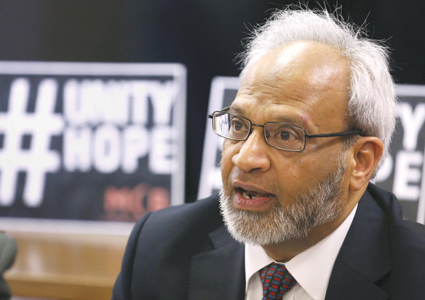
The Muslim Council of Britain's secretary-general, Dr Shuja Shafi: He has said he has "no idea" why young people become radicalised (Philip Toscano/PA Wire)
With Islamist terrorist plots now running at more than one a month, the UK counter-terrorism effort can deal only with the crocodiles that are bumping against the boat. So the Home Office is setting up a special unit that will analyse the effectiveness of government measures aimed at "draining the swamp" as the Prime Minister has put it.
The Extremism Analysis Unit (EAU) will be the first of its kind in government to gather empirical evidence about the behaviour and ideologies of extremists. In some ways, this may be even more challenging than the task performed by its companion unit—the Joint Terrorism Analysis Centre (JTAC), which analyses intelligence on the terrorist threat. While JTAC's job is to stop terrorists from killing, the EAU will analyse the extremist spectrum from its violent to its non-violent end. It will also explore the relationship between integration and extremism.
Many Muslims in Birmingham, Luton, parts of London and the old northern mill towns seem resistant to integrating into the liberal mainstream. More British Muslims have gone to Syria and Iraq than there are Muslims in the British army. I understand that officials have been unable to demonstrate that any initiatives by this government or the last to promote integration have had any beneficial impact.
The EAU will attract controversy because while it will, of course, analyse all sources of extremism, its principal focus will inevitably be on Islamist extremism, because this will pose the greatest threat to national security for the foreseeable future.
The reaction here to the slaughter of 17 people in Paris offers a glimpse into why extremism presents a generational challenge. The journalists and cartoonists at Charlie Hebdo magazine were executed for lampooning the Prophet Muhammad and the Jews shopping on the eve of Shabbat just because they were Jews. Paris probably inspired the Danish jihadist last month to target a Copenhagen synagogue killing a Jewish guard after killing a film director at a free speech debate hosted by Lars Vilks the Swedish cartoonist who has also sent up the Prophet.
How do you persuade those British mosques in London and the Midlands reported to have expressed greater offence over Charlie Hebdo's cartoons than the fate of the massacred that such attitudes won't create the common life required for a cohesive, harmonious society? Rather than demonstrate around the Cenotaph against global jihadi terrorism, 1,000 Muslims instead waved banners warning non-Muslims to "be careful with Muhammad", and telling them to "learn some manners".
"Whether Muslim people say it or not, deep down they are probably happy with what happened," the Muslim manager of a small supermarket in Slough told the BBC Today programme. "Not in the sense of people having lost their lives . . . but in the sense that something needs to be done to stop insulting our Prophet." The reporter pressed him. "Are you really saying what's happened [in Paris] has taught those who insult Islam a lesson?" He replied: "To be honest, it's not as if people are going to be jumping around the streets for joy but (it's also) not as if people are going to be mourning their deaths, in my opinion." Some mosque congregations are also reported to have been told that the killers simply could not have been Muslims. Mossad then? 9/11 déjà vu.
On the streets, verbal and physical abuse against both Muslims and Jews is sharply rising, with George Galloway, the Respect MP for Bradford West, claiming that the attacks on the former were "many times more" than the latter. Maybe, but per capita? The British Jewish population is just one tenth of the Muslim population. Galloway's moral strictures on the evils of anti-Semitism expressed on BBC Question Time last month also sit oddly with his support for Hamas and its genocidal outbursts.
A priority for the EAU should be an examination of the relationship between what the government calls "non-violent extremism" and "violent extremism". The government's current Prevent programme is aimed at restricting space for non-violent extremists who ministers say spread hatred and fear. The Prime Minister believes it is this ideology that lies at the root of violent extremism. Islamists not only insist that no such link exists but that to suggest it does represents yet another attack on Islam—"criminalising Islam" as they put it. They argue that the sort of behaviour the government regards as "extreme" is actually representative of orthodox/mainstream Islam.
Such are the claims of clerics like Sheikh Haitham al-Haddad, who espouses an ideological version of puritanical Wahhabi Salafism as practised in, and exported by, Saudi Arabia. In Britain, as in Europe, Salafists are gaining in popularity and influence, particularly among the Islamic societies of our universities.
A staunchly pro-Haddad website called "Islam 21C" describes the Saudi- and SOAS-trained sheikh as "someone well-known for propagating beliefs and practices that enjoy a unanimous consensus among classical schools of Islamic thought, which most Muslims ostensibly claim to follow." If Haddad does indeed represent mainstream Islam in this country, then we are in trouble.
In his popular and sometimes witty lectures on Islam to mosques, Islamic centres and on satellite TV channels, Haddad disdains Western values. He has described parliamentary democracy as "filthy", yet encourages his co-religionists to exploit the ballot box for the far-distant but ultimate purpose of establishing a Muslim majority in parliament as a prelude to a caliphate. He has described gender equality as "a very evil thing" and for citizens of Islamic states he advocates the death penalty for apostates (Muslims who leave Islam) and adulterers.
Where does Haddad stand on violent jihad, as opposed to its spiritual version? He argues against Muslims who say that jihad is just "spiritual" inner struggle: this is "not an acceptable opinion whatsoever . . . whether they will take us all to prison, or they don't, okay, it is up to them . . . this is "part of our deen [religion], yeah?"
To be clear, Haddad does not advocate violent jihad against the UK, or what he defines as innocent civilians. Yet speaking about the Israel-Palestine conflict, he seemed to expand its regional context to a wider one by referring to "the conflict between Islam and the enemies of Islam" as an "ongoing conflict and we should pay the price of this victory from our blood and Muslims are ready to do so". He went on to say the Israel-Palestine conflict "clearly encouraged all Muslims to prepare themselves for jihad, all Muslims all over the world".
Another popular Salafist cleric on the speaker circuit is Murtaza Khan, who has likened living in Britain to being "surrounded" by an "epidemic" of "evil". He laments that too many British Muslims are following one or other of two "accursed nations". He means Christians and Jews. Khan is an Islamic Studies teacher at a primary school in London and a visiting preacher at East London University. He seems to be permanently on fire, and the sheer aggression of his delivery and words can make the genial but hard-line Haddad look kitten-like by comparison.
A priority for the EAU should be an examination of the relationship between what the government calls "non-violent extremism" and "violent extremism". The government's current Prevent programme is aimed at restricting space for non-violent extremists who ministers say spread hatred and fear. The Prime Minister believes it is this ideology that lies at the root of violent extremism. Islamists not only insist that no such link exists but that to suggest it does represents yet another attack on Islam—"criminalising Islam" as they put it. They argue that the sort of behaviour the government regards as "extreme" is actually representative of orthodox/mainstream Islam.
Such are the claims of clerics like Sheikh Haitham al-Haddad, who espouses an ideological version of puritanical Wahhabi Salafism as practised in, and exported by, Saudi Arabia. In Britain, as in Europe, Salafists are gaining in popularity and influence, particularly among the Islamic societies of our universities.
A staunchly pro-Haddad website called "Islam 21C" describes the Saudi- and SOAS-trained sheikh as "someone well-known for propagating beliefs and practices that enjoy a unanimous consensus among classical schools of Islamic thought, which most Muslims ostensibly claim to follow." If Haddad does indeed represent mainstream Islam in this country, then we are in trouble.
In his popular and sometimes witty lectures on Islam to mosques, Islamic centres and on satellite TV channels, Haddad disdains Western values. He has described parliamentary democracy as "filthy", yet encourages his co-religionists to exploit the ballot box for the far-distant but ultimate purpose of establishing a Muslim majority in parliament as a prelude to a caliphate. He has described gender equality as "a very evil thing" and for citizens of Islamic states he advocates the death penalty for apostates (Muslims who leave Islam) and adulterers.
Where does Haddad stand on violent jihad, as opposed to its spiritual version? He argues against Muslims who say that jihad is just "spiritual" inner struggle: this is "not an acceptable opinion whatsoever . . . whether they will take us all to prison, or they don't, okay, it is up to them . . . this is "part of our deen [religion], yeah?"
To be clear, Haddad does not advocate violent jihad against the UK, or what he defines as innocent civilians. Yet speaking about the Israel-Palestine conflict, he seemed to expand its regional context to a wider one by referring to "the conflict between Islam and the enemies of Islam" as an "ongoing conflict and we should pay the price of this victory from our blood and Muslims are ready to do so". He went on to say the Israel-Palestine conflict "clearly encouraged all Muslims to prepare themselves for jihad, all Muslims all over the world".
Another popular Salafist cleric on the speaker circuit is Murtaza Khan, who has likened living in Britain to being "surrounded" by an "epidemic" of "evil". He laments that too many British Muslims are following one or other of two "accursed nations". He means Christians and Jews. Khan is an Islamic Studies teacher at a primary school in London and a visiting preacher at East London University. He seems to be permanently on fire, and the sheer aggression of his delivery and words can make the genial but hard-line Haddad look kitten-like by comparison.
Like Haddad, Khan has not advocated violence against his fellow UK citizens, but what might his audience have made of his tirade about the meaning of jihad when he explained that the "glory of the Muslim ummah" [global nation of believers] would only be revived when the "black ink . . . of the scholar" on a map of the world and the "red ink of the martyr . . . are put together". He said that to restore the map "to its original format [i.e. the Islamic empire] . . . only a few individuals . . . strive to . . . raise the word of Allah once again" but get "blamed" for "encouraging people . . . towards terrorism, towards bloodshed, towards evil action, to upheaval . . . Where is the evidence for this type of belief?"
According to Khan, when Islam finally dominates the map again, he "envisage[s] a beautiful time of victory" when Muslims can be "stern towards the disbelievers" and you will have "the right to show the power and the dominance of Islam. Even walking in the streets you shouldn't give them way."
While not advocating violence against UK citizens, it might be thought blindingly obvious that this angry and extreme world view championed by the likes of Khan and Haddad at least helps prepare the ground for violent extremism.
After all, terrorism is not just about violence for a specific purpose. Terrorists always draw on extreme ideology and the British jihadists who have joined IS have justified violence on the grounds of their beliefs. Non-violent extremist clerics like Haddad and Khan share some of the ideology of al-Qaeda and the extremist groups broadly sympathetic to them: namely, a triumphal belief in the superiority of Islam, a duty to work for the re-establishment of a caliphate by uniting Muslims under one interpretation of sharia, contempt for the West and its mores, and support for brutal punishments for "crimes" like adultery and apostasy, regarded in the West as matters of free conscience.
To take just one of those shared beliefs: hostility to our liberal, democratic, capitalist society, a view Salafist speakers often present forcefully to university Islamic societies. In 2008 Professor Martin Innes of Cardiff warned—presciently—that the threat to the UK from jihadist terrorism might increase. His research on behalf of the Association of Chief Police Officers showed that:
Do those who discount a relationship between non-violent extremism and violent extremism believe that sentiments like Haddad's about democracy being "filthy" are likely to dispel, or exacerbate that "disillusionment and disengagement"?
Still, the Salafists rely heavily on a recent report from the former editor of Race and Class, now lecturing in terrorism studies at John Jay College, New York. Professor Arun Kundnani is also the author of The Muslims are Coming! Islamophobia, Extremism and the Domestic War on Terror. He says the idea that terrorism is caused by extremism—as defined by opposition to British values—"does not stand up to scholarly scrutiny."
Kundnani has set up a straw man. For he also says that the "factors which lead someone to commit acts of terrorism are complex and cannot be reduced to holding a set of values deemed to be radical." No one has said otherwise.
A sense of alienation fostering an identity crisis, absence of role models, foreign policy—all can interact with theo-political factors without pushing a person into violence. The Home Secretary, Theresa May, has said as much. But as she also says, the "damage" caused by non-violent extremism that "promotes intolerance, hatred and a sense of superiority over others . . . is reason enough to act. And there is, undoubtedly, a thread that binds" these beliefs "to the actions of those who want to impose their values on us through violence".
According to Khan, when Islam finally dominates the map again, he "envisage[s] a beautiful time of victory" when Muslims can be "stern towards the disbelievers" and you will have "the right to show the power and the dominance of Islam. Even walking in the streets you shouldn't give them way."
While not advocating violence against UK citizens, it might be thought blindingly obvious that this angry and extreme world view championed by the likes of Khan and Haddad at least helps prepare the ground for violent extremism.
After all, terrorism is not just about violence for a specific purpose. Terrorists always draw on extreme ideology and the British jihadists who have joined IS have justified violence on the grounds of their beliefs. Non-violent extremist clerics like Haddad and Khan share some of the ideology of al-Qaeda and the extremist groups broadly sympathetic to them: namely, a triumphal belief in the superiority of Islam, a duty to work for the re-establishment of a caliphate by uniting Muslims under one interpretation of sharia, contempt for the West and its mores, and support for brutal punishments for "crimes" like adultery and apostasy, regarded in the West as matters of free conscience.
To take just one of those shared beliefs: hostility to our liberal, democratic, capitalist society, a view Salafist speakers often present forcefully to university Islamic societies. In 2008 Professor Martin Innes of Cardiff warned—presciently—that the threat to the UK from jihadist terrorism might increase. His research on behalf of the Association of Chief Police Officers showed that:
Increasing numbers of young Muslim people are becoming sufficiently disaffected with their lives in liberal-democratic-capitalist societies that they might be willing to support violent terrorism to articulate their disillusionment and disengagement.
Do those who discount a relationship between non-violent extremism and violent extremism believe that sentiments like Haddad's about democracy being "filthy" are likely to dispel, or exacerbate that "disillusionment and disengagement"?
Still, the Salafists rely heavily on a recent report from the former editor of Race and Class, now lecturing in terrorism studies at John Jay College, New York. Professor Arun Kundnani is also the author of The Muslims are Coming! Islamophobia, Extremism and the Domestic War on Terror. He says the idea that terrorism is caused by extremism—as defined by opposition to British values—"does not stand up to scholarly scrutiny."
Kundnani has set up a straw man. For he also says that the "factors which lead someone to commit acts of terrorism are complex and cannot be reduced to holding a set of values deemed to be radical." No one has said otherwise.
A sense of alienation fostering an identity crisis, absence of role models, foreign policy—all can interact with theo-political factors without pushing a person into violence. The Home Secretary, Theresa May, has said as much. But as she also says, the "damage" caused by non-violent extremism that "promotes intolerance, hatred and a sense of superiority over others . . . is reason enough to act. And there is, undoubtedly, a thread that binds" these beliefs "to the actions of those who want to impose their values on us through violence".
Kundnani appears to want to erase this ideological thread from the equation entirely. If not ideology, then what drives the thousands of Muslim youths from Muslim countries—some of them under the control of sharia—to become terrorists?
Kundnani's paper has been published and promoted by an organisation called Claystone Associates, which says it is an "an independent think tank formed to offer research, analysis and reasoned solutions to foster social cohesion in relation to Muslims in Britain".
How "independent"? One of Claystone's directors is also a main writer for Islam 21C, which says it is the "flagship website of the Muslim Research & Development Foundation (MRDF)." Until March 2014, MRDF's managing director was Haitham Haddad. It is hard not to see Kundnani's paper as part of an attempt to rehabilitate ideological Salafism as mainstream Islam in Britain today.
And Islam finds it hard to reconcile itself to being a minority. As the late Zaki Badawi, founder and principal of the Muslim College in London, said, Islam has an inherent drive for expansion beyond spiritual into politics, society and law: "A proselytising religion cannot stand still. It can either expand or contract. Islam endeavours to expand in Britain."
For the benefit of the wider Muslim community in Britain, there is a pressing need to settle this dispute between the government and Islamists over whether non-violent extremism helps push Muslims into violent extremism. The battle lines have been too fuzzy for too long. They urgently need clarifying to allow an open and honest debate, based on hard evidence.
Following the slaughter over Charlie Hebdo, four British Muslims went on a BBC Panorama documentary that I presented to explain why they believed the government was right—that their non- violent but extreme co-religionists were taking Muslims to the front door of violent extremists who then opened it. Whether they go through that door can also depend on the other factors I have mentioned.
The response was a fusillade of vicious personal insults at these Muslim interviewees. Bad manners again got the better of "Islamic etiquette". Some of this abuse was also irresponsible. Abu Eesa, an imam and lecturer, implied the interviewees were "apostates". In the current febrile climate, it is not fantasy to fear a fanatic might try to impose the death penalty. A poll has suggested that a third of young British Muslims support execution for apostates. Abu Eesa also complained that under the Prevent programme "scholars [presumably like Haitham Haddad and Murtaza Khan] cannot express basic Islamic facts to those willing to better themselves".
That is untrue. There is no law against saying that gender equality is "evil" or that homosexuals are worse than "animals" or that democracy is "filthy" or that apostates should be executed. Nor should there be—and if the government's Counter Terrorism Bill does restrict the expression of such beliefs, that would be like poking a beehive and would be unwise. Yet it's happened because the government believes the Muslim community has shown itself to be incapable or unwilling to put its own house in order.
Where then, does the organisation that claims to most widely represent Islam in Britain stand on the impact of non-violent extremism?
The Muslim Council of Britain's (MCB) secretary-general is a physician, Dr Shuja Shafi. He is reported to have said he has "no idea" why some young people become radicalised. That hasn't stopped the MCB from saying what they don't think causes radicalisation.
Kundnani's paper has been published and promoted by an organisation called Claystone Associates, which says it is an "an independent think tank formed to offer research, analysis and reasoned solutions to foster social cohesion in relation to Muslims in Britain".
How "independent"? One of Claystone's directors is also a main writer for Islam 21C, which says it is the "flagship website of the Muslim Research & Development Foundation (MRDF)." Until March 2014, MRDF's managing director was Haitham Haddad. It is hard not to see Kundnani's paper as part of an attempt to rehabilitate ideological Salafism as mainstream Islam in Britain today.
And Islam finds it hard to reconcile itself to being a minority. As the late Zaki Badawi, founder and principal of the Muslim College in London, said, Islam has an inherent drive for expansion beyond spiritual into politics, society and law: "A proselytising religion cannot stand still. It can either expand or contract. Islam endeavours to expand in Britain."
For the benefit of the wider Muslim community in Britain, there is a pressing need to settle this dispute between the government and Islamists over whether non-violent extremism helps push Muslims into violent extremism. The battle lines have been too fuzzy for too long. They urgently need clarifying to allow an open and honest debate, based on hard evidence.
Following the slaughter over Charlie Hebdo, four British Muslims went on a BBC Panorama documentary that I presented to explain why they believed the government was right—that their non- violent but extreme co-religionists were taking Muslims to the front door of violent extremists who then opened it. Whether they go through that door can also depend on the other factors I have mentioned.
The response was a fusillade of vicious personal insults at these Muslim interviewees. Bad manners again got the better of "Islamic etiquette". Some of this abuse was also irresponsible. Abu Eesa, an imam and lecturer, implied the interviewees were "apostates". In the current febrile climate, it is not fantasy to fear a fanatic might try to impose the death penalty. A poll has suggested that a third of young British Muslims support execution for apostates. Abu Eesa also complained that under the Prevent programme "scholars [presumably like Haitham Haddad and Murtaza Khan] cannot express basic Islamic facts to those willing to better themselves".
That is untrue. There is no law against saying that gender equality is "evil" or that homosexuals are worse than "animals" or that democracy is "filthy" or that apostates should be executed. Nor should there be—and if the government's Counter Terrorism Bill does restrict the expression of such beliefs, that would be like poking a beehive and would be unwise. Yet it's happened because the government believes the Muslim community has shown itself to be incapable or unwilling to put its own house in order.
Where then, does the organisation that claims to most widely represent Islam in Britain stand on the impact of non-violent extremism?
The Muslim Council of Britain's (MCB) secretary-general is a physician, Dr Shuja Shafi. He is reported to have said he has "no idea" why some young people become radicalised. That hasn't stopped the MCB from saying what they don't think causes radicalisation.
Like the Salafists, the MCB says there is no evidential link between the government's definition of non-violent extremism and violent extremism. It also says there is no justification for the Prevent programme to focus on Muslims when "the vast majority of terrorist attacks in EU countries have for years been perpetrated by separatist organisations, with less than 2 per cent being by Muslims". They point to an EU Europol report which says that two out of 152 terrorist attacks in 2013 were "religiously motivated".
Aside from the fact that Prevent does address all sources of extremism, what the MCB does not mention are the 216 arrested for religiously inspired attacks in 2013. This figure also appears to exclude the UK, which would boost it appreciably. Nor does the MCB mention that attacks from separatist organisations have decreased significantly and that 41 of these can be attributed to dissident republicans in Northern Ireland. Nor, unlike violent jihadists, do separatists go for mass casualty attacks. They tend to target infrastructure and, unlike jihadists, they pursue a limited goal of separatism—not changing the fabric of society or way of life in the West.
Nor does the MCB agree with the government as to what constitutes extremism. Two official inquiries into the so-called "Trojan Horse" plot affecting 16 Birmingham state schools found evidence of Muslim children being warned not to listen to Christians because they were "all liars", how they were "lucky to be Muslims and not ignorant like Christians or Jews", of children being warned they would go to hell if they didn't pray, of segregation, of homophobia, a hard-line curriculum, contempt for the armed forces and even scepticism about the near-beheading of Drummer Lee Rigby and American civilians killed by the Boston nail bombers. Yet the MCB dismissed most of this bigotry as merely evidence of "conservative Muslim practices".
At a recent London conference of head teachers, Muslim boys were reported to have turned their backs on girls dancing in a school performance and insisted that they needed to leave their classrooms in the middle of lessons in order to pray at set times.
Dr Shafi is reported to have supported the boys, only conceding that they should have adopted school rules after repeated questioning. Is it any wonder that those children opposed the British value of tolerance? Yet one can only imagine the furore had the head tried to enforce school rules with detention.
I have never heard the MCB condemn the bigoted beliefs which non-violent Salafists like Haddad and Khan proclaim as mainstream Islam. They agree with the Salafists that the current Prevent programme should be closed down. And like the Salafists-and other Islamists—they have a reflex tendency to dismiss criticism of such beliefs as "Islamophobic" and motivated by a right-wing "neo-con" agenda.The problem is that Islamists don't seem to know their Left from their Right. And we don't help by calling them "radical". The broad spectrum of Islamist ideology is not radical. In its views about equality, women, gays, freedom of conscience, and the economy, Islamism is, in fact, regressive and right-wing.
If you want to know just how much our deference to Islamic sensibilities has muddled our Left-Right thinking, look no further than the current "Stand Up To Racism" campaign, sponsored by the MCB, trade unions and the Communist newspaper the Morning Star. One of its speakers last month was billed as Shakeel Begg, for the past 14 years the chief imam of the Lewisham Islamic Centre in south London.
Some of the speakers whom Begg's Islamic Centre has given a platform to are very regressive indeed. Like the Saudi cleric Sheikh Muhammad Salih Al-Munajjid, who runs an online Q&A about Islam. Asked online what should be the punishment for gays, the sheikh quoted sacred texts saying they should be burned, or "thrown from a high place, then have stones thrown at them".
Islamic State literally enforces this. A man in his fifties, said to be gay, was recently thrown off a seven-storey building by IS. He survived the fall, only for a baying mob to finish him off with stones.
Aside from the fact that Prevent does address all sources of extremism, what the MCB does not mention are the 216 arrested for religiously inspired attacks in 2013. This figure also appears to exclude the UK, which would boost it appreciably. Nor does the MCB mention that attacks from separatist organisations have decreased significantly and that 41 of these can be attributed to dissident republicans in Northern Ireland. Nor, unlike violent jihadists, do separatists go for mass casualty attacks. They tend to target infrastructure and, unlike jihadists, they pursue a limited goal of separatism—not changing the fabric of society or way of life in the West.
Nor does the MCB agree with the government as to what constitutes extremism. Two official inquiries into the so-called "Trojan Horse" plot affecting 16 Birmingham state schools found evidence of Muslim children being warned not to listen to Christians because they were "all liars", how they were "lucky to be Muslims and not ignorant like Christians or Jews", of children being warned they would go to hell if they didn't pray, of segregation, of homophobia, a hard-line curriculum, contempt for the armed forces and even scepticism about the near-beheading of Drummer Lee Rigby and American civilians killed by the Boston nail bombers. Yet the MCB dismissed most of this bigotry as merely evidence of "conservative Muslim practices".
At a recent London conference of head teachers, Muslim boys were reported to have turned their backs on girls dancing in a school performance and insisted that they needed to leave their classrooms in the middle of lessons in order to pray at set times.
Dr Shafi is reported to have supported the boys, only conceding that they should have adopted school rules after repeated questioning. Is it any wonder that those children opposed the British value of tolerance? Yet one can only imagine the furore had the head tried to enforce school rules with detention.
I have never heard the MCB condemn the bigoted beliefs which non-violent Salafists like Haddad and Khan proclaim as mainstream Islam. They agree with the Salafists that the current Prevent programme should be closed down. And like the Salafists-and other Islamists—they have a reflex tendency to dismiss criticism of such beliefs as "Islamophobic" and motivated by a right-wing "neo-con" agenda.The problem is that Islamists don't seem to know their Left from their Right. And we don't help by calling them "radical". The broad spectrum of Islamist ideology is not radical. In its views about equality, women, gays, freedom of conscience, and the economy, Islamism is, in fact, regressive and right-wing.
If you want to know just how much our deference to Islamic sensibilities has muddled our Left-Right thinking, look no further than the current "Stand Up To Racism" campaign, sponsored by the MCB, trade unions and the Communist newspaper the Morning Star. One of its speakers last month was billed as Shakeel Begg, for the past 14 years the chief imam of the Lewisham Islamic Centre in south London.
Some of the speakers whom Begg's Islamic Centre has given a platform to are very regressive indeed. Like the Saudi cleric Sheikh Muhammad Salih Al-Munajjid, who runs an online Q&A about Islam. Asked online what should be the punishment for gays, the sheikh quoted sacred texts saying they should be burned, or "thrown from a high place, then have stones thrown at them".
Islamic State literally enforces this. A man in his fifties, said to be gay, was recently thrown off a seven-storey building by IS. He survived the fall, only for a baying mob to finish him off with stones.
Again quoting from sacred texts, here's what the sheikh says about taking non-Muslims as friends: "Allah forbids all this." Why? Because Muslims are "forbidden" from appointing kaafirs [disbelievers] to positions where they might "find out the secrets of the Muslims and plot against them by trying to do all kinds of harm" like "bring[ing] our children up as kaafirs".
Why would Shakeel Begg, the imam of an Islamic Centre in London, which has given a platform for clerics like Sheikh Al-Munajjid, Murtaza Khan, Haitham Haddad and other regressives be seen by the "Stand Up To Racism" campaign as a champion of progressive thinking?
The premise on which this far-right Islamist alliance with the British Left and far-Left is based seems bogus. The Islamists need the support of Britain's Left to mainstream themselves, while the Left has needed the Islamists to inject new revolutionary life into last-century Marxism.
We need to change the language. The Beggs, Haddads and Khans of this world aren't radicals. The radicals are the four Muslims who appeared on Panorama challenging their regressive ideas, precisely because they are the progressives.
All four were observant Muslims in their own right and they dared to speak the truth that too often has not dared speak its name: that violent extremism is evidence of a terrible schism within Islam. Politicians reach out to Muslims after every major atrocity by emphasising that it has "nothing to do with Islam", but rather, a "poisonous ideology." This reflex is a measure of how successful the Islamist-propagated catchphrase "religion of peace" (like "Islamophobia") has become. And of course as a personal faith rather than a political ideology Islam is genuinely a religion of peace for many millions of Muslims. Yet people aren't stupid. They wonder why—if all that can be said about this ideological version of Islam is that it's "poisonous"—its believers keep coming back to the religious texts.
The fact of the matter is that the Prophet Muhammad was a warrior and the Koran does contain many passages which, if taken literally, sanction the foulest deeds imaginable. The Koran also contains passages that furnish the basis for religious pluralism. The problem is there has never been an exclusive truth about how to interpret these conflicting narratives in the 21st century from Islam's two prime sources—the Koran and the Hadiths.
The near daily news of atrocities across the world committed in the name of Islam may have nothing to do with traditional or classical Sunni jurisprudence. But the gap between those traditionalists and the Islamists has been growing for more than a century and it has accelerated more recently. Until that gap is closed, there will continue to be a "problem with Islam".
Baroness Warsi, who resigned last year as minister for faith and communities, says she wants the government to engage with a wider cross-section of Muslims, rather than only the "dozen people" who agree with it. She urges ministers to re-engage with the MCB. Yet she also acknowledges that the MCB "continues to produce a leadership that is neither equipped to represent, nor is genuinely reflective of, the contemporary aspirations of large sections of British Muslim communities". So what exactly is there to re-engage with?
The Baroness also says that Muslims will speak up for British values only when they know their concerns will be heard. Yet since 9/11 we have heard little else but these concerns from Muslim community leaders, while the rest of us are waiting to hear more of those voices that spoke out on Panorama. We know there are many more but they fear the abuse they know will be heaped upon them. There is also a natural reluctance to fracture the unity forged by faith, and a sense of being under siege. "The problem is they get stuck in the Muslim First camp," a Muslim friend told me. Not for much longer, we must hope. We risk becoming a very fractured society and we are running out of time.
Why would Shakeel Begg, the imam of an Islamic Centre in London, which has given a platform for clerics like Sheikh Al-Munajjid, Murtaza Khan, Haitham Haddad and other regressives be seen by the "Stand Up To Racism" campaign as a champion of progressive thinking?
The premise on which this far-right Islamist alliance with the British Left and far-Left is based seems bogus. The Islamists need the support of Britain's Left to mainstream themselves, while the Left has needed the Islamists to inject new revolutionary life into last-century Marxism.
We need to change the language. The Beggs, Haddads and Khans of this world aren't radicals. The radicals are the four Muslims who appeared on Panorama challenging their regressive ideas, precisely because they are the progressives.
All four were observant Muslims in their own right and they dared to speak the truth that too often has not dared speak its name: that violent extremism is evidence of a terrible schism within Islam. Politicians reach out to Muslims after every major atrocity by emphasising that it has "nothing to do with Islam", but rather, a "poisonous ideology." This reflex is a measure of how successful the Islamist-propagated catchphrase "religion of peace" (like "Islamophobia") has become. And of course as a personal faith rather than a political ideology Islam is genuinely a religion of peace for many millions of Muslims. Yet people aren't stupid. They wonder why—if all that can be said about this ideological version of Islam is that it's "poisonous"—its believers keep coming back to the religious texts.
The fact of the matter is that the Prophet Muhammad was a warrior and the Koran does contain many passages which, if taken literally, sanction the foulest deeds imaginable. The Koran also contains passages that furnish the basis for religious pluralism. The problem is there has never been an exclusive truth about how to interpret these conflicting narratives in the 21st century from Islam's two prime sources—the Koran and the Hadiths.
The near daily news of atrocities across the world committed in the name of Islam may have nothing to do with traditional or classical Sunni jurisprudence. But the gap between those traditionalists and the Islamists has been growing for more than a century and it has accelerated more recently. Until that gap is closed, there will continue to be a "problem with Islam".
Baroness Warsi, who resigned last year as minister for faith and communities, says she wants the government to engage with a wider cross-section of Muslims, rather than only the "dozen people" who agree with it. She urges ministers to re-engage with the MCB. Yet she also acknowledges that the MCB "continues to produce a leadership that is neither equipped to represent, nor is genuinely reflective of, the contemporary aspirations of large sections of British Muslim communities". So what exactly is there to re-engage with?
The Baroness also says that Muslims will speak up for British values only when they know their concerns will be heard. Yet since 9/11 we have heard little else but these concerns from Muslim community leaders, while the rest of us are waiting to hear more of those voices that spoke out on Panorama. We know there are many more but they fear the abuse they know will be heaped upon them. There is also a natural reluctance to fracture the unity forged by faith, and a sense of being under siege. "The problem is they get stuck in the Muslim First camp," a Muslim friend told me. Not for much longer, we must hope. We risk becoming a very fractured society and we are running out of time.