"We're not that keen on free speech in this country." These words were said to me by a tabloid journalist in London the day after two men gunned their way into the offices of Charlie Hebdo in Paris. At a time when most people were digging down into comforting half-truths and flagrant untruths, here at least were some honestly spoken words. And although recent events in Britain are not comparable to Paris and Copenhagen, think back to the days before Paris and you will see that Britain is a country which now has trouble with free speech. The problem runs through our laws, policymakers and public.
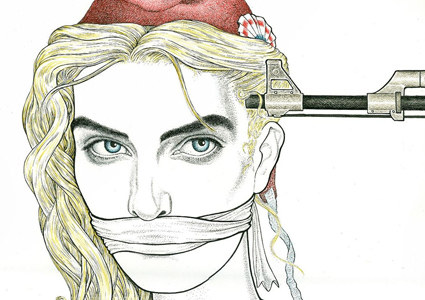
(Illustration by Michael Daley)
Early in January a major news story was whether the Sun columnist Katie Hopkins would be arrested for tweeting about "sweaty jocks". Hundreds of complaints were made to the police and "Police Scotland" announced that it would "thoroughly investigate any reports of offensive or criminal behaviour online and anyone found to be responsible will be robustly dealt with". Hopkins had been reported for "hate crimes" before, including once live on television after criticising a fat woman's size. Such recourse to the law is now the norm in Britain.
Recent freedom of information requests revealed that in the UK in the past three years nearly 20,000 adults and 2,000 children (the youngest aged nine) have been investigated by the police for comments made online. Like everything else, there usually needs to be a "celebrity" link to make these stories public knowledge. But Twitter is now full of people and groups who not only report anything that offends them as a crime but encourage others to do the same. Some are recipients of public funds from a system which encourages reporting of what it terms "hate crime".
The truth is that Britain's free speech sinews were flabby long before their most serious challenge came along. Few people wanted to defend the right to be rude on Twitter. Nobody wanted to defend a Sun columnist who makes a career out of meanness. It is hardly surprising that there is barely anyone left to defend people who might have offended, as we are always threateningly reminded, around one and a half billion Muslims. The idea that we might need to retain the right to offend the religious must have got lost around the time we were wondering what to do with people who tell fat people they are fat.
Britain's free-speech problems have been mounting for years. The first mistakes were the legal ones over what does and does not constitute free speech. Even free-speech absolutists support incitement laws. But the bar of what constitutes incitement has been greatly lowered in recent years. You used to need a mob with pitchforks in front of you; now the perception has arisen that the public are perpetually in pitchfork mode, so that almost anything addressed to them could be incitement. The last Labour government consistently worked to lower this bar, even criminalising speech simply deemed "offensive". It is also worth recalling that in 2006 that same government came within one vote of passing a Racial and Religious Hatred Act which would have criminalised all criticism or ridiculing of religion. The government's defeat did not close the debate. When the current government overturned the worst portion of the Public Order Act (relating to "insulting words") the Labour opposition expressed deep concern over how this might negatively affect minority groups. This was a great theme of the Blair years and it has remained with us-the idea that minority groups are especially beleaguered and must therefore have special protections from offensive words.
The other legal problem has been the right to determine crime slipping from the hands of the law into the eyes of the beholder. Ever since the Macpherson Report on the Metropolitan Police investgigation into the death of Stephen Lawrence, a hate crime can be deemed to have been a hate crime if the victim perceives it to have been so. Well-intentioned though it may have been, this move has further blended speech and action. Hate speech is now so wedded to hate crime that speech itself is tantamount to physical violence. The lady who reported Katie Hopkins to the police for commenting on her weight believed a crime had been committed against her person. Many religious and other minorities cause the police to investigate for precisely the same reason—that they have actually been injured by the remarks. Physical and psychological injury have been elided so that an attack on one's person and an attack on one's self-esteem might be deemed equally deserving of police attention.
Such badly-worded laws hang over us, but the sheer profusion of speech is what is undermining our free-speech traditions from below. Citizens and government are still struggling to work out what our approach to social media—a phenomenon which not only speeds up human interactions but removes what used to be its filters—ought to be. As anybody who has scrolled through an online comments thread will know, people interact on their computers and mobile phones with a bluntness, boldness and rudeness which if used in ordinary life would make any bus stop a warzone.
But the response to social media is indicative of the wider challenge we are going through. We now live in a society where we meet a greater variety of people on any high street than an 18th century anthropologist could have met in a lifetime. Combine that diversity and the resulting range of opinion with a speed and volume of communication unparalleled in human history and the view has emerged that something is going to have to give. There are those who believe—like Flemming Rose, the Danish editor who commissioned the 2005 Muhammad cartoons—that the more diverse your society becomes the more diversity of opinion you are going to have to cope with. But that does not appear to be the settling British consensus.
In Britain it seems to have been decided that the potential range of expression in a diverse society is unworkable and that as a result everyone must be encouraged to tone it down a bit. No less a figure than Lord Woolf, the former Lord Chief Justice, used a speech in Oxford in February to argue for precisely this. Reflecting on events in Paris, Lord Woolf argued that freedom of thought, conscience and religion must be exercised "in a way which respects the sensitivities and needs of other individuals, groups or society as a whole. In other words, they should be exercised reasonably and in a manner that does not impinge disproportionately on the rights of others." Do not, in other words, draw a cartoon of Muhammad.
If free speech, and the arguments for it are muscles which must be exercised regularly, these are some of the reasons why Britain's response to its challengers have become so flabby of late. It is no surprise that we have failed the great test of free speech which started a decade ago with the Danish cartoons. It has been fought in Copenhagen and Paris but almost wholly avoided in London. Even Private Eye—the nearest approximation we have to a satirical magazine in Britain—has repeatedly sheltered behind "good taste" as its reason for not publishing cartoons of Islam's founder.
Such badly-worded laws hang over us, but the sheer profusion of speech is what is undermining our free-speech traditions from below. Citizens and government are still struggling to work out what our approach to social media—a phenomenon which not only speeds up human interactions but removes what used to be its filters—ought to be. As anybody who has scrolled through an online comments thread will know, people interact on their computers and mobile phones with a bluntness, boldness and rudeness which if used in ordinary life would make any bus stop a warzone.
But the response to social media is indicative of the wider challenge we are going through. We now live in a society where we meet a greater variety of people on any high street than an 18th century anthropologist could have met in a lifetime. Combine that diversity and the resulting range of opinion with a speed and volume of communication unparalleled in human history and the view has emerged that something is going to have to give. There are those who believe—like Flemming Rose, the Danish editor who commissioned the 2005 Muhammad cartoons—that the more diverse your society becomes the more diversity of opinion you are going to have to cope with. But that does not appear to be the settling British consensus.
In Britain it seems to have been decided that the potential range of expression in a diverse society is unworkable and that as a result everyone must be encouraged to tone it down a bit. No less a figure than Lord Woolf, the former Lord Chief Justice, used a speech in Oxford in February to argue for precisely this. Reflecting on events in Paris, Lord Woolf argued that freedom of thought, conscience and religion must be exercised "in a way which respects the sensitivities and needs of other individuals, groups or society as a whole. In other words, they should be exercised reasonably and in a manner that does not impinge disproportionately on the rights of others." Do not, in other words, draw a cartoon of Muhammad.
If free speech, and the arguments for it are muscles which must be exercised regularly, these are some of the reasons why Britain's response to its challengers have become so flabby of late. It is no surprise that we have failed the great test of free speech which started a decade ago with the Danish cartoons. It has been fought in Copenhagen and Paris but almost wholly avoided in London. Even Private Eye—the nearest approximation we have to a satirical magazine in Britain—has repeatedly sheltered behind "good taste" as its reason for not publishing cartoons of Islam's founder.
It is so very British—that "good taste" argument. But it brings at least two colossal problems along with it, once it is either effectively or informally enshrined in law. First, it fails to identify those moments when free speech must supersede good manners (as, for instance, when cartoonists get murdered for drawing cartoons). Second, it ducks the crucial question of truth. In an amazingly diverse society the remit of good manners has the potential to be so wide that the issue of what is true and what is not, let alone the ability to stand up for what is true against what is not, risks getting lost completely. It may simply become a numbers game. Or a decibel one.
And this is the part of Britain's free-speech problem that is most worrying. Because the idea of free speech which was nurtured in these islands by Milton and Mill, exported across the Anglosphere and perhaps best reinforced in recent years in America by Jonathan Rauch, was founded on the principle that free speech was needed not just in and of itself, but in order that good ideas should chase out bad ones. For centuries proponents of free speech centred their arguments not just on the validity of good speech but the necessity of true ideas.
In the days after Charlie Hebdo it struck me repeatedly that this notion was nowhere to be found in the British discussion. Television presenters and newspapers asked, "What are the limits of free speech?" and "Do we have the right to offend?" as though this was some national stab at a GCSE question. The point that was lost was precisely the one that the staff of Charlie Hebdo and Jyllands Posten knew. If you cannot lampoon bad ideas it means you can only lampoon good ideas. If you must refrain from insulting targets which might harm you then you will be limited to only insulting targets which are harmless. The problem then is not simply that you let bad ideas get a free pass; it means bad ideas have the opportunity to win.
That is why the Islamists have chosen their targets so wisely and so well. In a free exchange and free debate they will always lose. That is why they try to stop the debate. It is the purest fluke of Danish history that cartoons have become the battleground. It could just as well have been a novel, a film or a work of scholarship. What they are trying to stop—and are partly succeeding in stopping—is all of this and more.
Some of us have great confidence of victory in the realm of unfettered ideas. But it is striking how little confidence exists, and how much confusion there is, among those in power. Whether they are fearful of allowing the free debate to occur, dread its short-term rumbustiousness or genuinely fail to understand the nature of the challenges our society faces, this misunderstanding or loss of confidence is disturbing. When the Home Secretary Theresa May addressed the Conservative party's annual conference last autumn she proposed (having failed to prosecute various extremists under existing laws) the possibility of putting "banning orders" on extremist preachers. These would prevent them from speaking in public places. The tangle that a country's counter-terror laws must be in for such a thing to even be suggested is a subject on its own. Having failed to deport or prosecute notorious terrorists the one thing the government knows it can do is crack down on their right to speak.
And this is the part of Britain's free-speech problem that is most worrying. Because the idea of free speech which was nurtured in these islands by Milton and Mill, exported across the Anglosphere and perhaps best reinforced in recent years in America by Jonathan Rauch, was founded on the principle that free speech was needed not just in and of itself, but in order that good ideas should chase out bad ones. For centuries proponents of free speech centred their arguments not just on the validity of good speech but the necessity of true ideas.
In the days after Charlie Hebdo it struck me repeatedly that this notion was nowhere to be found in the British discussion. Television presenters and newspapers asked, "What are the limits of free speech?" and "Do we have the right to offend?" as though this was some national stab at a GCSE question. The point that was lost was precisely the one that the staff of Charlie Hebdo and Jyllands Posten knew. If you cannot lampoon bad ideas it means you can only lampoon good ideas. If you must refrain from insulting targets which might harm you then you will be limited to only insulting targets which are harmless. The problem then is not simply that you let bad ideas get a free pass; it means bad ideas have the opportunity to win.
That is why the Islamists have chosen their targets so wisely and so well. In a free exchange and free debate they will always lose. That is why they try to stop the debate. It is the purest fluke of Danish history that cartoons have become the battleground. It could just as well have been a novel, a film or a work of scholarship. What they are trying to stop—and are partly succeeding in stopping—is all of this and more.
Some of us have great confidence of victory in the realm of unfettered ideas. But it is striking how little confidence exists, and how much confusion there is, among those in power. Whether they are fearful of allowing the free debate to occur, dread its short-term rumbustiousness or genuinely fail to understand the nature of the challenges our society faces, this misunderstanding or loss of confidence is disturbing. When the Home Secretary Theresa May addressed the Conservative party's annual conference last autumn she proposed (having failed to prosecute various extremists under existing laws) the possibility of putting "banning orders" on extremist preachers. These would prevent them from speaking in public places. The tangle that a country's counter-terror laws must be in for such a thing to even be suggested is a subject on its own. Having failed to deport or prosecute notorious terrorists the one thing the government knows it can do is crack down on their right to speak.
Perhaps we should not be surprised that while this loss of confidence emerges other people should crop up to claim as free speech that which is no such thing. In January there was another eruption of anger from university vice-chancellors complaining about what they claim are government attempts to infringe free speech on campus. What they are resisting are renewed attempts by government to get public bodies to comply with its "Prevent" anti-terrorism programme. It seems a bit rich for university vice-Chancellors who have failed for years to prevent terrorist recruitment and real incitement on campuses to claim these are in fact free-speech issues. Recruitment and incitement on behalf of foreign terrorist groups is already illegal, and likely to remain so. The fact that it happens on a university campus does not make it otherwise. Simultaneously in the media there are supporters of the former NSA contractor Edward Snowden who portray his theft and dissemination of thousands of British and American national security secrets in such a light. At very few times in history would freedom of expression and the "freedom" to steal vast swathes of secret government information and then dump it in such a fashion that only enemies of the state could gain from it have been confused. But they are widely confused here, and it represents only a portion of the mix-up.
When free speech includes the right to betray national security but not the right to call someone a mean name then free speech has become a meaningless term to protect whatever our particular prejudices happen to be and to criminalise everyone else's. Nobody in 21st-century Britain seems to have the guts of the French or the Danes. And if there is a reason why nobody in Britain seems willing to die for freedom of speech it is probably because at some point in the not-too-distant past we lost our passion for living with it.
When free speech includes the right to betray national security but not the right to call someone a mean name then free speech has become a meaningless term to protect whatever our particular prejudices happen to be and to criminalise everyone else's. Nobody in 21st-century Britain seems to have the guts of the French or the Danes. And if there is a reason why nobody in Britain seems willing to die for freedom of speech it is probably because at some point in the not-too-distant past we lost our passion for living with it.